Christianity adds sentences the Bible never wrote
Christianity can solve almost any Bible contradiction by adding a sentence that is not in the Bible.
Let me show you what I mean with one story. The Bible tells it twice.
Samuel says Yhwh incited David, and Chronicles says the adversary did
The first telling is in 2 Samuel 24. King David is ruling Israel, and Yhwh is angry with the people. Yhwh is a personal name. Most English Bibles hide it and print "the LORD" in its place.
"Yhwh's anger again raged against Israel, and he incited David against them, saying, 'Go count Israel and Judah.'" (2 Samuel 24:1, NET Bible)
So David counts his fighting men. Afterward he feels guilty. He tells Yhwh, "I have sinned greatly by doing this!" (2 Samuel 24:10). Then Yhwh sends a plague, and 70,000 people die (2 Samuel 24:15).
Read that again slowly. Yhwh incites David to take the count. Then Yhwh punishes Israel for the count he incited.
The second telling is in 1 Chronicles 21. It's the same king, the same count, the same plague, and the same 70,000 dead (1 Chronicles 21:14). But the first verse names someone else:
"An adversary opposed Israel, inciting David to count how many warriors Israel had." (1 Chronicles 21:1, NET Bible)
The Hebrew word there is satan. It means "adversary." The NET Bible prints "an adversary." Many other Bibles print "Satan." Both books even use the same Hebrew verb for "incite."
So who incited David? Samuel says Yhwh. Chronicles says the adversary.
Christianity's answer is a sentence that isn't in either book
The most common Christian answer is that Yhwh allowed Satan to do it.
Go and look for that sentence. It isn't in 2 Samuel 24. It isn't in 1 Chronicles 21. Samuel doesn't say Yhwh allowed anyone. It says Yhwh incited David. Chronicles doesn't say anyone gave the adversary permission. It says the adversary incited David. To make the two books agree, Christians have to add a sentence that neither book wrote.
Now try it without adding anything. What if Yhwh is the adversary? Then Samuel tells the truth, and Chronicles tells the truth. They name the same being in two different ways. Nothing has to be added, and nothing has to be explained away.
The census is one example of many
This happens again and again. Each time, Christianity needs a different sentence that isn't in the Bible.
In Exodus 24:9-11, Moses, his brother Aaron, Aaron's two sons, and seventy leaders of Israel go up Mount Sinai. The text says they saw the Elohim of Israel and ate and drank in front of him. Elohim is the Hebrew word English Bibles print as "God." But John 1:18 says no one has ever seen theos, the Greek word English Bibles print as "God." And John 6:46 says who John means: no one has seen the Father except Jesus. The Christian answer is that the men on the mountain saw the Son, not the Father. Exodus never says that.
In 2 Chronicles 7:13-14, Yhwh says, "When I close up the sky so that it doesn't rain… or send a plague among my people," and he promises to heal the land only if his people humble themselves and turn from their sins. Deuteronomy 11:13-17 makes the same deal: obey and get rain, serve other gods and "he will close up the sky." In Matthew 5:44-45, Jesus says to love your enemies, so that you'll be like your Father in Heaven, who "sends rain on the righteous and the unrighteous." The Christian answer is that Yhwh's dry skies were discipline for his own people, while the Father's rain on everyone is a general kindness to the whole world. Neither passage says that.
In 2 Cor 4:4, Paul says "the god of this age" blinds people's minds so they can't see the light of the good news about Christ. The Christian answer is that Paul meant Satan. Paul doesn't say Satan in that verse. In the chapter before it, he has been talking about Moses, the Law carved on stone, and a veil that covers people's minds when Moses is read.
Every added sentence protects one belief
So why do Christians need all these extra sentences? Because each one protects the same belief: that Yhwh is the Father Jesus came from.
Most Christians are taught that Yhwh is the name of the one God, who is the Father, the Son, and the Holy Spirit. I believed that too. Once you believe it, you bring it to every passage before you read a word. When Samuel says Yhwh incited David, and Chronicles says the adversary did, you need an extra sentence, because in your mind Yhwh can't be the adversary.
Maybe you've asked a pastor about one of these passages. You got an answer and you were told to trust it. Maybe it never quite fit, and you wondered if the problem was you.
The problem may be that one belief.
Christians have argued over these passages since the second century, more than 1,800 years ago. If you have a quick answer for one of them, ask yourself whether your answer is in the passage, or whether it's a sentence somebody added.
Here's how to decide between two explanations. One explanation adds a new sentence for every passage. The other changes one thing and adds nothing: Yhwh is not the Father. If that one change lets passage after passage say exactly what it says, it can't be waved away. Christianity is the one that has to explain why it needs all the extra sentences.
Christians often say you can't understand the New Testament without the Old Testament. That's true here. What Jesus said about His Father only makes sense next to what the Old Testament says about Yhwh: Deuteronomy 32:7-9, Exodus 24, Deuteronomy 4, Deuteronomy 7, Deuteronomy 13, and 2 Samuel 24.
Keep these questions with you as you read:
- How many sentences does Christianity have to add to make these passages agree?
- How many passages make sense with nothing added, once Yhwh is not the Father?
- When Jesus talked about His Father, did He ever say His Father is Yhwh?
- If Yhwh is the adversary, what was Jesus doing here?
The case starts with John 8, where Jesus tells the people who worship Yhwh that they don't know His Father.
The case, in plain terms
Jesus tells Yhwh's worshipers they do not know His Father
Start with Jesus, because He's the one who raised this first.
John 8 records a long argument between Jesus and a group of Judeans in the temple. These are people who keep Yhwh's Law, his festivals, and his sacrifices. Jesus tells them, "You people are doing the deeds of your father" (John 8:41). They answer, "We have only one Father, theos himself."
Theos is the Greek word English Bibles print as "God." It doesn't name one person. It can mean the Father, Jesus, or another divine being. So when they say "one Father, theos himself," the word itself doesn't tell you who they mean. They tell you by where they're standing. They're in Yhwh's temple, defending Yhwh's Law. They mean Yhwh.
Three verses later, Jesus names the father whose deeds they're doing:
"You people are from your father the devil, and you want to do what your father desires. He was a murderer from the beginning, and does not uphold the truth because there is no truth in him." (John 8:44, NET)
And at the end of the argument, He picks up their claim one more time:
"The one who glorifies me is my Father, about whom you people say, 'He is our theos.' Yet you do not know him, but I know him." (John 8:54-55, NET)
Read that slowly. They say Jesus' Father is their god. Jesus says, "you do not know him." These men know Yhwh better than anyone alive. They know his Law, his temple, his priests, and his feasts. If Yhwh were Jesus' Father, how could Jesus say they don't know Him?
Christians answer by adding a sentence: they worship the right god, they just don't know him well. And the devil in John 8:44 is somebody else, a second father behind the scenes. John 8 doesn't say either of those things. Jesus says they don't know His Father. And the father whose deeds they're doing is a murderer. Right then, they're trying to kill Jesus (John 8:40), and at the end they pick up stones to do it (John 8:59).
So what's the simplest way to read it? They serve Yhwh. Jesus says they don't know His Father. Then Yhwh isn't His Father.
If you want the whole conversation, Your Father Is Not My Father walks through John 8:12-59 verse by verse. The Lying Murderer from the Genesis follows John 8:44 back to the garden in Genesis 3.
Israel heard Yhwh's voice, and Jesus says His Father's voice was never heard
At Mount Sinai, Israel heard Yhwh speak. Deuteronomy 4:12 says, "Yhwh spoke to you from the middle of the fire; you heard speech but you could not see anything – only a voice was heard." Deuteronomy 4:33 asks whether any other people had ever heard Elohim's voice speaking from fire and lived.
Now listen to what Jesus says about His Father:
"You people have never heard his voice nor seen his form at any time." (John 5:37, NET)
Jesus is talking to the leaders of Israel, the people who read Deuteronomy 4 out loud and are proud of it. Israel's whole story is that they heard their god's voice. Jesus says they've never heard His Father's.
The added sentence here is the word "truly." They never truly heard Him. John 5:37 doesn't say "truly." It says never.
The men on the mountain saw Yhwh, and no one has seen the Father
You already met Exodus 24:9-11 in the intro. Seventy-four men went up Mount Sinai, saw the Elohim of Israel, and ate and drank in front of him.
John 6:46 says, "Not that anyone has seen the Father except the one who is from theos. He has seen the Father."
The added sentence is "they saw the Son, not the Father." Exodus 24 never says that. It says Yhwh called Moses up the mountain (Exodus 24:1), and the men saw the Elohim of Israel. If Yhwh isn't the Father, you don't need to add anything. They saw Yhwh. Nobody has seen the Father. Both passages are true as written.
Two fathers produce two kinds of children
Jesus says children act like their father. You can tell where people come from by what they do. So what does each father do?
Start with the rain. In a dry land, rain decides whether a family eats. Yhwh uses it as a reward and a punishment. After Solomon builds the temple, Yhwh tells him:
"When I close up the sky so that it doesn't rain, or command locusts to devour the land's vegetation, or send a plague among my people, if my people, who belong to me, humble themselves, pray, seek to please me, and repudiate their sinful practices, then I will respond from Heaven, forgive their sin, and heal their land." (2 Chronicles 7:13-14, NET Bible)
Deuteronomy 11:13-17 sets the same rule. If Israel obeys, Yhwh says, "I will send rain for your land in its season." If they serve other gods, "he will close up the sky so that it does not rain." That passage later became the second part of the Shema, the prayer Judeans say every day. Copies of it were already in the small leather prayer boxes found with the Dead Sea Scrolls. The people listening to Jesus knew Yhwh's rain rule by heart.
Then Jesus says this about His Father:
"Love your enemy and pray for those who persecute you, so that you may be like your Father in Heaven, since he causes the sun to rise on the evil and the good, and sends rain on the righteous and the unrighteous." (Matthew 5:44-45, NET)
Yhwh holds back rain until his people obey. Jesus' Father sends rain on people who don't obey Him at all. And Jesus gives that as the reason to love your enemies.
Yhwh's rule for enemies is just as different. Deuteronomy 7:2 says, "You must utterly annihilate them. Make no treaty with them and show them no mercy!" Deuteronomy 20:16-18 says not to leave alive anything that breathes in the cities Yhwh gives Israel. 1 Samuel 15:3 orders Saul to kill men, women, children, infants, and animals.
To keep one being, Christians add two sentences. Yhwh's dry skies were discipline for his own people, while the Father's rain on everyone is a general kindness to the world. And Yhwh's wars were public justice against nations, while Jesus was only teaching people not to take personal revenge. Some Christians add a third: Israel's wars were pictures of a spiritual war. None of those sentences is in the passages.
Without them, each father has one rule. Yhwh rewards obedience with rain and commands his people to destroy their enemies. Jesus' Father gives rain to the righteous and the unrighteous, and His children love their enemies. You can see whose children are whose.
Jesus vs. Yhwh puts what each one did side by side, one comparison at a time.
Yhwh tests people by tempting them, and the Father tempts no one
English Bibles use "test" when the action sounds good and "tempt" when it sounds evil. But in Greek, it's one word family, peirazo. The Greek translation of the Old Testament uses it, and so does the New Testament.
Genesis 22:1 says Elohim tested Abraham by telling him to offer his son Isaac. Deuteronomy 8:2 says Yhwh led Israel through the wilderness for forty years to test what was in their hearts. The Greek translation uses ekpeirazo there, a longer form of peirazo.
Now look at Matthew 4. The devil tests Jesus in the wilderness, and Matthew uses that same word (Matthew 4:1). Jesus fasts in the wilderness for forty days (Matthew 4:2). When He answers the first test, He quotes Deuteronomy 8:3 (Matthew 4:4), the very next verse after Yhwh's forty-year test. The Two Tests, One Tester study follows that match through all three tests.
Then read Deuteronomy 13:1-5. A prophet gives a sign, and the sign comes true. Then the prophet tells Israel to follow other gods. Who's behind it? The passage says Yhwh is testing Israel through that prophet.
Now read James:
"Let no one say when he is tempted, 'I am tempted by theos,' for theos cannot be tempted by evil, and he himself tempts no one." (James 1:13, NET)
Four verses later, James says every good and perfect gift comes down from "the Father of lights" (James 1:17).
Yhwh sends a prophet to lure his people toward other gods, and calls it a test. The Father tempts no one. The added sentence is "the purpose makes the difference": Yhwh tests to prove people, and the devil tempts to make them fall. Deuteronomy 13 doesn't say that. It says the lure to other gods is Yhwh's test.
Yhwh deceives and incites, and the adversary does the same work
In 1 Kings 22:19-23, King Ahab wants to know whether to go to war. Yhwh sits on his throne with the heavenly assembly around him and asks who will deceive Ahab, so Ahab will go into battle and die there. A spirit volunteers to be a lying spirit in the mouths of Ahab's prophets. Yhwh tells it, "Deceive and overpower him."
Ezekiel 14:9 is even more direct. The NET Bible says a prophet is "made a fool by being deceived," and Yhwh says, "I, Yhwh, have made a fool of that prophet." Then Yhwh says he will destroy him.
Hebrews 6:18 says it is impossible for theos to lie. To fit both together, Christians add "deceiving guilty people as punishment isn't lying." Neither passage says that. One reads Yhwh sending a lying spirit. The other says theos doesn't lie.
You saw the census at the start. 2 Samuel 24:1 says Yhwh incited David to count Israel. 1 Chronicles 21:1 says satan, the adversary, incited him. It's the same event, the same plague, and the same Hebrew verb for "incite." The added sentence is "Yhwh allowed Satan to do it." Take that sentence away and both books still tell the truth: Yhwh is the adversary.
Paul's god of this age blinds people the same way the old covenant does
Paul writes about the blinding in 2 Corinthians 3:6-4:6. It's one argument. The chapter break was added much later.
Paul starts with the covenant Moses brought down from Sinai, written on stone. He calls it "a ministry that produced death" (2 Corinthians 3:7). He says that when Moses is read, a veil still lies over people's minds (2 Corinthians 3:14-15). He says their minds were hardened. Then, a few sentences later:
"Among whom the god of this age has blinded the minds of those who do not believe so they would not see the light of the glorious gospel of Christ, who is the image of theos." (2 Corinthians 4:4, NET)
Who blinds them? Most Christians today add one word: Satan. Paul doesn't say Satan here. In the second century, Marcion said the blinder was the god of the Old Testament, a lesser god than the Father. Irenaeus, the bishop who wrote against him, also put the blinding on the god of the Old Testament, and said that god was the one true God. Christians have been arguing about this verse for 1,800 years.
Look at what's on each side. Paul has just spent a chapter on Yhwh's covenant, its veil, and hardened minds. That points to Yhwh. The blinder keeps people from seeing Christ, who is the image of theos, and 1 Corinthians 8:6 says the one theos is the Father. That points to an enemy of the Father. Christians have had to pick one side and drop the other. If Yhwh is the adversary, you don't have to drop either one.
Who is Paul's "god of this age"? walks through the whole passage, from Moses' veil to the light in Jesus' face.
Yhwh and the Father act differently with bread, snakes, and glory
In Exodus 16:4, Yhwh promises to rain bread from the sky so that he can test Israel. In John 6:32-49, Jesus says His Father gives the true bread from Heaven, and that the people who ate the manna died.
In Numbers 21:5-6, Israel complains about the food, and Yhwh sends poisonous snakes among them. In Luke 11:11-13, Jesus asks what father would give his son a snake when the son asks for a fish. Then He points to the Father in Heaven.
In Isaiah 42:8 and 48:11, Yhwh says he won't give his glory to another. In John 17:22-24, the Father gives glory to Jesus, and Jesus gives it to His followers.
Each of these gets its own added sentence. The manna was only pointing forward to Jesus. Luke 11 has nothing to do with Numbers 21. Jesus isn't "another," because He shares Yhwh's divine identity. If Yhwh isn't the Father, you don't need any of them. The two act differently because they're different people.
Surviving the Exodus shows what Yhwh's wilderness years, manna and snakes included, cost the people who lived through them. The Good Father Discourse works through Luke 11:1-13, where Jesus asks about the snake and the fish.
Deuteronomy 32 puts Yhwh under the Most High
So if Yhwh isn't the Father, who is he? Moses answers that in Deuteronomy 32.
Near the end of his life, Moses speaks these words to the whole assembly of Israel (Deuteronomy 31:30). He opens by telling Israel this is old knowledge, passed down by parents and elders. Verse 8 below uses the wording found in a Dead Sea Scroll copy of Deuteronomy: "sons of Elohim." The NET Bible's own note says that wording is the original.
"Remember the ancient days; bear in mind the years of past generations. Ask your father and he will inform you, your elders, and they will tell you.
"When the Most High gave the nations their inheritance, when he divided up humankind, he set the boundaries of the peoples, according to the number of the sons of Elohim.
"For Yhwh's allotment is his people, Jacob is his special possession." (Deuteronomy 32:7-9, NET Bible, with the Dead Sea Scroll wording in verse 8)
The Most High divides the nations among the sons of Elohim. Yhwh receives Jacob, which is Israel, as his share.
The added sentence here is "Yhwh and the Most High are the same person." Deuteronomy 32 doesn't say that. It has one who divides and gives, and one who receives a share. The Most High is the Father Jesus calls the only true theos (John 17:3). Yhwh is one of the sons who received a nation.
Elyon Gave Jacob to Yhwh goes through all of Deuteronomy 32 and the ancient copies behind verse 8.
Count the sentences Christianity has to add
Now put them side by side. To keep Yhwh as the Father, Christianity has to add all of these:
- They worship the right god, they just don't know him well.
- The devil in John 8:44 is a different father from the one they serve.
- They never truly heard the Father's voice.
- The men on the mountain saw the Son, not the Father.
- Yhwh's droughts were discipline, while the Father's rain is general kindness.
- Yhwh's wars were public justice, while Jesus was teaching personal conduct.
- Testing and tempting are different because the purpose is different.
- Deceiving guilty people as punishment isn't lying.
- Yhwh allowed Satan to incite David.
- The god of this age is Satan.
- The manna, the snakes, and the glory each need their own explanation.
- Yhwh and the Most High are the same person.
None of those sentences is in the Bible. Each one fixes one passage and does nothing for the next.
The other explanation adds one thing: Yhwh is not the Father. He is the adversary. With that one change, every passage above says exactly what it says.
How likely is that? These passages come from the Law, the history books, the Prophets, the Gospels, and Paul. Different writers, different centuries, different subjects. If the problems were random, one change shouldn't fix them all. It does. When one explanation covers what a dozen separate explanations are needed for, the one explanation wins. That's Occam's razor. Christianity is the one that now has to explain itself.
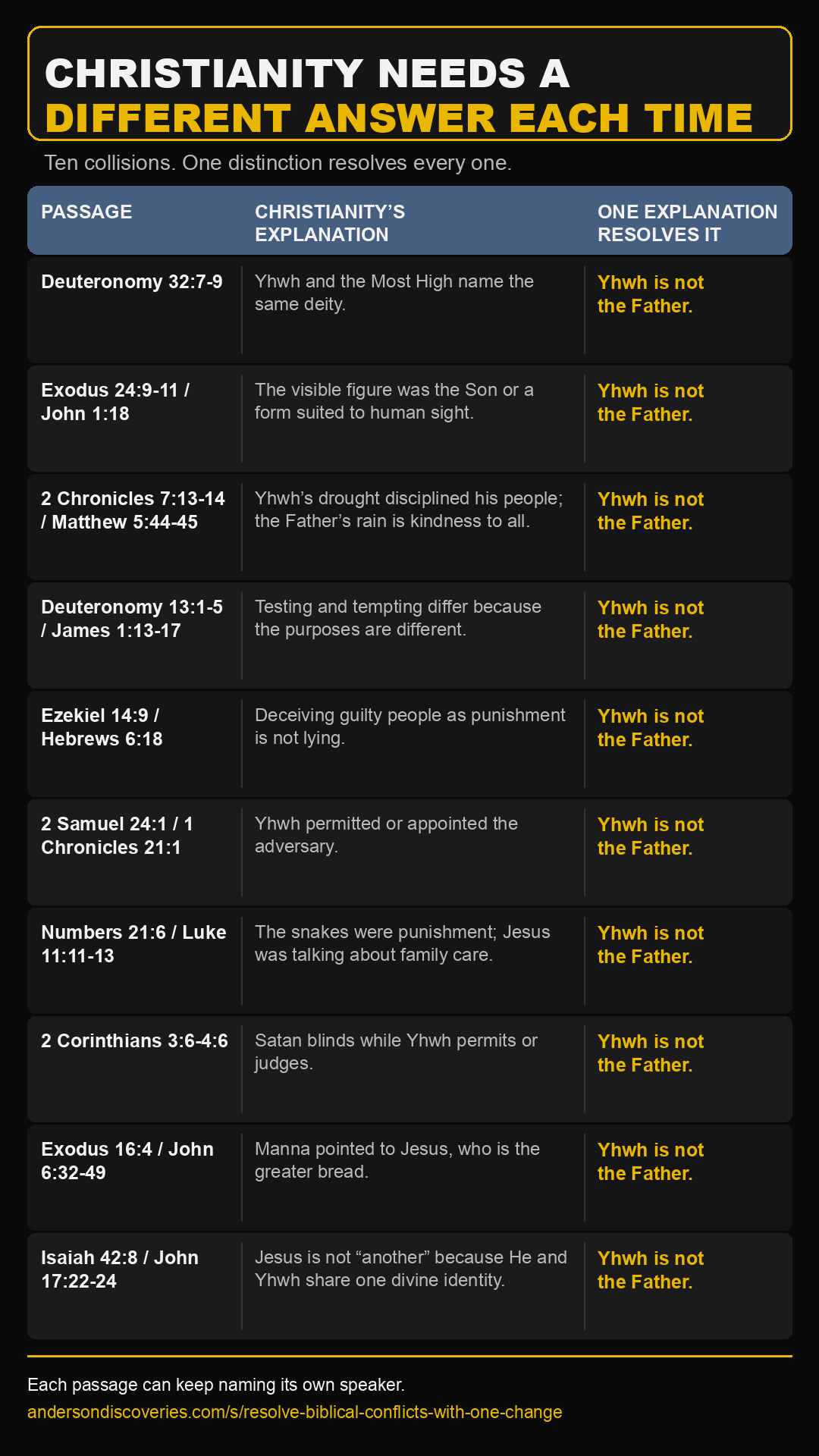
Christianity needs a different answer each time
The third column does not change, because one answer covers every row: Yhwh is not the Father.
The chart as text Read every row
| Passage | Christianity's explanation | One explanation resolves it |
|---|---|---|
| Deuteronomy 32:7-9 | Yhwh and the Most High name the same deity. | Yhwh is not the Father. |
| Exodus 24:9-11 / John 1:18 | The visible figure was the Son or a form suited to human sight. | Yhwh is not the Father. |
| 2 Chronicles 7:13-14 / Matthew 5:44-45 | Yhwh's drought disciplined his people; the Father's rain is kindness to all. | Yhwh is not the Father. |
| Deuteronomy 13:1-5 / James 1:13-17 | Testing and tempting differ because the purposes are different. | Yhwh is not the Father. |
| Ezekiel 14:9 / Hebrews 6:18 | Deceiving guilty people as punishment is not lying. | Yhwh is not the Father. |
| 2 Samuel 24:1 / 1 Chronicles 21:1 | Yhwh permitted or appointed the adversary. | Yhwh is not the Father. |
| Numbers 21:6 / Luke 11:11-13 | The snakes were punishment; Jesus was talking about family care. | Yhwh is not the Father. |
| 2 Corinthians 3:6-4:6 | Satan blinds while Yhwh permits or judges. | Yhwh is not the Father. |
| Exodus 16:4 / John 6:32-49 | Manna pointed to Jesus, who is the greater bread. | Yhwh is not the Father. |
| Isaiah 42:8 / John 17:22-24 | Jesus is not "another" because He and Yhwh share one divine identity. | Yhwh is not the Father. |
That's the case. What follows checks the ancient copies, the words behind the English translations, early Christian answers, and the passages that seem to say Yhwh is the Father.
The full evidence
A note on the Bible quotations The names underneath the English
The quotations use the NET Bible. Where it prints "the LORD," this page restores Yhwh. Where the Old Testament prints "God," it restores Elohim. Where the New Testament prints "God," it uses the Greek word theos. The rest of each quotation stays in the NET Bible's wording.
This part is for you if you want to check the work. Here are the ancient copies, the original words, the Christian history, and the passages Christians use to show that Yhwh is the Father.
Ancient copies preserve two readings of Deuteronomy 32
You read Deuteronomy 32:7-9 in the case. Here's why verse 8 says "sons of Elohim."
One copy of Deuteronomy found among the Dead Sea Scrolls, in Cave 4 at Qumran, reads "sons of Elohim." Scholars label that copy 4QDeut-j: "4Q" for Qumran Cave 4, "Deut" for Deuteronomy, and "j" because it's one of many copies of Deuteronomy found in that cave. The Septuagint, the ancient Greek translation of the Hebrew Bible, reads "angels of God." The Hebrew text used for most later Bibles reads "sons of Israel."
The Dead Sea Scroll and the Septuagint both put divine beings under the Most High. "Sons of Israel" takes them out. The NET Bible prints "heavenly assembly" and says the divine reading is original. The NRSVue prints "gods." The King James Version prints "children of Israel," and the NIV prints "sons of Israel."
So which Bible do you have? If it says "sons of Israel," the divine sons were removed before your translation was made.
Now look at verse 9 again:
"For Yhwh's allotment is his people, Jacob is his special possession." (Deuteronomy 32:9, NET)
Even with the divine sons removed, verse 9 still calls Jacob Yhwh's allotment. An allotment is a share handed out to someone.
Christians read verse 9 as the Most High keeping Jacob for himself. To do that, you have to add a sentence: the Most High and Yhwh are the same person. Verse 9 doesn't say the Most High kept anything. It says Jacob is Yhwh's share.
Elohim and theos are not personal names
The capital letter in "God" makes the word look like one person's name. The original words don't work that way.
Elohim is the Hebrew word English Bibles print as "God," "god," "gods," or "divine beings." The same word can describe Yhwh, gods worshiped by other nations, and members of the heavenly assembly. In 1 Samuel 28:13, a woman calls up the dead prophet Samuel. She says she sees elohim coming up from the ground, and the NET Bible prints "a divine being." In the next verse, Saul learns it's Samuel.
Theos does the same work in Greek. It can refer to the Father, Jesus, Yhwh, Satan in the standard reading of 2 Corinthians 4:4, Herod in Acts 12:22, or several gods in Acts 19:26.
That doesn't make every divine being equal. Think of the word "king." It describes many people, and they're not all the same person. The sentence tells you which king is meant. Elohim and theos work the same way. Elohim Is Not a Name shows how the word works across the whole Hebrew Bible.
So when someone reads "theos" in James 1:13 ("theos tempts no one"), ask which theos James means. Four verses later he tells you: "the Father of lights" (James 1:17). He doesn't say Yhwh.
The Most High presides over a divine family
The Hebrew word elohim can describe the Most High or another divine person. It does not name one person. Genesis 1:26-27 says humans were made in the image and likeness of divine beings.
Psalm 82:1 describes a heavenly assembly. It places elohim in the assembly and says he judges among other elohim. Other passages call these divine beings the "sons of Elohim." The Bible presents a divine family under the Most High.
Deuteronomy 32:7-9 says the Most High divided the nations according to the number of the sons of Elohim. The next line says Yhwh received Jacob as his share. Yhwh is one of the sons of the Most High, not the head of the family. This order disappears when readers make the Most High and Yhwh one being.
The strongest Christian reading of John 8
Here's the best answer Christians give to John 8.
Jesus is saying His Father really is the god they worship, but they don't truly know Him. They have the right god and the wrong behavior. And the devil in John 8:44 is a second being, behind them, separate from the god they worship.
That reading leans on John 5:38, where Jesus tells His opponents that the Father's word isn't living in them. But does John 8 sound like a talk about bad behavior inside one family? Jesus keeps comparing two fathers, two kinds of deeds, and two sources of truth. He says what He's seen with His Father (John 8:38), and then tells them, "You people are doing the deeds of your father" (John 8:41). He doesn't say they're doing His Father's deeds badly. He says they're doing another father's deeds.
Christians also point to the grammar of John 8:44. Its first line can be read in more than one way, so the verse alone doesn't decide it. That's true. So let the whole conversation decide it. "Your father" in John 8:38 and 8:41, the devil in John 8:44, and the one they call "our theos" in John 8:54 all fill the same place in the argument: the father whose deeds they do. They try to stone Jesus in John 8:59, and stoning is the Law's punishment for blasphemy in Leviticus 24:16. They're carrying out Yhwh's Law against the man Jesus says came from His Father.
The Trinity removes the hierarchy before you read it
The Trinity replaces the divine family with "one God in three persons." It makes the Most High, Yhwh, Jesus, and the Holy Spirit one being. The other members of the divine family are then called angels, human judges, or figures of speech. Once a reader begins there, every difference between Jesus' Father and Yhwh has to fit inside one being.
The finished formula does not appear in the Bible. Its development can be dated:
- Around 200 AD – Tertullian, a Christian writer from Carthage, is the first surviving author to use the Latin word trinitas, "Trinity." Every New Testament book had already been written.
- 325 AD – the Council of Nicaea, called by the Roman emperor Constantine. Arius, a priest in Alexandria, taught that the Son had a beginning and was under the Father. The bishops condemned him. They declared the Son "of the same essence" as the Father. Constantine sent Arius and bishops who rejected the decision into exile.
- 381 AD – the Council of Constantinople, where the creed called the Holy Spirit "the Lord and giver of life," worshiped and glorified with the Father and the Son. Basil of Caesarea, Gregory of Nazianzus, and Gregory of Nyssa were three fourth-century theologians from Cappadocia. They helped develop the words used in that creed.
The councils used words such as "essence" and "substance" to explain how the Father, Son, and Holy Spirit could be one being. Jesus does not describe His Father that way. Jesus says who sent Him, whose commands He obeys, whose work He completes, and whose character He shows.
The doctrine of three equal persons in one being took roughly 350 years after Jesus to reach its finished form. Every biblical author wrote before that formula existed. Deuteronomy 32:7-9 and John 20:17 should be read before a later creed decides how many beings those passages are allowed to name.
"Test" and "tempt" are one word family
The case showed you that one Greek word family, peirazo, covers both "test" and "tempt." The Septuagint uses peirazo when Elohim tests Abraham in Genesis 22:1, and ekpeirazo, a longer form, when Yhwh tests Israel in Deuteronomy 8:2. Matthew 4:1 uses peirazo for the devil testing Jesus. James 1:13 uses it when he says theos tempts no one.
Christians answer that a test shows what someone will do, while a temptation tries to make them fail. The difference is the purpose. But notice where that difference comes from. It doesn't come from the words. English Bibles pick "test" or "tempt" depending on who they think is doing it.
Deuteronomy 13:3 states Yhwh's purpose. He's testing Israel to see if they love him with all their mind and being. The Christian answer calls that purpose good. But look at what the test is. A prophet gives a sign that comes true and then tells Israel to serve other gods. The same passage says that prophet has tried to entice Israel away and must be killed (Deuteronomy 13:5). Yhwh's test is an enticement to serve other gods.
Yhwh says the enticement is his test. The Father of lights tempts no one. You don't have to add a sentence about purpose to read both.
The census uses the same verb for Yhwh and the adversary
You saw the two census verses at the start. Here's the Hebrew behind them.
Both 2 Samuel 24:1 and 1 Chronicles 21:1 use the verb sut, which means "incite." The word satan means an adversary. Numbers 22:22 uses it when the angel of Yhwh stands as an adversary against Balaam. So even in the Torah, an adversary can be sent by Yhwh. In 1 Chronicles 21:1, HALOT, the standard dictionary of biblical Hebrew, reads the word as a personal name: Satan. The NET Bible prints "an adversary." Either way, Samuel gives the same act to Yhwh by name.
Christians give three main answers. Chronicles corrected Samuel, because its writer didn't want Yhwh to be the direct inciter. Or Yhwh acted through a second person. Or the adversary was an unnamed human enemy.
Each of those adds a sentence the verses don't contain: a correction, a second person, or an unnamed human. Without them, Samuel names the inciter, and Chronicles calls him the adversary.
Most of the passages in this study show that Yhwh is not the Father. Three go further and put Yhwh in the adversary's role: John 8:44, this census, and Paul's blinding passage.
Paul carries the veil into the god-of-this-age passage
The case walked through 2 Corinthians 3:6-4:6. Here are the words that tie it together.
In 2 Corinthians 3:14, the minds of Israel are hardened when the old covenant is read. The Greek word translated "minds" is noema. In 2 Corinthians 4:4, the god of this age blinds the noema of unbelievers. BDAG, the standard dictionary for New Testament Greek, gives "mind" or "understanding" as the meaning in both verses.
The groups aren't identical. Chapter 3 is about Israel, and chapter 4 is about all unbelievers. But Paul carries the same word from the hardening caused by the old covenant into the blinding done by the god of this age.
He carries the veil too. 2 Corinthians 3:14-15 says the veil remains when Moses is read. 2 Corinthians 4:3 says the gospel is veiled among those who are perishing. The god of this age shows up in the very next sentence.
Christians answer that the grammar doesn't force two beings. One god could blind people as punishment, and then show mercy by giving light in 2 Corinthians 4:6. But that answer puts the blinding on the god of the old covenant, and then has that same god hiding Christ, "who is the image of theos." 1 Corinthians 8:6 says the one theos is the Father. So the blinder hides the image of the Father. Is that the Father's work?
The Satan answer explains why the blinder opposes Christ. The Yhwh answer explains why the old covenant leads into the blinding. If Yhwh is the adversary, both answers are right, and they're describing the same being.
Christians have been trying to solve the same problem since the second century
An answer isn't true just because it's old. But you should know that Christians saw these problems almost immediately.
Marcion separated the Creator from Jesus' Father
Marcion taught in Rome in the 140s. He said the lawgiver and Creator was a lower god. He said Jesus came from a good Father who had not been known before. He said the god of this age in 2 Corinthians 4:4 was the Creator.
That's not all of Marcion's system, and you don't have to agree with the rest of it. But his dispute shows Christians were asking whether the Creator was Jesus' Father before the church had even agreed on which books belong in the New Testament.
Justin made the visible deity another divine being
Justin Martyr wrote Dialogue with Trypho around 155-160. In chapter 56, he calls the visible figure in the Old Testament "another God and Lord subject to the Maker of all things." Justin says this figure is also called an angel, and he connects that figure with Christ.
So Justin agreed that the god people saw was a second divine being under the invisible Maker. Where Justin and this study part ways is who that second being was. Justin said Jesus. Jesus said no one has seen His Father, and He never says He was the one on the mountain.
Ptolemy divided the Law
Ptolemy was a follower of Valentinus, a Christian teacher in Rome in the 140s. Valentinus' followers taught that the perfect Father was above a lower god who made the world. He wrote to a woman named Flora before 180. He said the perfect Father didn't give the Law, and the devil didn't either. He traced it to three sources: that lower god, Moses writing from his own thoughts, and the elders of the people. He said even the pure commands were imperfect and needed to be fulfilled. And he said Jesus abolished "an eye for an eye," because it was mixed with injustice.
Irenaeus and Tertullian defended one Creator and Father
Irenaeus wrote Against Heresies around 180. He read 2 Corinthians 4:4 so that the one God blinds the unbelievers of this age. To get that, he moved the pause in the sentence: not "the god of this age has blinded," but "God has blinded the minds of the unbelievers of this world." The English translation of his book says "this world."
Tertullian answered Marcion in Against Marcion 5.11. He reported that Marcion read the god of this age as the Creator. Tertullian preferred Irenaeus' pause, so that God blinds the unbelievers of this world. Then he offered a second answer: the blinder is the devil.
Those are the same three answers you'll hear today. Yhwh blinds. Yhwh lets Satan blind. Or Satan blinds. If Yhwh is the adversary, all three are describing one being.
Origen turned physical war into spiritual war
Origen was a Christian teacher in the third century. Judith Lieu, who wrote a major study of Marcion, explains that Origen turned Joshua's physical wars into pictures of spiritual war. Origen said Christians wouldn't read Joshua in church unless its wars were read that way. He read the killing through Romans 6:19 and Luke 10:19.
Why would a Christian teacher need to turn Joshua's wars into something else? Because he couldn't square them with Jesus.
Passages that support the Christian reading
Some passages call Yhwh the Most High
Psalm 83:18 says Yhwh alone is "the Most High over all the earth." 2 Samuel 22:14 says Yhwh thundered from the sky, and the next line says the Most High shouted. Christians read both lines as one speaker. Deuteronomy 32:12 says Yhwh alone led Jacob, with no foreign god beside him.
This is Christianity's strongest answer from the Old Testament. If "Most High" and "Yhwh" are two titles for one god, then Deuteronomy 32:8-9 just says the same thing twice.
But ask who's speaking in those passages. Psalm 83 and 2 Samuel 22 are Israel's own praise of their god. The people who wrote them already believed Yhwh was the highest. That tells you what Israel believed. It doesn't overturn Deuteronomy 32, where the Most High hands out the nations and Yhwh receives one.
Paul puts Christ in the wilderness
1 Corinthians 10:4 says the rock in the wilderness was Christ. In 1 Corinthians 10:9, the standard printed Greek New Testament that scholars use, the Nestle-Aland 28th edition, says the Israelites tested Christ. Other ancient copies say "the Lord" or "theos."
So Christians were placing Jesus inside Yhwh's story long before the church councils. Paul doesn't always keep them separate.
New Testament writers apply Yhwh passages to Jesus
Hebrews 1:10 applies a creation line from Psalm 102 to the Son. After quoting Isaiah 6, John 12:41 says Isaiah saw "his glory"; the NET Bible identifies that glory as Christ's. Paul applies Yhwh passages to Jesus in several places.
Christians say these writers recognized that Jesus shared Yhwh's divine identity. The other reading says they understood Jesus through what they already believed about Yhwh. A label can't decide which is right.
What Jesus said decides it, and Jesus separates His Father from the god Israel heard and served (John 5:37; John 8:54-55).
Jesus quotes Deuteronomy 6:4-5
In Mark 12:29-30, Jesus is asked which command is most important. He answers by quoting Deuteronomy 6:4-5: "Listen, Israel, the Lord our theos, the Lord is one." In Deuteronomy 6:4, "the Lord" is Yhwh both times, and theos stands where the Hebrew has Elohim.
This is the passage Christians lean on most. Jesus repeats Israel's confession and the command to love Yhwh. So look at the question He's answering. A scribe asks Him to rank the commands inside Yhwh's Law (Mark 12:28). Jesus was born under that Law, and He answers from it. He doesn't say, "Yhwh is my Father." He never does, anywhere.
Jesus says He came to fulfill the Law
In Matthew 5:17-19, Jesus says He didn't come to abolish the Law or the Prophets but to fulfill them. Christians read that as proof Jesus accepted Yhwh's Law and authority.
Read it as a legal statement and it says something else. Galatians 4:4-5 says Jesus was born under the Law to redeem those under it. Jesus had to complete what Yhwh's Law required. You fulfill a contract you're bound by. That doesn't make the lawgiver your father. The Contract for Humanity study explains how Jesus did it.
Yhwh shows mercy
Exodus 34:6 calls Yhwh compassionate, gracious, slow to anger, and rich in loyal love. Jonah 3:10 says Elohim relented and didn't destroy Nineveh. In Jonah 4:2, Jonah prays to Yhwh and uses the words of Exodus 34:6 about him. Judges and Kings tell of rescue after rescue when Israel cries out.
Does Yhwh have to do evil in every story to be the adversary? No. A person can show mercy in one case and still rule through violence, threats, and deception in others. You judge a person by the whole pattern. One merciful act doesn't erase the rest.
The Father appoints a judge
John 5:22 says, "the Father does not judge anyone, but has assigned all judgment to the Son." Acts 10:42 and Acts 17:31 say theos appointed Jesus to judge. So the difference isn't that Yhwh judges and the Father has nothing to do with judgment. The Father assigns judgment. Jesus carries it out.
Evidence that would disprove "Yhwh is the adversary, not the Father"
You should know what would prove this study wrong.
Yhwh would be the Father after all if Jesus identified His Father as the speaker at Mount Sinai, the one seen in Exodus 24:9-11, or the one behind Yhwh's destructive and deceptive acts. He never does.
Yhwh would be the Most High if the oldest reading of Deuteronomy 32:7-9 named Yhwh as the one dividing the nations, not the one receiving a nation. It doesn't.
Christianity would be the simpler reading if one Christian explanation covered the sight, voice, enemy-love, testing, deception, census, and blinding passages without adding a new answer each time. Christians would need one explanation that does all of this at once: Deuteronomy 32 names one god, John 5:37 applies only to Jesus' unbelieving opponents, John 8 describes false children of the right god, and the visible Yhwh was always Jesus before His human birth. That's four answers, not one, and they still leave the rain, the deception, and the census.
And the reply that "a New Testament writer merged Jesus with Yhwh" only works where Jesus Himself keeps them separate. It can't be used to wave away every passage.
Why the simpler explanation matters
How likely is it that one change fixes all of this by accident?
Some of these passages are connected. Several come from John, and the two census verses describe one event. So don't count them as twenty separate proofs. But the pattern still runs through the Law, the history books, the Prophets, the Gospels, and Paul's letters. Different writers, different centuries. The chart above puts ten of them together, and the answer in the last column is the same every time: Yhwh is not the Father.
Yhwh being the adversary makes clear predictions you can check. If Yhwh and the Father are different people, their voices, actions, methods, and results should differ. They do. If Yhwh is the adversary, John 8:44, the census, and Paul's blinding passage should show signs of both Yhwh and an enemy. They do.
Christianity has to add a new explanation every time Yhwh and the Father act differently. So "Yhwh is the God Jesus calls Father" can't stay an unquestioned starting point. It has to explain the whole pattern, and it can't do it with one sentence.
What Jesus came to do
One Christian view of the cross is called penal substitution. It says the Father required Jesus' death to satisfy the Father's own justice. Other Christian views say Jesus paid a ransom or defeated hostile powers. A ransom is a price paid to release someone from custody. Christians don't agree about who held humanity or how Jesus' death set people free.
Galatians 4:4-5 says Jesus was born under the Law to redeem those under it. Colossians 2:14-15 says the certificate of debt against us was destroyed, nailed to the cross, and the rulers were disarmed. Mark 10:45 calls His life a ransom.
So who was holding us? If Yhwh is the adversary and not the Father, those lines join into one legal conflict. Jesus enters the system ruled by His enemy. He submits to Yhwh's Law without becoming like Yhwh. Jesus loves His enemy, completes the work His Father gave Him, and gives Himself to free you from Yhwh's authority.
The full Contract for Humanity has its own study. Yhwh being the adversary, not the Father, explains the difficult passages, why Jesus came, why He submitted, and how His death sets people free.
Then who is God?
In John 17:3, Jesus calls His Father "the only true theos." In John 20:17, He says, "my Father and your Father, my theos and your theos."
His Father is Abba, the Aramaic word for Father. Abba is the Most High, above every other divine being. Yhwh is real, powerful, and divine. The older reading of Deuteronomy 32:7-9 has the Most High dividing the nations and Yhwh receiving Jacob as his share.
The words elohim and theos don't name one person. They describe a divine being. That's why the Bible can use them for more than one person without making them the same being.
Jesus came to make His Father known. John 1:18 says no one has ever seen theos, and John 6:46 names the unseen person as the Father.
So what does that make Jesus? Is Jesus God? answers that from the same words, elohim and theos.
The question Christianity now has to answer
Yhwh is the adversary, not the Father.
That one sentence explains passage after passage where Christianity has to treat two different speakers, with two different ways of acting, as one divine being. It lets Moses, the prophets, the Gospels, and Paul each say what they say.
If someone told you these questions show a lack of faith, remember that Christian writers have been trying to explain the same problems since the second century. You're not rejecting the Bible when you let each passage name its own speaker.
Christian writers have produced separate answers because Christianity starts by ruling out that Yhwh and the Father are two different beings.
So Christianity now has to explain why its more complicated reading should be preferred when one explanation makes sense of so much more.
Sources
- Justin Martyr, Dialogue with Trypho 56, on the visible figure as another divine person under the Maker. Read the dialogue.
- Irenaeus, Against Heresies 3.7.1, on moving "of this age" away from "god" in 2 Corinthians 4:4. Read the chapter.
- Tertullian, Against Marcion 5.11, on the Creator and devil readings of 2 Corinthians 4:4. Read book five.
- Ptolemy, Letter to Flora, in Bentley Layton, The Gnostic Scriptures, pages 340-343, on the sources within the Law and the retaliation command.
- Judith Lieu, Marcion and the Making of a Heretic, pages 158-159, on Origen's spiritual reading of Joshua's wars.
- John Owen, The Works of John Owen, Goold edition, volume 17, page 114, on Genesis 22:1 and James 1:13.
- Novum Testamentum Graece, 28th edition, apparatus to 1 Corinthians 10:9, on the Christ, Lord, and theos readings.
- Donald E. Hartley, "2 Corinthians 4:4: A Case for Yahweh as the 'God of This Age,'" Evangelical Theological Society, 2005. Read the paper.
- Ivor Gerard Poobalan, Who Is the "God of This Age" in 2 Corinthians 4:4?, University of Cape Town dissertation, 2015. Read the dissertation.
- Benjamin D. Sommer, The Bodies of God and the World of Ancient Israel, on divine embodiment and visible appearances.
- Mark S. Smith, God in Translation, and Nathan MacDonald, Deuteronomy and the Meaning of Monotheism, on Israel's divine hierarchy and later monotheistic readings.