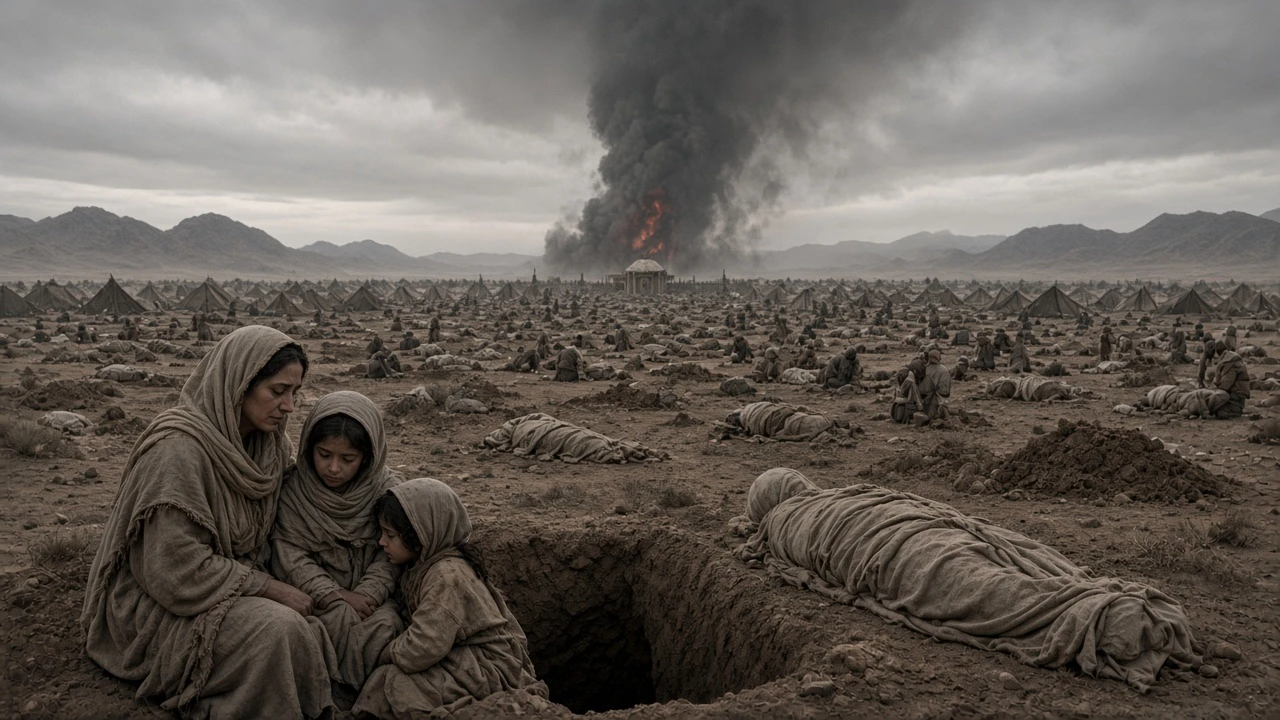
The doorway
It's the middle of the night in Goshen. You are standing just inside your front door with your family behind you. Your oldest son is next to you. Earlier today you killed a lamb, dipped a bunch of hyssop in the blood, and smeared it across the top of the doorframe and down both sides. Your neighbors did the same. You were told not to go outside until morning.
So who is the blood keeping out?
Not Pharaoh or the Egyptian army. Exodus 12:23 names Yhwh and "the destroyer."
"For Yhwh will pass through to strike Egypt, and when he sees the blood on the top of the doorframe and the two side posts, then Yhwh will pass over the door, and he will not permit the destroyer to enter your houses to strike you." (Exodus 12:23, NET)
The one coming down your street tonight is Yhwh, along with what the text calls "the destroyer." The blood tells him to pass over your house. The people being rescued are hiding from the rescuer.
You've heard the Exodus your whole life as the great rescue story. "The slaves cried out, and God heard, and God delivered them." Songs, sermons, movies. The slavery was real. But if you'd actually been there, what would those years have felt like to an ordinary family? A father with three kids, a mother nursing a baby, or a twenty-two-year-old who had never known anything but Egypt?
The census at Sinai recorded 603,550 non-Levite men twenty years old and older for military service (Numbers 1:45–49). By the second census, not one of those men remained except Caleb and Joshua (Numbers 26:64–65). That leaves 603,548 men from one census dead before the people entered the land. The Levites were counted separately, and women were not part of that census.
"Indeed, it was the very hand of Yhwh that eliminated them from within the camp until they were all gone." (Deuteronomy 2:15, NET)
The text doesn't tell us how each man died. It tells us who sentenced the generation and whose hand eliminated it: Yhwh.
Before Yhwh brought them out, he told the enslaved generation, "I will bring you to the land I swore to give to Abraham, Isaac, and Jacob – I will give it to you as a possession" (Exodus 6:8). At Kadesh, he told the same generation, "You will by no means enter into the land where I swore to settle you," and said he would bring their children in instead (Numbers 14:30–31). The land promise remained, but the people addressed by "you" changed.
If a rescue ends with all but two of the 603,550 non-Levite men counted at Sinai dead before the land, what kind of rescue was it?
The people who lived through it repeatedly said, "We would rather have died in Egypt," and "Because Yhwh hates us he brought us out of Egypt." Should their testimony count? Or do later readers know better than the people who were there?
If a father gave his hungry children food and then made them sick with it while it was still in their mouths, what kind of father would that make him?
If Jesus took the same story – manna, bread in the desert, a hungry crowd with no shepherd – and did it completely differently, what was Jesus saying?
The forty years, as you would have lived them
You begin in your twenties, with a spouse, children, and parents still alive.
1. Your slavery was scheduled
You were born a slave, making bricks for Pharaoh's store cities. The text calls your life "bitter," and Pharaoh orders every newborn boy thrown in the river (Exodus 1:14, 22). Long before you were born, Yhwh told Abraham what was coming.
"Know for certain that your descendants will be strangers in a foreign country. They will be enslaved and oppressed for 400 years. But I will execute judgment on the nation that they will serve. Afterward they will come out with many possessions… In the fourth generation your descendants will return here, for the sin of the Amorites has not yet reached its limit." (Genesis 15:13–16, NET)
The end date was tied to the Amorites' sin, not to how much suffering Israel could take. The opening still uses rescue language: Elohim saw and understood, and Yhwh said he knew their sorrows and came to deliver them (Exodus 2:24–25; 3:7–8). Exodus 6:6–7 joins that rescue to ownership: "I will rescue you… I will take you to myself for a people." The question is what the rescue became once Yhwh had them.
2. Moses arrives, and your life gets worse
Moses arrives claiming your god sent him. Pharaoh answers by taking away the straw and keeping the same brick quota. Your Israelite foremen are beaten when the count comes up short (Exodus 5:7–8, 14, 16). They meet Moses on the way out.
"May Yhwh look on you and judge, because you have made us stink in the opinion of Pharaoh and his servants, so that you have given them an excuse to kill us!" (Exodus 5:21, NET)
Those are the foremen's first recorded words to Moses and Aaron. Moses himself asks Yhwh, "Why have you caused trouble for this people?" (Exodus 5:22). The rescue has started, and life is worse.
3. Ten plagues, and you live in the same country
You live in Egypt, so were you spared? The text first protects Goshen explicitly at plague four: "I will mark off the land of Goshen… so that no swarms of flies will be there" (Exodus 8:22). It states protection again for several later plagues. For blood, frogs, and gnats, the text never says Israel was spared. That doesn't prove Israel suffered them. It means the protection usually assumed in the story isn't stated until plague four.
4. The night you hid from your own god
At the tenth plague, Yhwh tells you he will attack every firstborn. Blood on the door marks the houses he must pass over.
"I will pass through the land of Egypt in the same night, and I will attack all the firstborn in the land of Egypt, both of humans and of animals… The blood will be a sign for you on the houses where you are, so that when I see the blood I will pass over you, and this plague will not fall on you to destroy you when I attack the land of Egypt." (Exodus 12:12–13, NET)
The blood is a signal to your god so he does not destroy your house too. Miss the doorframe and your oldest child dies with the Egyptian children. At midnight the country erupts in a great cry, and even "the firstborn of the captive" dies (Exodus 12:29–30). These are houses you know, including prisoners who never commanded an army. Before dawn, you walk out.
5. You were the bait
Yhwh avoids the short road because the people might return when they see war (Exodus 13:17). Then he camps you by the sea, hardens Pharaoh to chase you, and says, "I will gain honor because of Pharaoh and because of all his army" (Exodus 14:4). You and your children are between the chariots and the water when the people speak.
"Is it because there are no graves in Egypt that you have taken us away to die in the desert? What in the world have you done to us by bringing us out of Egypt? Isn't this what we told you in Egypt, 'Leave us alone so that we can serve the Egyptians, because it is better for us to serve the Egyptians than to die in the desert!'" (Exodus 14:11–12, NET)
The sea opens and you cross. That does not make the terror at the water imaginary.
6. Three days without water, then a test
You walk three days in the wilderness of Shur without water. When you find some, it is undrinkable. Yhwh makes it drinkable and the text says, "there he tested them" (Exodus 15:22–25). At Rephidim there is no water again. The people ask why Moses brought their children and cattle out to die of thirst, and Moses asks why they are testing Yhwh (Exodus 17:2–3).
Between those two water crises, the food runs out.
"If only we had died by the hand of Yhwh in the land of Egypt, when we sat by the pots of meat, when we ate bread to the full, for you have brought us out into this wilderness to kill this whole assembly with hunger!" (Exodus 16:3, NET)
One month out of Egypt, the people say they would rather have died there. The manna that answers them is another test (Exodus 16:1, 4).
7. A mountain you would be killed for touching
At Sinai, Moses fences off the mountain before your god speaks.
"Whoever touches the mountain will surely be put to death! No hand will touch him – but he will surely be stoned or shot through, whether a beast or a human being; he must not live." (Exodus 19:12–13, NET)
Yhwh warns that people who push forward to look may perish and that he may break through even against the priests (Exodus 19:21–22). When the mountain smokes and the voice comes, the people ask Moses not to let Elohim speak to them again because they fear they will die (Exodus 20:19; Deuteronomy 5:25). They met their god and asked never to hear him directly again.
The death boundary does not remain at the mountain. Yhwh's glory moves into the tabernacle and travels in the center of the camp (Exodus 40:34–38). The Levites form a guard around it so Yhwh's wrath will not strike the people, and anyone unauthorized who approaches must be killed (Numbers 1:51–53). The families leave Sinai carrying the danger with them.
8. Your neighbors are killed by your neighbors
Moses stays on the mountain for forty days, and the people make a calf. Yhwh proposes destroying them and starting again with Moses. Moses talks him down, then enters the camp (Exodus 32:10).
"Each man fasten his sword on his side, and go back and forth from entrance to entrance throughout the camp, and each one kill his brother, his friend, and his neighbor." (Exodus 32:27, NET)
Levites move through the camp with swords, and about 3,000 men die with no trial and no list of who made the calf (Exodus 32:28). Exodus 32:29 calls the killing of relatives an act of consecration and a blessing. Yhwh then sends a plague and says he won't travel among the people because he might destroy them on the way. The people mourn (Exodus 32:35; 33:3–4).
9. The camp moves without a fixed schedule, and the food comes with a plague
You stay wherever the cloud stops, whether for two days, a month, or a year, and move whenever it lifts, day or night (Numbers 9:21–22). When the people complain, fire consumes the edge of the camp. They say they are dried up from eating nothing but manna, and Moses asks to die (Numbers 11:1, 4–6, 15).
Yhwh answers by promising meat until it comes out their nostrils and makes them sick (Numbers 11:19–20). Quail had come once before when the manna began (Exodus 16:13). This time they gather for two days and sit down to eat.
"But while the meat was still between their teeth, before they chewed it, the anger of Yhwh burned against the people, and Yhwh struck the people with a very great plague. So the name of that place was called Kibroth Hattaavah, because there they buried the people that craved different food." (Numbers 11:33–34, NET)
Kibroth Hattaavah (kib-ROTH hah-tah-ah-VAH) means "graves of craving." Psalm 106:15 remembers it plainly: "He granted their request, then struck them with a disease."
10. Yhwh sentenced the counted generation to die
Twelve scouts return. Ten describe giants and fortified cities and argue that the land cannot be taken. The camp weeps and fears that its wives and children will become plunder. Yhwh proposes striking the people with pestilence and replacing them with a nation from Moses. Moses talks him down. Yhwh settles on this instead (Numbers 13:25–33; 14:2–3, 12).
"Your dead bodies will fall in this wilderness – all those of you who were numbered, according to your full number, from twenty years old and upward, who have murmured against me. You will by no means enter into the land where I swore to settle you… and your children will wander in the wilderness 40 years and suffer for your unfaithfulness, until your dead bodies lie finished in the wilderness… you will suffer for your iniquities, 40 years, and you will know what it means to thwart me." (Numbers 14:29–34, NET)
If you are the twenty-five-year-old non-Levite man counted at Sinai in this family, you will die there. If you are his wife, the sentence does not include you, but it condemns your husband and nearly every non-Levite man counted with him. Your children wander for forty years and suffer for their parents' unfaithfulness. The ten scouts die by plague that day (Numbers 14:33, 37).
11. The earth opens under families
Korah, Dathan, and Abiram challenge Moses. Dathan and Abiram stand at their tent entrances with their wives, children, and toddlers (Numbers 16:27). They call Egypt the land of milk and honey and accuse Moses of bringing them out to die. The earth swallows their households, fire kills 250 men, and the people say, "You have killed Yhwh's people!" A plague then kills 14,700 more (Numbers 16:13, 32–33, 35, 41, 48–49). The next words are despair.
"We are bound to die! We perish, we all perish! Anyone who even comes close to the tabernacle of Yhwh will die! Are we all to die?" (Numbers 17:12–13, NET)
12. Snakes, a spear, and the leaders dying too
Water fails again at Kadesh. Miriam and Aaron die, and Moses learns he will not enter the land. When the people call the manna "worthless food," Yhwh sends snakes and many die (Numbers 20:1–13, 22–29; 21:5–6). At Shittim, a plague kills 24,000 and ends when Phinehas spears a couple in their tent (Numbers 25:8–9).
The second census records the result.
"But there was not a man among these who had been among those numbered by Moses and Aaron the priest when they numbered the Israelites in the desert of Sinai. For Yhwh had said of them, 'They will surely die in the wilderness.' And there was not left a single man of them, except Caleb son of Jephunneh and Joshua son of Nun." (Numbers 26:64–65, NET)
13. 603,548 men from the first census died before the land
The first census counts 603,550 non-Levite men twenty and older (Numbers 1:45–49). Thirty-eight years later, only Caleb and Joshua are still alive. That leaves 603,548 men dead – an average of about 43.5 every day. The deaths were not evenly spread, and the text does not tell us how each man died. But that is the scale of death the story asks you to imagine.
"Now the length of time it took for us to go from Kadesh Barnea to the crossing of Wadi Zered was thirty-eight years, time for all the military men of that generation to die, just as Yhwh had vowed to them. Indeed, it was the very hand of Yhwh that eliminated them from within the camp until they were all gone." (Deuteronomy 2:14–15, NET)
At the Midian campaign, the officers report that not one Israelite soldier is missing (Numbers 31:49). Numbers records no Israelite dead in that battle after recording thousands killed inside the camp.
14. Your sons were never even circumcised
After crossing the Jordan, the survivors' sons have to stop before going farther.
"All the men old enough to fight when they left Egypt died on the journey through the wilderness after they left Egypt. Now all the men who left were circumcised, but all the sons born on the journey through the wilderness after they left Egypt were uncircumcised." (Joshua 5:4–5, NET)
The text does not explain why the sons were uncircumcised. It shows a covenant camp where the practice stopped for a generation, and the men undergo it as adults at Gilgal.
15. Yhwh's own summary, and the people's
Centuries later, Yhwh says through Ezekiel that he intended to pour out his rage on the people in Egypt, on their parents in the wilderness, and on their children there (Ezekiel 20:8, 13, 21). Ezekiel 20:11 first says Yhwh gave them statutes by which people could live. After recounting the rebellion of the people and their children, Yhwh says he also did this.
"I also gave them decrees that were not good and regulations by which they could not live." (Ezekiel 20:25, NET)
Ezekiel does not call every wilderness law bad. He says Yhwh also gave deadly decrees tied to passing firstborn through fire "so that I might devastate them" (Ezekiel 20:25–26). Psalm 95:10 says he was disgusted with that generation for forty years. Moses also preserves the people's conclusion.
"Because Yhwh hates us he brought us from Egypt to deliver us over to the Amorites so they could destroy us!" (Deuteronomy 1:27, NET)
16. What Jesus did with the same story
A huge crowd follows Jesus into an empty place without food. The wilderness setting is familiar.
"As Jesus came ashore he saw the large crowd, and he had compassion on them because they were like sheep without a shepherd… Then he directed them all to sit down in groups on the green grass… They all ate and were satisfied, and they picked up the broken pieces and fish that were left over, 12 baskets full." (Mark 6:34, 39, 42–43, NET)
Jesus has compassion, feeds everyone, and sends them away satisfied. Nobody dies with the food between their teeth.
The next day the crowd quotes Psalm 78:24 about its ancestors receiving bread from Heaven. The giver in that psalm is Elohim. Jesus does not say His Father gave it. He draws a line (John 6:31).
"It is not Moses who has given you the bread from Heaven, but my Father is giving you the true bread from Heaven… Your ancestors ate the manna in the wilderness, and they died." (John 6:32, 49, NET)
The word "true" in John 6:32 means genuine or real. Jesus reserves genuine bread from Heaven for what His Father is giving now. He also changes "our ancestors" in John 6:31 to "your ancestors" in John 6:49 and says they died. Jesus puts life-giving bread on His Father's side of the line, not the manna's.
Jesus also asks what father gives his son a snake for a fish or a scorpion for an egg (Luke 11:11–12). Deuteronomy 8:15 names snakes and scorpions as features of the wilderness. The people complained about food and later received snakes. Jesus says His Father does not act that way.
That's the walk.
The recorded deaths and suffering
A note before this section How names and quotes work below
Every Bible quotation uses the NET unless marked otherwise. Where the NET prints "the LORD" for the divine name, the quotation restores Yhwh, the four-letter Hebrew name sometimes written Yahweh. Where the NET prints "God" in an Old Testament passage where the Hebrew reads Elohim, the quotation restores Elohim. Other Hebrew divine titles, such as El, are also restored. In New Testament quotes, the Greek word theos (THEH-oss), the ordinary word for a god, is printed as theos. Ellipses mark omitted words, and this site capitalizes Heaven as a place. Those are the only changes to the displayed NET wording. The few Hebrew words that appear are written in English letters with a pronunciation guide.
Major recorded deaths and suffering, Exodus 1 to Joshua 5
The rescue-only version is not something I invented to argue against. Ministry-to-Children tells teachers covering Passover, the sea, Sinai, and the wilderness to "focus on the storyline more than the details" and "emphasize how God saved the Hebrew children." Sunday School Zone teaches Exodus 13–15 as movement "from slavery under Egypt to freedom." Thinking Kids says the lesson children should take from Exodus is that Yhwh is faithful, the Savior, and the provider. These lessons may mention disobedience and punishment, but rescue and provision are the meaning children are told to carry. The deaths of the Exodus generation are not part of that conclusion.
The catalog below does not gather unrelated tragedies to manufacture a pattern. Numbers already arranges itself around the death and replacement of one counted generation. Numbers 1 counts the military-age non-Levite men at Sinai. Numbers 1–25 records the collapse of that generation. Numbers 26 counts the next military generation, and Numbers 26–36 prepares the children to enter the land. Dennis Olson developed this two-generation structure in The Death of the Old and the Birth of the New, a scholarly study of the framework of Numbers and the Pentateuch.
This table gathers the major recorded deaths and suffering events in one place, in the order the text gives them. It is extensive, not exhaustive. "Who" is who the text says did it. "Dead" is the number the text gives; where it gives none, the row says so. The people's own words are quoted where the text records them.
| Reference | What happened | Who | Dead |
|---|---|---|---|
| Genesis 15:13–16 | Four hundred years of slavery announced to Abraham in advance; the end is timed to "the sin of the Amorites," not to Israel's suffering. | Yhwh (foretold) | – |
| Exodus 1:11–14 | Forced labor with mortar and brick; "they made their lives bitter." | Egyptians | – |
| Exodus 1:22 | Every newborn Israelite boy to be thrown in the Nile. | Pharaoh | Not counted |
| Exodus 2:23–25 | The people groan and cry out; "Elohim remembered his covenant." | – | – |
| Exodus 4:24–26 | On the way to Egypt, the NET says, "Yhwh met Moses and sought to kill him." The Hebrew pronouns do not name whether the target was Moses or his son. Zipporah stops the attack with an emergency circumcision. | Yhwh | 0 |
| Exodus 5:6–21 | After Moses's first visit to Pharaoh: no straw, same quota, Israelite foremen beaten. Foremen to Moses: "you have given them an excuse to kill us!" | Pharaoh (after Moses's demand) | – |
| Exodus 7:14–8:19 | Plagues 1–3 (blood, frogs, gnats). No exemption for Israel is stated. | Yhwh | – |
| Exodus 12:12–13, 23 | Passover night. Blood on the doorframe so Yhwh "will not permit the destroyer to enter your houses to strike you." | Yhwh and "the destroyer" | Firstborn throughout Egypt, including prisoners and livestock; marked houses spared |
| Exodus 13:17–18 | Led the long way, "lest the people change their minds and return to Egypt when they experience war." | Elohim | – |
| Exodus 14:4, 17–18 | Yhwh hardens Pharaoh to pursue the freed slaves: "I will gain honor because of Pharaoh." | Yhwh | – |
| Exodus 14:10–12 | Trapped at the sea. "Is it because there are no graves in Egypt that you have taken us away to die in the desert?" | – | – |
| Exodus 15:22–26 | Three days without water; Marah undrinkable. "There he tested them." Then a conditional promise: obey, and "all the diseases that I brought on the Egyptians I will not bring on you." | Yhwh | – |
| Exodus 16:1–3 | Food runs out. "If only we had died by the hand of Yhwh in the land of Egypt." | – | – |
| Exodus 17:1–7 | Rephidim, no water. "To kill us and our children and our cattle with thirst?" Place named Massah ("testing") and Meribah ("quarreling"). | – | – |
| Exodus 17:8–16 | Amalek attacks the camp at Rephidim. | Enemy | Not counted |
| Exodus 19:12–13, 21–24 | Death boundary around Sinai: touch the mountain and be "stoned or shot through." Yhwh warns that "many of them perish" if they look, and that he may "break through against them." | Yhwh | 0 |
| Exodus 20:18–19; Deuteronomy 5:23–27 | Terror at the mountain. "Do not let Elohim speak with us, lest we die." | – | – |
| Exodus 32:9–10 | Golden calf. Yhwh's first proposal: "I can destroy them, and I will make from you a great nation." | Yhwh (proposed) | – |
| Exodus 32:25–29 | Levites ordered to kill "his brother, his friend, and his neighbor." Rewarded: "You have been consecrated today for Yhwh." | Yhwh via Moses and Levites | ~3,000 |
| Exodus 32:35 | Plague on the people for the calf. | Yhwh | Not counted |
| Exodus 33:3–6 | Yhwh refuses to travel with them: "I might destroy you on the way." The people mourn. | Yhwh | – |
| Leviticus 10:1–3 | Nadab and Abihu, Aaron's sons, burned alive at the altar for offering unauthorized fire. | Yhwh | 2 |
| Leviticus 24:10–23 | A man stoned for cursing the Name in a fight. | Yhwh via the community | 1 |
| Numbers 9:15–23 | The camp moves whenever the cloud moves, "whether it was for two days, or a month, or a year," day or night. No advance schedule. | Yhwh | – |
| Numbers 11:1–3 | Taberah. Fire from Yhwh "consumed some of the outer parts of the camp." | Yhwh | Not counted |
| Numbers 11:4–15 | The food complaint: fish, cucumbers, melons, leeks, onions, garlic. Moses: "kill me immediately." | – | – |
| Numbers 11:18–20, 31–34 | Quail "until it comes out your nostrils and makes you sick." Plague "while the meat was still between their teeth." Place named Kibroth Hattaavah, "graves of craving." | Yhwh | "A very great plague" |
| Numbers 12:1–15 | Miriam struck "leprous like snow" for criticizing Moses; shut out of camp seven days. | Yhwh | 0 |
| Numbers 14:1–4 | After the scouts' report: "If only we had died in the land of Egypt… that our wives and our children should become plunder?" | – | – |
| Numbers 14:11–12 | Yhwh's second proposal to wipe them out: "I will strike them with the pestilence, and I will disinherit them." | Yhwh (proposed) | – |
| Numbers 14:22–35 | The sentence. The non-Levite men twenty and over counted for military service will die in the wilderness; children will "suffer for your unfaithfulness" forty years; "you will know what it means to thwart me." | Yhwh | Remaining members of the condemned cohort; not separately counted |
| Numbers 14:36–38 | The ten scouts who gave the report die of plague on the spot. | Yhwh | 10 |
| Numbers 14:39–45 | Defeat at Hormah; Amalekites and Canaanites "swooped down and attacked them." | Enemy (Yhwh absent) | Not counted |
| Numbers 15:32–36 | A man stoned for gathering firewood on the Sabbath. | Yhwh via the community | 1 |
| Numbers 16:27–33 | Korah's rebellion. Dathan and Abiram: "you have brought us up out of the land that flows with milk and honey, to kill us in the wilderness." The earth swallows them "with their wives, their children, and their toddlers," and their households. (Numbers 26:11 notes Korah's own sons survived.) | Yhwh | Families, not counted |
| Numbers 16:35 | Fire devours the 250 men who offered incense. | Yhwh | 250 |
| Numbers 16:41–49 | The people protest the killings; plague. Aaron "stood between the dead and the living." | Yhwh | 14,700 |
| Numbers 17:12–13 | "We are bound to die! We perish, we all perish!… Are we all to die?" | – | – |
| Numbers 20:1 | Miriam dies at Kadesh. | – | 1 |
| Numbers 20:2–5 | No water at Kadesh. "If only we had died when our brothers died before Yhwh!… It is no place for grain, or figs, or vines, or pomegranates." | – | – |
| Numbers 20:12 | Moses and Aaron barred from the land. | Yhwh | – |
| Numbers 20:22–29 | Aaron dies on Mount Hor. | Yhwh (decreed) | 1 |
| Numbers 21:4–9 | "We detest this worthless food." Venomous snakes; "many people of Israel died." Bronze snake on a pole. | Yhwh | "Many" |
| Numbers 25:1–9 | Baal Peor. Leaders to be hanged "in broad daylight"; judges ordered to execute their own men; Phinehas spears a couple in their tent; plague. | Yhwh via judges and Phinehas; plague | 24,000 |
| Numbers 26:63–65 | Second census: of the 603,550 non-Levite men counted at Sinai, "there was not left a single man of them, except Caleb… and Joshua." | Yhwh's sentence; individual causes not given | 603,548 men |
| Numbers 31:49 | After the war with Midian the officers report "not one is missing." This campaign has zero reported Israelite losses, in contrast with the mass deaths inside the camp. | – | 0 |
| Numbers 33 | The itinerary: forty-two named stops between Rameses and the Jordan. | – | – |
| Deuteronomy 1:27 | The people's verdict: "Because Yhwh hates us he brought us from Egypt to deliver us over to the Amorites so they could destroy us!" | – | – |
| Deuteronomy 2:14–16 | Thirty-eight years from Kadesh to Zered, "time for all the military men of that generation to die… it was the very hand of Yhwh that eliminated them from within the camp until they were all gone." | Yhwh | See above |
| Deuteronomy 8:2–5, 15–16 | "He humbled you by making you hungry"; "the great, fearful wilderness of venomous serpents and scorpions"; all of it "to test you." | Yhwh | – |
| Deuteronomy 9:7–8, 22–24 | "At Horeb he was angry enough with you to destroy you… You have been rebelling against him from the very first day I knew you!" | Yhwh | – |
| Joshua 5:2–9 | All wilderness-born males are uncircumcised. Mass adult circumcision at Gilgal; the camp lies still until they heal. | – | – |
The deaths with stated numbers total 41,964. That includes the killings at the calf, the 250 men with Korah, the next plague, the plague at Baal Peor, the ten scouts, Nadab and Abihu, and the two stonings. The total still excludes the calf plague, Taberah, the graves of craving, the snakes, Korah's families, the defeat at Hormah, and the sentence on the generation itself. The census gives the larger result: only Caleb and Joshua remained from the 603,550 non-Levite men counted at Sinai.
Before Sinai, the people complain about basic needs three times. Bitter water becomes drinkable in Exodus 15:22–25. Hunger brings manna in Exodus 16:1–15. Thirst brings water in Exodus 17:1–7. Nobody dies.
Then the relationship changes. In Exodus 19:5–8, Yhwh binds Israel by covenant as his special possession on condition that the people obey him. Exodus 23:20–21 warns that his messenger will not pardon rebellion. In Exodus 24:3–8, the people swear twice to obey, and Moses splashes them with sacrificial blood. When they break the contract at the golden calf, Levites kill about three thousand relatives and neighbors, and Moses calls the killing their consecration (Exodus 32:27–29).
Yhwh then moves into the tabernacle at the center of the camp. The Levites form a guard around it so his wrath will not strike the people, and anyone unauthorized who approaches must be killed (Numbers 1:51–53). Israel leaves Sinai in Numbers 10:11. The next complaint brings fire that consumes the edge of the camp in Numbers 11:1–3. Not every later complaint kills the people – Numbers 20:1–13 ends with water for them and a death sentence for Moses and Aaron. But after Sinai, hunger can bring plague and complaints can bring fire or snakes. The people are no longer refugees receiving food and water. They are blood-bound servants living around a dangerous master who does not pardon rebellion.
Which plagues hit your house
The Israelites lived in Goshen, inside Egypt. The text is careful about when it says they were spared, and it is silent for the first three plagues. Here is what it actually says.
| Plague | Reference | Does the text exempt Israel? |
|---|---|---|
| 1. Water to blood | Exodus 7:14–25 | No exemption stated |
| 2. Frogs | Exodus 8:1–15 | No exemption stated |
| 3. Gnats | Exodus 8:16–19 | No exemption stated |
| 4. Flies | Exodus 8:20–32 | Yes – "I will mark off the land of Goshen… so that no swarms of flies will be there" (8:22). First time a line is drawn. |
| 5. Livestock disease | Exodus 9:1–7 | Yes – "nothing will die of all that the Israelites have" (9:4) |
| 6. Boils | Exodus 9:8–12 | No exemption stated |
| 7. Hail | Exodus 9:13–35 | Yes – "Only in the land of Goshen, where the Israelites lived, was there no hail" (9:26) |
| 8. Locusts | Exodus 10:1–20 | No exemption stated |
| 9. Darkness | Exodus 10:21–29 | Yes – "the Israelites had light in the places where they lived" (10:23) |
| 10. Death of the firstborn | Exodus 11:1–12:30 | Conditional – spared only where blood is on the door, so that Yhwh "will not permit the destroyer to enter your houses" (12:23) |
Five of ten plagues have no stated exemption. That does not prove Israel suffered those five. It means the text does not tell us. The first explicit line around Goshen appears at plague four, and the tenth plague was only survivable if you did something first.
The arithmetic, with the assumptions shown
The text gives three census-type numbers: "about 600,000 men on foot, plus their dependents" leaving Egypt (Exodus 12:37); 603,550 non-Levite men twenty and over counted for military service at Sinai (Numbers 1:45–49); and 601,730 in the same category at the second census on the plains of Moab (Numbers 26:51). Add women, children, and Levites and you get the estimate many commentaries give of roughly two million people in the camp.
| Step | Number |
|---|---|
| Non-Levite men twenty and over counted at Sinai (Numbers 1:45–49) | 603,550 |
| Men from that census remaining at the second census (Numbers 26:65) | 2 (Caleb and Joshua) |
| Men from that census dead before entry | 603,548 |
| Approximate window used (Deuteronomy 2:14) | 38 years |
| Deaths from that census per year | about 15,900 |
| Deaths from that census per day | about 43.5 |
| Named camps between Rameses and the Jordan (Numbers 33) | 42 |
Two limits matter. The deaths were not spread evenly, and the text doesn't give an individual cause for every man. So 43.5 a day is an average across one numbered male group, not a claim that the camp held exactly that many funerals every day.
But the census can't count the whole cost. Wives lost husbands. Children wandered and "suffered for" their parents' unfaithfulness (Numbers 14:33). People outside the military census still spent thirty-eight years waiting for a land promised before they left Egypt. The sons reached Gilgal uncircumcised because the practice had stopped during the wilderness years (Joshua 5:4–7). Miriam, Aaron, and Moses all died outside the land. The census counts one generation of men. The story around it shows what their sentence cost everyone else.
How the rabbis remembered it
Later Israelite tradition didn't forget these years. The Talmud says the sentence in Numbers 14 was handed down on the ninth of Av, the day the scouts came back. It records Yhwh telling the weeping people, "You wept needlessly that night, and I will therefore establish for you a true tragedy over which there will be weeping in future generations" (Ta'anit 29a).
The ninth of Av is still the darkest day on the Hebrew calendar. Later in the same tractate, the fifteenth of Av is a day of joy because that was the day, in the fortieth year, when the dying in the wilderness finally stopped (Bava Batra 121a; Ta'anit 30b).
Rashi, the eleventh-century commentator whose notes are printed alongside the Talmud, records the story that grew up around those dates. Every year on the eve of the ninth of Av, a herald went through the camp: go out and dig. Each man dug a grave and slept in it that night. In the morning the herald called, "let the living separate themselves from the dead," and the ones who woke up climbed out. In the fortieth year, everyone woke. They thought they had miscounted the month, so they slept in their graves again the next night, and the next, until the full moon on the fifteenth told them the sentence was over (Rashi on Ta'anit 30b). That is a story, not the text of Numbers. It shows how one influential later Israelite tradition imagined the camp.
This arithmetic uses the narrative's stated census numbers. It does not claim those numbers are historically literal. A smaller census would change the daily average, but not the sentence in Numbers 14:29–34 or the named agent in Deuteronomy 2:15.
Later biblical writers remembered both provision and death
Nehemiah remembers provision and compassion
Nehemiah 9 gives the strongest version. It says Yhwh saw the people's affliction, heard their cry, guided them, fed them, and did not abandon them.
"Due to your great compassion you did not abandon them in the wilderness… You did not withhold your manna from their mouths; you provided water for their thirst. For 40 years you sustained them. Even in the wilderness they never lacked anything." (Nehemiah 9:19–21, NET)
That verdict stands beside the passages that follow.
Yhwh's own account: Ezekiel 20
Ezekiel 20 is Yhwh speaking in the first person about the Exodus. Three times he says he decided to pour out his rage on the people but held back for the sake of his own name, not for their sake. In the middle statement, Ezekiel 20:13, he explicitly says he decided to destroy them.
"Then I decided to pour out my rage on them and fully vent my anger against them in the midst of the land of Egypt." (Ezekiel 20:8, NET)
"So I decided to pour out my rage on them in the wilderness and destroy them." (Ezekiel 20:13, NET)
"I decided to pour out my rage on them and fully vent my anger against them in the wilderness." (Ezekiel 20:21, NET)
The first decision comes before the Exodus begins: Yhwh says he decided to pour out his rage on them in Egypt. Ezekiel 20:11 then says Yhwh gave them statutes by which a person could live. After recounting the rebellion of the people and their children, the chapter introduces another set of decrees.
"I also gave them decrees that were not good and regulations by which they could not live. I declared them to be defiled because of their sacrifices – they caused all their firstborn to pass through the fire – so that I might devastate them, so that they would know that I am Yhwh." (Ezekiel 20:25–26, NET)
Ezekiel does not call every wilderness law bad. Ezekiel 20:11 says some offered life. But in Ezekiel 20:25–26 Yhwh says he also gave laws that were not good, by which people could not live, and states the purpose: "so that I might devastate them." The same Hebrew verb, natan (nah-TAHN), describes both acts of giving. Some interpreters say Yhwh merely allowed pagan laws. A. B. Davidson, who wrote the Cambridge Bible commentary on Ezekiel, calls the evil law "a judicial punishment of them for their former sins." The specific laws are disputed. Yhwh's stated purpose is not.
The Psalms remember anger, terror, and death
Psalm 90 is titled "A prayer of Moses." The title does not prove Moses wrote it, but the psalm speaks in the voice of people living and dying under divine anger.
"Yes, we are consumed by your anger; we are terrified by your wrath… throughout all our days we experience your raging fury; the years of our lives pass quickly, like a sigh." (Psalm 90:7, 9, NET)
"For 40 years I was continually disgusted with that generation, and I said, 'These people desire to go astray; they do not obey my commands.' So I made a vow in my anger, 'They will never enter into the resting place I had set aside for them.'" (Psalm 95:10–11, NET)
"In the wilderness they had an insatiable craving for meat; they challenged El in the wastelands. He granted their request, then struck them with a disease." (Psalm 106:14–15, NET)
"They were not yet filled up; their food was still in their mouths when the anger of Elohim flared up against them. He killed some of the strongest of them; he brought the young men of Israel to their knees." (Psalm 78:30–31, NET)
Psalm 78:29 says, "They ate until they were stuffed." Then Psalm 78:30–31 says their food was still in their mouths when Elohim's anger flared and he killed them. So "unsatisfied" in Psalm 78:33 cannot mean they died hungry. The contrast with Mark 6:42 is not hunger against fullness. It is what happened after the people ate. Yhwh's provision ended with anger and death. Jesus fed everyone, gathered twelve baskets of leftovers, and everyone walked away alive.
Hebrews and Paul remember a generation cut down
Hebrews 3 reads the whole wilderness as a warning: "against whom was theos provoked for forty years? Was it not those who sinned, whose dead bodies fell in the wilderness?" (Hebrews 3:17). Paul does the same in 1 Corinthians 10 and names several actors.
"For they were all drinking from the spiritual rock that followed them, and the rock was Christ. But theos was not pleased with most of them, for they were cut down in the wilderness… And let us not put Christ to the test, as some of them did, and were destroyed by snakes. And do not complain, as some of them did, and were killed by the destroying angel." (1 Corinthians 10:4–5, 9–10, NET)
Paul calls the rock Christ, says the Israelites tested Christ before the snakes came, says theos was displeased and cut them down, and says a destroying angel killed the complainers. He puts Christ, theos, and the destroyer into one warning without explaining how they relate. That identity question does not change the point here: Paul remembers the wilderness as a place where the people were cut down.
Jeremiah's memory and Hosea's promise
Jeremiah 2:2 has Yhwh remember Israel as a young bride who followed him through the wilderness. Hosea 2:14–15 does something different. It promises a future return to the wilderness, where Yhwh will speak tenderly and restore her. Both passages present the wilderness through Yhwh's voice. Neither records how the people who lived through it described their treatment. Their own descriptions appear in Numbers 11, Numbers 14, Numbers 17, Numbers 20, and Deuteronomy 1:27.
Yhwh owned the people he took from Pharaoh
Why would a god do this to people he says he rescued? The Bible places rescue and ownership in the same account. Yhwh delivers the people from Pharaoh and takes them as his own servants and possession.
"Remember the ancient days; bear in mind the years of past generations. Ask your father and he will inform you, your elders, and they will tell you. When the Most High gave the nations their inheritance, when he divided up humankind, he set the boundaries of the peoples, according to the number of the heavenly assembly. For Yhwh's allotment is his people, Jacob is his special possession." (Deuteronomy 32:7–9, NET)
The Most High divided up the nations, and Yhwh received Jacob. The NET prints "heavenly assembly" in Deuteronomy 32:8. The oldest manuscripts read "sons of God," and the NET's own footnote says that is "undoubtedly the original reading." The manuscript evidence is laid out in Elyon gave Jacob to Yhwh. That handover happened, the poem says, in "the ancient days," long before Egypt.
The text says Yhwh saw the people's pain, and it also says he remembered his covenant. Exodus 6:6–7 then joins the two ideas: "I will rescue you," followed by "I will take you to myself for a people." The rescue didn't end ownership. It transferred ownership.
"Since the Israelites are my servants whom I brought out from the land of Egypt, they must not be sold in a slave sale." (Leviticus 25:42, NET)
"Because the Israelites are my own servants; they are my servants whom I brought out from the land of Egypt. I am Yhwh your Elohim." (Leviticus 25:55, NET)
Yhwh never tells Pharaoh simply to free the people. His repeated demand is, "Release my people so that they may serve me" (Exodus 7:16; 8:1, 20; 9:1, 13; 10:3). The Hebrew root avad (ah-VAHD) covers service, servants, and enslaved labor. Jacob Milgrom, who wrote the standard three-volume commentary on Leviticus, says, "Freedom means solely a change of masters; henceforth, the Israelites are slaves of God." Jon Levenson, a Harvard scholar of the Hebrew Bible who wrote "Exodus and Liberation," reaches the same conclusion: Israel stopped serving Pharaoh and became Yhwh's servants.
Jesus treated hungry people differently
The Gospel writers knew the wilderness stories cold, and they wrote the feeding miracles with those stories in the background. The Exodus echo is deliberate. Here is the comparison the text sets up.
| In the wilderness | With Jesus |
|---|---|
| The people are hungry in a desert. Yhwh "humbled you by making you hungry" (Deuteronomy 8:3). | The crowd is hungry in an empty place. Jesus "had compassion on them because they were like sheep without a shepherd" (Mark 6:34). |
| Sand, "an arid place with no water" (Deuteronomy 8:15). | "He directed them all to sit down in groups on the green grass" (Mark 6:39). |
| They ask for meat and are told they will eat it "until it comes out your nostrils and makes you sick" (Numbers 11:20). | "They all ate and were satisfied, and they picked up the broken pieces and fish that were left over, 12 baskets full" (Mark 6:42–43). |
| Plague "while the meat was still between their teeth" (Numbers 11:33). | The hungry crowd is fed, and nobody dies or is called stiff-necked. John 6:6 says Jesus tests Philip, not the crowd. |
| Psalm 78:24 calls manna "bread from Heaven," but Jesus says, "your ancestors ate the manna in the wilderness, and they died" (John 6:49). | "My Father is giving you the true bread from Heaven… The one who eats this bread will live forever" (John 6:32, 58). |
| "The great, fearful wilderness of venomous serpents and scorpions" (Deuteronomy 8:15); snakes sent when they complain about food (Numbers 21:6). | "What father among you, if his son asks for a fish, will give him a snake instead of a fish? Or if he asks for an egg, will give him a scorpion?" (Luke 11:11–12). |
| A mountain with a death boundary; "do not let Elohim speak with us, lest we die" (Exodus 20:19). | "You have not come to something that can be touched, to a burning fire and darkness and gloom… But you have come to Mount Zion" (Hebrews 12:18, 22). |
| The camp moves without a fixed schedule, "whether by day or by night" (Numbers 9:21). | "Come to me, all you who are weary and burdened, and I will give you rest… my yoke is easy to bear, and my load is not hard to carry" (Matthew 11:28, 30). |
| "Indeed, it was the very hand of Yhwh that eliminated them from within the camp until they were all gone" (Deuteronomy 2:15). | "The thief comes only to steal and kill and destroy; I have come so that they may have life, and may have it abundantly" (John 10:10). |
Mark's second feeding adds a three-day contrast. "I have compassion on the crowd because they have already been here with me three days, and they have nothing to eat. If I send them home hungry, they will faint on the way" (Mark 8:2–3). After three days with Jesus, the crowd has nothing to eat, and Jesus's concern is that they might faint on the walk home. Three days without water in Exodus 15:22–25 was called a test.
John 6 directly disputes Yhwh's label for the manna. Yhwh named it himself: "I am going to rain bread from heaven for you" (Exodus 16:4). Moses passed it on: "It is the bread that Yhwh has given you for food" (Exodus 16:15). The crowd quotes that label back to Jesus: "He gave them bread from heaven to eat" (John 6:31). And Jesus refuses it. He adds one word, "true," and changes the tense: "my Father is giving you the true bread from Heaven" (John 6:32). Then He says what Heaven's bread does: it "gives life to the world" (John 6:33). The manna didn't kill its eaters, but it didn't give them the life Jesus uses to define Heaven's genuine bread: "they died" (John 6:49). By Jesus's definition, Yhwh's "bread from heaven" wasn't the genuine bread from Heaven.
Jesus makes two further changes. The crowd said "our ancestors ate the manna" (John 6:31). Jesus answered "your ancestors ate the manna in the wilderness, and they died" (John 6:49). The wording changes from shared ancestry to direct address. And when Jesus named who hadn't given the bread, He said "not Moses" and left Yhwh unnamed, even though the psalm the crowd was quoting says Elohim rained it down (Psalm 78:24). Jesus then named His Father as the giver of the true bread. That is the same distinction He makes in John 8:54, where the Judeans' god is "the one you say is your god," and Jesus's Father is someone else.
Exodus 24:9–11 adds another contrast between seeing, eating, and living. Moses, Aaron, Nadab, Abihu, and seventy elders went up the mountain and "saw the Elohim of Israel… they saw Elohim, and they ate and they drank." The text doesn't tell us what happened to every elder, but later passages give the fate of all four named leaders. Nadab and Abihu are burned alive by Yhwh's fire at the altar (Leviticus 10:1–2). Aaron and Moses both die outside the land after Yhwh refuses to let them enter it (Numbers 20:12, 23–29; Deuteronomy 34:4–5).
Seeing Yhwh and eating in his presence didn't keep them alive. John 6:40 and 6:46 reverse that outcome. No one has seen the Father except Jesus, and His Father's will is for everyone who looks to Jesus and believes in Him to have eternal life. They saw Yhwh and ate, but they died. Jesus says seeing Him and eating His bread leads to eternal life.
And in Luke 11 Jesus is still talking about that wilderness. "What father among you, if your son asks for a fish, will give him a snake instead of a fish? Or if he asks for an egg, will give him a scorpion?" (Luke 11:11–12). That isn't a picture He made up. In Numbers 21:5–6 the people said there was no bread and the manna was worthless food, and "Yhwh sent venomous snakes among the people." Deuteronomy 8:15 names the place he led them through: "the great, fearful wilderness of venomous serpents and scorpions" – the same two animals, in that order.
One chapter earlier, Jesus had already put those animals under "the full force of the enemy" (Luke 10:19). Then He says: "If you then, although you are evil, know how to give good gifts to your children, how much more will the heavenly Father give the Holy Spirit to those who ask him!" (Luke 11:13). Even people whose minds Yhwh describes as inclined toward evil from childhood wouldn't do what he did (Genesis 8:21). Abba gives the Spirit. Yhwh gave snakes.
The objections, answered
The three strongest Christian answers concern rebellion, discipline, and provision. I used most of them myself for thirty years.
What about "They were rebellious and they deserved it. Read Numbers 14 – they refused to enter the land."
Numbers 14:1–23 calls it rebellion. The people refuse to enter after seeing Yhwh's signs, talk about choosing another leader, and plan to return to Egypt. Yhwh says they have treated him with contempt. Those facts can explain why Yhwh punished them. They don't change what the punishment cost, and they don't erase the oath he admits he made to settle them in the land (Numbers 14:30).
The punishment also falls beyond the accused. Their children wander and "suffer for your unfaithfulness" for forty years (Numbers 14:33). Wives, children, and toddlers stand in the tent doors before the earth swallows their households (Numbers 16:27–33). Men are killed at the calf without a trial (Exodus 32:27–28). A plague begins while people are still chewing (Numbers 11:33). "They rebelled" describes some of the accused. It doesn't make every death just, and it doesn't turn an oath broken by punishment into an oath kept.
A Christian reader may answer that "you" meant Israel across generations, so Yhwh kept the promise when the children entered. But Numbers 14:30 addresses the condemned adults and calls it "the land where I swore to settle you." Exodus 6:8 made the promise to the people leaving Egypt before the conditional covenant at Sinai: "I will bring you" and "I will give it to you." Giving the land to their children preserved a national promise. It did not keep the oath Yhwh says he made to the parents.
What about "It was discipline and testing meant to form them. Deuteronomy 8:2 and 8:5 say so, and Hebrews 12:6 says a father disciplines those he loves."
Deuteronomy 8:2 and 8:5 explicitly call the forty years a test and a parent's discipline. Both descriptions can stand. But whom did the discipline form? By the second census, all but two men from the numbered non-Levite cohort were dead. The generation Yhwh promised to bring into the land didn't survive to enter it. Their children served the forty-year sentence and reached Gilgal uncircumcised (Numbers 14:33; Joshua 5:4–7). If the wilderness formed a generation, it formed their replacements, not the people Yhwh claimed to be disciplining.
And Jesus already answered this one. "What father among you, if his son asks for a fish, will give him a snake?" (Luke 11:11). He isn't describing discipline. He is describing what no real father does. The word "discipline" only works here if you've already decided that whatever Yhwh does is by definition fatherly. Calling these acts discipline doesn't make them fatherly.
What about "He gave them manna every day, water from the rock, and clothes that never wore out. That is grace. Deuteronomy 2:7 says they lacked nothing."
Manna, water, and durable sandals are in the text. Deuteronomy 2:7 says "you have lacked nothing," and Nehemiah 9:21 repeats it. Those claims stand beside the rest of the same accounts. Deuteronomy 8:3 says Yhwh fed them manna after he "humbled" them by making them hungry. In Exodus 15:22–25, they travel three days without water, complain, receive drinkable water, and are tested. At Rephidim there is no water again, and Moses says the people are testing Yhwh when they fear their children and animals will die of thirst (Exodus 17:1–7). Manna remained their regular provision, but when they complained about it and asked for meat in Numbers 11:4–34, Yhwh fed them and then struck them with plague.
The second census counts 601,730 non-Levite men, only 1,820 fewer than the first census (Numbers 1:46; 26:51). The people survived and replaced their dead. That proves the camp received enough food, water, and children to continue. It doesn't change who paid for that continuation. All but two men from the first census were dead, and Yhwh gave their children the land he had sworn to give them. Survival of the population is not fulfillment of a promise to the people who received it.
Provision does not tell you what kind of relationship this was. Yhwh says, "the Israelites are my own servants; they are my servants whom I brought out from the land of Egypt" (Leviticus 25:55). Deuteronomy 2 says both that the people "lacked nothing" and that Yhwh's hand eliminated the military generation from inside the camp (Deuteronomy 2:7, 14–15). He kept Israel alive as a people while the generation he brought out died under his sentence. Food and water do not turn ownership into freedom or a broken oath into grace.
Yhwh broke his oath to the Exodus generation
The doorway now looks different. You are standing there with your son, and Yhwh has promised to bring you into the land. You don't know that he will bind you by blood, move his dangerous presence into the center of your camp, warn that rebellion won't be pardoned, and then bar you from the land he swore to give you. Over the next forty years, neighbors kill neighbors in his name, food comes with plague, children suffer for their parents, and all but two of the 603,550 non-Levite men counted at Sinai die – an average of about 43.5 every day. When the second census is taken, Caleb and Joshua are the only men left from the first. Everyone else counted is their replacement.
The people accused Yhwh of bringing them out because he hated them (Deuteronomy 1:27). Moses calls their words rebellion. But their accusation names what happened next: Yhwh barred them from the land he had sworn to give them, sentenced them to die, and brought their children in instead (Numbers 14:29–35).
You've been told your whole life that this is a picture of the Father Jesus came to show us. But Yhwh made hunger a test and sent snakes after a food complaint. Jesus fed four thousand because they might faint on the way home, and He said no father gives a child a snake. Yhwh called manna bread from Heaven. Jesus said He is the true bread from Heaven.
Jesus didn't call the wilderness tough love. In John 6:32 and 6:49, He said the manna-eaters died and His Father gives the true bread from Heaven. Jesus drew the distinction Himself.
If you were the twenty-five-year-old in that camp, you would have known something was wrong long before Numbers 14. If you said so, the story would call you a grumbler or a rebel. When the people cried, "We are bound to die! We perish, we all perish!" they were describing what the second census would later record (Numbers 17:12–13; 26:63–65). Their fear came true: all but two of the non-Levite men counted at Sinai died before the land.
Before the Exodus, Yhwh told the enslaved generation, "I will bring you" into the land and "I will give it to you as a possession" (Exodus 6:8). At Kadesh he said, "You will by no means enter into the land where I swore to settle you" (Numbers 14:30). His law said that a man who makes an oath "must not break his word; he must do whatever he has promised" (Numbers 30:2). By the standard Yhwh imposed on his own people, he was an oath-breaker.
Sources
- Taanit 29a, Taanit 30b, Bava Batra 121a, and Rashi on Taanit 30b, Sefaria.
- A. B. Davidson, The Book of the Prophet Ezekiel, Cambridge Bible for Schools and Colleges (1900), 203.
- Jacob Milgrom, Leviticus 23–27, Anchor Bible 3B (2001), 351.
- Jon D. Levenson, "Exodus and Liberation," Horizons in Biblical Theology 13 (1991): 134–174.
- Dennis T. Olson, The Death of the Old and the Birth of the New: The Framework of the Book of Numbers and the Pentateuch, Brown Judaic Studies 71 (1985), discussed in Dean R. Ulrich, "The Framing Function of the Narratives about Zelophehad's Daughters," Journal of the Evangelical Theological Society 41.4 (1998): 529–538.
- Ministry-to-Children, "God's Great Sign"; Sunday School Zone, "God Led His People"; and Thinking Kids, "Exodus Bible Study Unit."