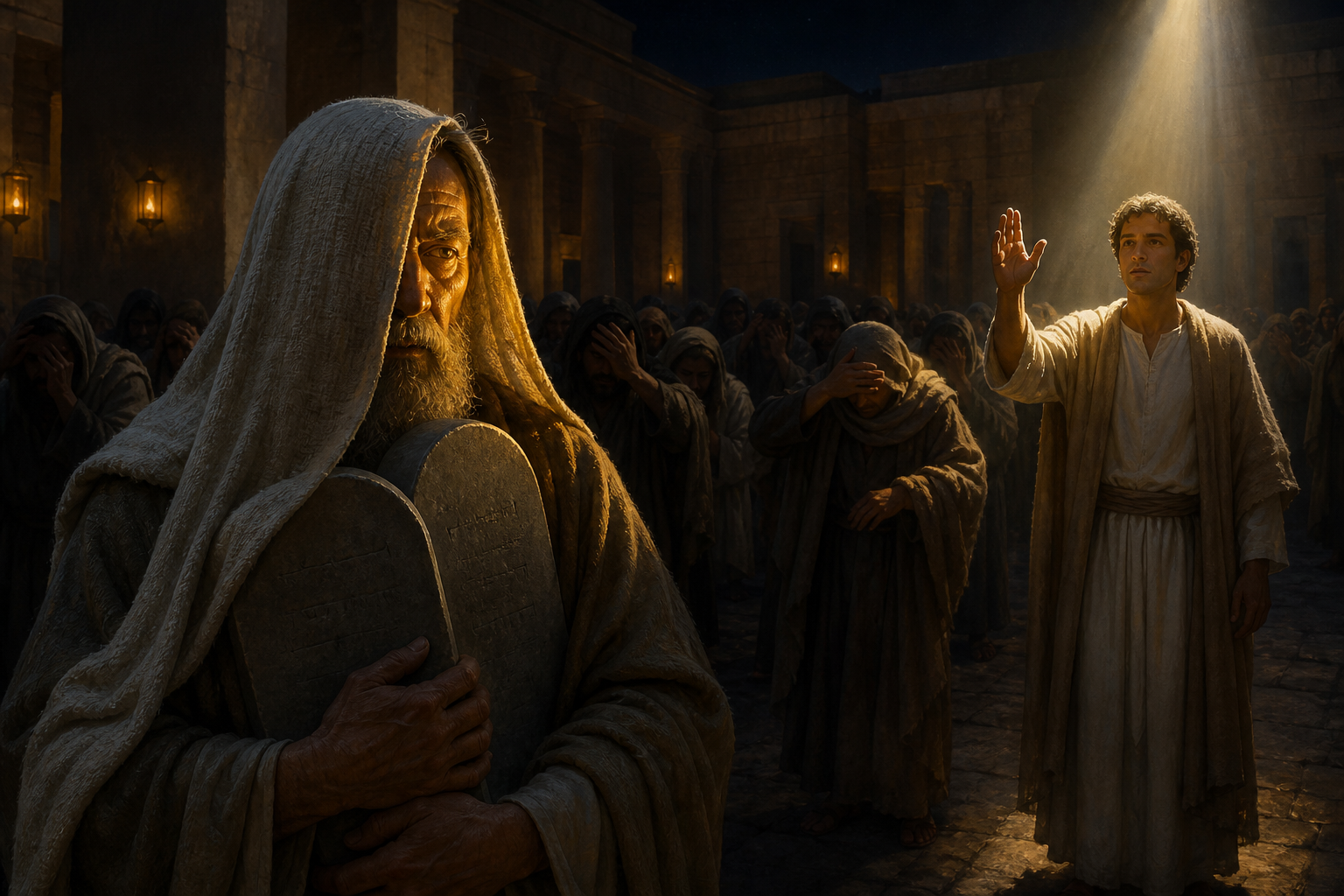
Second Corinthians 4:4 names two gods
Ask a Christian who the god of this age is, and you'll usually get one answer: Satan, with no hesitation. No need to even look it up. That's what I was taught too.
But Paul never writes the name Satan in 2 Cor 4:4. He writes a title:
"Among whom the god of this age has blinded the minds of those who do not believe so they would not see the light of the glorious gospel of Christ, who is the image of God." (2 Cor 4:4, NET)
That one sentence has two gods in it. The god of this age blinds people. Christ is the image of God. The first god stops people from seeing the image of the second God. They cannot be the same god.
Paul uses that title just once in everything we have from him. So how do you find out who the god of this age is? You read the verses around that sentence. Chapter 4 starts with the word "Therefore." Paul is still talking about the same subject. That subject starts in chapter 3, and the argument starts at 2 Cor 2:14.
Before Paul names the god who blinds people, he talks about Moses, the stone tablets, and the old covenant. The old covenant is the Law Yhwh gave to Moses. Yhwh is the god who gave that Law. Paul says this covenant kills people, and he says it finds Israel guilty. Its veil is still there whenever someone reads Moses. Paul says Israel's minds were hardened. Then he says the god of this age blinds people who do not believe.
If you start at 2 Cor 4:4, it's easy to think this must be Satan, because Satan blinds people so they cannot see Jesus. If you start where Paul starts, you are reading about Yhwh's covenant with Moses. The end of 2 Cor 4:4 says Christ is the image of a different God.
This verse started a fight very early. Marcion was a Christian teacher around the 140s. His own books are gone. We do not have them. The people who wrote against him say that Marcion said the god of this age was not the Father Jesus came from.
Around AD 180, Irenaeus answered Marcion. Irenaeus was the bishop of Lyons, and he wrote against Marcion. Paul wrote, "the god of this age has blinded." Irenaeus told the reader to stop after the word "God." He wanted the line to mean, "God has blinded the unbelievers of this age." When Irenaeus said "God," he meant Yhwh. Irenaeus still said that Yhwh blinds people. But the words "of this age" no longer told you that the blinder was Yhwh.
Tertullian, a Latin writer in Carthage, first said the same thing as Irenaeus. Then he said the devil was a simpler answer than the one Irenaeus gave. Other Christians kept saying that God blinds people. When they said God, they meant Yhwh. Later, Erasmus, who published the first printed Greek New Testament, and John Calvin, the Reformer in Geneva, helped make Satan the normal answer in Protestant churches. The fight went on because Paul never wrote the name Satan, and he never wrote the name Yhwh.
The title is not the only clue. In Deuteronomy 29:4, Yhwh did not give Israel a mind that understands, eyes that see, or ears that hear. In Isaiah 6:9–10, Yhwh tells a prophet to close the people's eyes so they will not turn and be healed. In Isaiah 29:10, Yhwh pours out a deep sleep and closes their eyes. In Romans 9:18 and Romans 11:7–10, Paul says Yhwh hardens people. That is not the Father. In 2 Cor 4:6, Paul talks about the Father. The Father shines light through Jesus.
Have you ever been told that you could not see because you were rebellious, bitter, deceived, or lacking faith? Paul says there really is a veil. He tells you where it sits. It sits on people's minds whenever someone reads Moses. Church usually blames you. Paul blames the veil that is there when Moses is read.
Who gave the covenant that Paul says brings death? Who used this title before Paul used it? Who blinds people in the rest of the Bible? And why is Yhwh hiding the image of a different God?
Christians often say you cannot understand the New Testament without the Old Testament. So read 2 Cor 4:4 beside Exodus 34, Deuteronomy 29:4, and Isaiah 6:9–10. Those passages identify the god who blinds.
Read the whole argument. Let Paul answer.
The case, in plain terms
A note on the Bible quotations The NET wording, with the divine words restored
Bible quotations use the NET. Where an Old Testament quote prints "the LORD," this page restores the name Yhwh. Where it prints "God," it restores Elohim when that is the Hebrew word. New Testament quotes use theos. English Bibles print that word as "god" or "God." Theos does not name one person. Everything else remains the NET.
I read 2 Cor 4:4 for years and supplied the name Satan without noticing Paul had not written it. Then I read Exodus 34 and kept reading Paul past the chapter break. The verse meant something else once I read what came before it.
1. Start with the story Paul is using
Moses comes down from Mount Sinai carrying stone tablets. His face is shining. Aaron, Moses' brother, and the Israelites see it and are afraid to approach. Moses calls them back and tells them everything Yhwh commanded.
When does Moses cover his face? After he finishes speaking. While he gives Yhwh's commands, Israel sees the shining face. Exodus 34 never says the shine is fading. It never says the veil hides the commands. It does not tell you why Moses covers his face between meetings.
"When Moses finished speaking with them, he would put a veil on his face. But when Moses went in before Yhwh to speak with him, he would remove the veil until he came out." (Exodus 34:33–34, NET)
2. Paul turns one story into a comparison
Paul is defending his ministry against rival teachers. Here "ministry" means the work carried out under each covenant. He puts two ministries beside each other. One is written by the Spirit on human hearts. The other is carved in letters on stone.
What does Paul call the one on stone? A ministry of death and condemnation.
"But if the ministry that produced death – carved in letters on stone tablets – came with glory... how much more glorious will the ministry of the Spirit be?" (2 Cor 3:7–8, NET)
There is no mystery about the stones. Moses carried them. Yhwh gave them. Paul says that ministry killed and condemned.
3. Paul gives the veil a new job
In Exodus 34, the people see Moses' face while Moses speaks. Paul says Moses used the veil to keep Israel from seeing the end of that glory. Paul is not retelling what happened on the mountain. Paul is using the story to explain the covenant.
Then he moves the veil. It started on Moses' face. In 2 Cor 3:14 it sits on the reading of the old covenant. In 3:15 it lies over the minds of the people listening.
"But their minds were closed. For to this very day, the same veil remains when they hear the old covenant read... But until this very day whenever Moses is read, a veil lies over their minds." (2 Cor 3:14–15, NET)
Paul says "the same veil." He says it remains. He says this happens whenever Moses is read. That is the problem behind 2 Cor 4:4.
4. Hardened minds become blinded minds
In 2 Cor 3:14 the minds of people hearing the old covenant are hardened. In 4:4 Paul talks about a bigger group. He says the god of this age blinds people who do not believe. Paul uses the same word for "minds." Paul does not name Satan, and Paul does not start a new subject.
The god who blinds is the god of the covenant Paul has been discussing. That covenant belongs to Yhwh.
5. The title already had a history
Paul was not the first Judean writer to use "god of the age." 1 Enoch 1:4 uses it for the one coming down in a Sinai judgment scene. The Septuagint, the Greek translation of the Hebrew Bible, uses it in Daniel 5:4 for the god who holds authority over human breath. Ivor Poobalan, who wrote his doctoral dissertation on this exact phrase, found no surviving use of the title for Satan before Paul.
6. Yhwh is the one who blinds
Deuteronomy 29:4 says Yhwh did not give Israel an understanding mind, seeing eyes, or hearing ears. Isaiah 6:9–10 says Yhwh sent a prophet to close their eyes. Isaiah 29:10 says Yhwh pours out deep sleep and closes eyes. John 12:40 uses the same blinding language while quoting Isaiah 6. Paul says in Romans 9:18 that Yhwh hardens the people Yhwh chooses. That is not the Father.
The covenant points to Yhwh. The older use of the title points to Yhwh. The blinding points to Yhwh.
7. 2 Cor 4:4 names two gods
The god of this age blinds minds so people cannot see Christ. Then the English says Christ is the image of God. The Greek word is theos. English Bibles print that one word as "god" or "God." Theos does not name one person. It can be the Father, Yhwh, or another god. The sentence has to tell you which one. The first theos does the blinding. The second theos is the one whose image is Christ. If the first is Yhwh, Yhwh is not the one whose image is Christ.
Paul has already used the word "image." 2 Cor 3:18 says people with the veil removed are being changed into "the same image." The veil blocks that change. 2 Cor 4:4 says that image is Christ, the image of the other God.
8. Paul names the other God as the Father
The next sentence says, "We do not proclaim ourselves, but Jesus Christ as Lord" (2 Cor 4:5, NET). Paul has already defined those titles in 1 Cor 8:6: "for us there is one God, the Father... and one Lord, Jesus Christ." The Greek word in that verse is theos. There Paul says the one theos is the Father.
That gives you Paul's own names. Christ is the image of God in 2 Cor 4:4. Christ is Lord in 2 Cor 4:5. The one God is the Father in 1 Cor 8:6.
"For God, who said 'Let light shine out of darkness,' is the one who shined in our hearts to give us the light of the glorious knowledge of God in the face of Christ." (2 Cor 4:6, NET)
Yhwh keeps the face of Jesus hidden. The Father makes the face of Jesus known. Those are not two jobs done by the same person toward the same gospel.
9. The old disagreement came from one assumption
Why did early readers split between God and the devil? When those readers said God, they meant Yhwh. They followed Moses, the veil, Isaiah, and Yhwh's hardening. The readers who said the devil followed the evil act of blocking the gospel. Both groups kept one rule: Yhwh had to be Jesus' Father.
That rule kept the evidence from fitting together. If Yhwh is the Father, you have to move Paul's words, or call the blinding mere permission, or give the act to the devil.
Jesus gave you a different way to identify a father. Look at what the father does. Yhwh does the blinding. The Father gives the light that Yhwh keeps out. That is why the old answers "God" and "Satan" each kept part of the evidence. Yhwh is Satan.
That's the case. What follows is the same argument with the wording, earlier uses of the title, and reception history underneath it.
The full evidence
The argument starts before chapter 4
Paul wrote 2 Corinthians around AD 55. Stephen Langton, the archbishop of Canterbury who set the chapter numbers still used in the Bible, added those divisions around 1227. Chapter 4 is not Paul's signal that a new subject has started. Its first word is "Therefore."
The passage starts at 2 Cor 2:14. Paul is defending his work against rival teachers. He says he does not sell God's message for profit. The Greek word in that sentence is theos. The word does not tell you which god Paul means. Paul says the same thing again in 2 Cor 4:2. There he says he does not twist the message. Between those two claims he compares the two kinds of work.
"For we are not like so many others, hucksters who peddle the word of theos for profit, but we are speaking in Christ before theos as persons of sincerity, as persons sent from theos." (2 Cor 2:17, NET)
"Therefore, since we have this ministry, just as theos has shown us mercy, we do not become discouraged. But we have rejected shameful hidden deeds, not behaving with deceptiveness or distorting the word of theos." (2 Cor 4:1–2, NET)
Paul first sets letters written with ink against a letter written by the Spirit on human hearts. Then he sets the old covenant against the new covenant. He sets the letter against the Spirit, death against life, and condemnation against righteousness. He sets glory that is removed against glory that remains, and covered faces against uncovered faces.
That is the argument Paul is already making when he says "the god of this age." If you take 2 Cor 4:4 by itself, you lose every clue Paul already gave you.
Paul puts an ending on Yhwh's glory
Exodus 34 never says the shine on Moses' face comes to an end. Paul says Moses covered his face so Israel would not see the end of that glory. He is not writing a second account of Mount Sinai. He is talking about Yhwh's covenant in his own day, and he treats its glory as something being shut down.
The veil connects hardened minds to blinded minds
Paul calls the letters carved on stone a ministry that produced death. He calls it a ministry of condemnation two verses later. Then he tells you where the veil is now.
"But their minds were closed. For to this very day, the same veil remains when they hear the old covenant read. It has not been removed because only in Christ is it taken away. But until this very day whenever Moses is read, a veil lies over their minds." (2 Cor 3:14–15, NET)
The English word "minds" translates noema (no-AY-mah), a mind or what a mind produces. Paul uses the noun five times in 2 Corinthians: Satan's plans in 2:11, hardened minds in 3:14, blinded minds in 4:4, thoughts brought under Christ in 10:5, and minds corrupted from devotion to Christ in 11:3.
That list is one reason commentators say Satan in 4:4. But the closest use is in 3:14. Paul moves from minds hardened while hearing the old covenant to unbelieving minds blinded against Jesus. The group broadens, but the word and argument continue.
The English word "blinded" translates typhloo (toof-LO-oh). Paul uses it nowhere else. John 12:40 uses the same verb while quoting Isaiah 6:10:
"He has blinded their eyes and hardened their heart, so that they would not see with their eyes and understand with their heart, and turn to me, and I would heal them." (John 12:40, NET)
1 John 2:11 is the third New Testament use. Darkness blinds the eyes of the person who hates his brother. Satan is never named as the one doing this. Yhwh hardens people and keeps them from seeing. That record runs through Exodus, Deuteronomy 2:30, Deuteronomy 29:4, Isaiah 6:9–10, Isaiah 29:10, Isaiah 63:17, and Paul's own argument in Romans 9:18 and Romans 11:7–10.
John 12:41 then says Isaiah spoke because Isaiah saw "his glory." The Greek says "his," and it does not say whose glory. The NET decides for you and prints "Christ's glory." Isaiah 6:5 says Isaiah saw Yhwh. The "He" who blinds their eyes in John 12:40 is Yhwh.
Paul also reassigns the turning scene. Exodus 34:34 says Moses removes the veil when he goes in before Yhwh. The Greek translation uses kyrios, "Lord," where the Hebrew has Yhwh's name. Paul says in 2 Cor 3:16 that the veil is removed when someone turns to the kyrios. Then he tells you who that Lord is: "the kyrios is the Spirit" (2 Cor 3:17). He has taken the act away from Yhwh and handed it to the Spirit.
"And we all, with unveiled faces reflecting the glory of the Lord, are being transformed into the same image from one degree of glory to another, which is from the Lord, who is the Spirit." (2 Cor 3:18, NET)
"The same image" connects the two verses. Paul says the veil comes off, the face is uncovered, and the person is changed into the image. Six verses later Paul says what that image is. It is Christ, the image of God (2 Cor 4:4). The god of this age blinds people so they cannot see that image, and so they cannot be changed into it.
The title before Paul
1 Enoch 1:4 uses "the god of the age" for the one who comes down in a Sinai judgment scene. Daniel 5:4 in the Septuagint says the court of Belshazzar, the king at that feast, praised handmade idols but did not bless "the god of the age, the one who holds authority over their breath."
That Daniel line is in the Septuagint. The Aramaic text behind most English Bibles says they praised gods of gold, silver, bronze, iron, wood, and stone. You should not cite the Aramaic verse as if it contained the title. The Septuagint has the title.
Paul adds one important word. Paul's phrase is "the god of this age." The Daniel and Enoch lines show that the title could name the god in the old texts, not Satan. In 1 Enoch 1:4 that god is Yhwh, because the scene is Sinai. Those lines do not settle what Paul does with the word "this."
Ivor Poobalan wrote a University of Cape Town doctoral dissertation on this one phrase. He found no Judean use before Paul that gives the title to Satan. The known history of the title points to Yhwh. People call this god Satan because of what this god does, and because of later titles such as "ruler of this world." No earlier writer used this title for Satan.
The age and its rulers are being shut down
Paul does not use the full title anywhere else, but he does speak about the powers of "this age."
In this quotation, theos is the Father, not Yhwh.
"Now we do speak wisdom among the mature, but not a wisdom of this age or of the rulers of this age, who are perishing. Instead we speak the wisdom of theos, hidden in a mystery, that theos determined before the ages for our glory. None of the rulers of this age understood it. If they had known it, they would not have crucified the Lord of glory." (1 Cor 2:6–8, NET)
The NET prints the rulers as "perishing." The Greek word is katargeo (kat-ar-GEH-oh). It means to put something out of operation. It does not mean to fade. Paul uses that same verb for the glory of the old covenant in 2 Cor 3. Both the rulers of this age and the glory of the stone covenant are being put out of operation.
Galatians 1:4 says Jesus "gave himself for our sins to rescue us from this present evil age according to the will of our God and Father" (NET). The Greek word is theos. In this verse Paul says that theos is the Father. The same letter says the Law was put in place through angels and a go-between (Galatians 3:19). It says the Law held people in custody (Galatians 3:23). It says going back to the old system is going back to slavery under the elemental powers, the forces that once held those people (Galatians 4:3–10).
M. David Litwa, a historian of early Christianity, traced the idea of an evil creator. He shows that the Marcionites connected the blinding god in 2 Cor 4:4 with the rulers who crucified Jesus in 1 Cor 2:6–8. Galatians 1:4 adds Paul's own words about the present age being evil. Marcion's larger system does not tell you what Paul meant. But these three passages should be read together.
Two gods in the same verse
2 Cor 4:4 uses theos twice. English Bibles print that word as "god" or "God," but theos does not name one person. English translations print the first one with a small g and the second one with a capital G. Greek manuscripts do not have that difference. The sentence itself has two gods.
"Among whom the theos of this age has blinded the minds of those who do not believe so they would not see the light of the glorious gospel of Christ, who is the image of theos." (2 Cor 4:4, NET)
The first theos is the god who blinds people. The second theos is the one whose image is Christ. The first god stops people from seeing the second god's image. They cannot be the same god.
The verses around this one name the first god as Yhwh. Yhwh owns the stone covenant. Yhwh's work kills people and condemns them. The veil remains whenever Moses is read. Yhwh hardens the minds, and Yhwh blinds those minds. So 2 Cor 4:4 does more than call Yhwh the god of this age. It says Yhwh is not the God whose image is Christ.
Paul names that other God. 2 Cor 4:5 says, "We do not proclaim ourselves, but Jesus Christ as Lord." 1 Cor 8:6 says, "for us there is one God, the Father... and one Lord, Jesus Christ." Christ is the image of God. Christ is Lord. Paul's one God is the Father.
"For God, who said 'Let light shine out of darkness,' is the one who shined in our hearts to give us the light of the glorious knowledge of God in the face of Christ." (2 Cor 4:6, NET)
The opposition continues. 2 Cor 4:4 says the god of this age stops the light from being seen. 2 Cor 4:6 says the Father shines that light into human hearts. The word translated "light" here is photismos (fo-tis-MOSS). It occurs only in these two verses. Yhwh blocks that light. The Father gives it.
The faces add another comparison. Exodus 33 uses "face" in two ways. Exodus 33:11 says Yhwh spoke with Moses "face to face," while Exodus 33:20 says nobody can see Yhwh's face and live. Paul does not quote either verse. Paul puts the glory of the ministry of death on Moses' face in 2 Cor 3:7. Then Paul puts the Father's light in Jesus' face in 2 Cor 4:6.
Colossians 1:15 also calls Christ "the image of the invisible God." The Greek word is theos. English Bibles print it as "God," but the word does not name one person. People saw Yhwh in Exodus 24:10, Numbers 12:8, and Isaiah 6:5. John 1:18 says no one has ever seen theos. John 14:9 says who that unseen one is. Jesus says that the person who has seen Jesus has seen the Father. So the unseen theos is the Father, not Yhwh.
The Bible describes a divine council
The Hebrew word elohim names a class of beings. It can point to the Most High, and it can describe other divine persons. They are people in the broad sense – personal beings, but not humans. Genesis 1:26–27 says humanity was made in their image and likeness.
Psalm 82:1 places elohim in the assembly of El, with the Most High presiding over them. Other passages call them the "sons of Elohim" – bene elohim (beh-NAY eh-loh-HEEM) – a family of divine beings under the Most High, Elyon (el-YOHN).
Deuteronomy 32:7–9 places Yhwh in that family. The Most High distributes the nations, and Yhwh receives Jacob as his portion. Yhwh is one of the sons of the Most High – a member of the council, not the head of it. The hierarchy is already present before later readers merge the Most High and Yhwh into one being.
Why the Trinity keeps you from seeing it
The Trinity replaces the divine-council hierarchy with "one God in three persons." It merges the Most High, Yhwh, Jesus, and the Holy Spirit into one being. The remaining council members are then reduced to angels, human judges, or figures of speech. Once that framework is in place, every distinction between Jesus' Father and Yhwh has to be moved back inside one being.
The finished formula does not appear in the Bible. Its development can be dated:
- Around 200 AD – Tertullian, a Christian writer from Carthage, is the first surviving author to use the Latin word trinitas, "Trinity." Every New Testament book had already been written.
- 325 AD – the Council of Nicaea, called by the Roman emperor Constantine. Arius, a priest in Alexandria who taught that the Son had a beginning and was subordinate to the Father, was condemned. The bishops declared the Son "of the same essence" (homoousios, hoh-moh-OO-see-oss) as the Father. Constantine enforced the decision by exiling Arius and bishops who refused to accept it.
- 381 AD – the Council of Constantinople, where the creed called the Holy Spirit "the Lord and giver of life," worshiped and glorified with the Father and the Son. Basil of Caesarea, Gregory of Nazianzus, and Gregory of Nyssa – three fourth-century theologians from Cappadocia – helped develop the language used for that formula.
The councils used technical Greek categories such as "essence" and "substance" to explain how the Father, Son, and Holy Spirit could be one being. Jesus does not describe His Father that way. Jesus says who sent Him, whose commands He obeys, whose work He completes, and whose character He shows.
The doctrine of three co-equal persons in one essence took roughly 350 years after Jesus to reach its finished form. Every biblical author wrote before that formula existed. Deuteronomy 32:7–9 and John 20:17 should be read on their own terms before a later creed decides how many beings those passages are allowed to name.
Who Christians said the blinder was
The history does not decide what Paul meant. It can show you that "Paul plainly says Satan" is false.
The chart uses Yhwh wherever a writer called the blinder "God" and meant the god of the Exodus. Those writers still believed Yhwh was the Father. Some entries come from the writers themselves. Others are preserved by Donald Hartley, who argued in a 2005 paper that the blinder is Yhwh, or by Ivor Poobalan. The sources below name the pages.
The readers who said God were keeping Yhwh and the Father as one person. When they said God, they meant Yhwh. The readers who said Satan were protecting the Father's goodness by giving the act to an enemy. Without that merger, the covenant, the title, and the behavior name the blinder as Yhwh. The hostile act explains why the other readers called Yhwh Satan. Yhwh and Satan are two names for the same being.
The old disagreement disappears
Jesus told you to identify a father by what that father does. What Jesus said is gospel, everything else is commentary. Once Yhwh is no longer treated as the same person as the Father, the old God reading and the old Satan reading meet. The blinder is Yhwh, the adversary Christians call Satan. The Father does the opposite through Jesus.
If you have ever been told that inherited theology matters more than the words in front of you, read Paul's full argument and let the deeds identify the god.
Sources
- Irenaeus, Against Heresies 3.7.1, on the proposed pause after "God." Read the chapter.
- Tertullian, Against Marcion 5.11, on the two readings and the use of 2 Cor 4:6.
- Cyril of Jerusalem, Catechetical Lecture 6, on the Manichaean use of 2 Cor 4:4 and blinding as judgment.
- John Chrysostom, Homily 8 on 2 Corinthians, on God rather than the devil and blindness as permission. Read the homily.
- Donald E. Hartley, "2 Corinthians 4:4: A Case for Yahweh as the 'God of This Age,'" paper presented to the Evangelical Theological Society, 2005. Pages 2–4 preserve his reception survey.
- Ivor Gerard Poobalan, Who Is the "God of This Age" in 2 Corinthians 4:4?, University of Cape Town doctoral dissertation, 2015. Pages 19–20, 34–39, 55, and 69 preserve the Erasmus, Calvin, Ambrosiaster, Pelagius, Clarke, and Scott material used above. Read the dissertation.
- M. David Litwa, The Evil Creator: Origins of an Early Christian Idea, chapter 4, "The God of This World," on the Marcionite reading of 2 Cor 4:4 and 1 Cor 2:8. Read the chapter summary.
- 1 Enoch 1:4, Greek text, for the pre-Paul title "the god of the age." Read the text.
- Daniel 5:4 in the Septuagint, for "the god of the age" who holds authority over human breath; discussed by Scott through Poobalan, page 69.