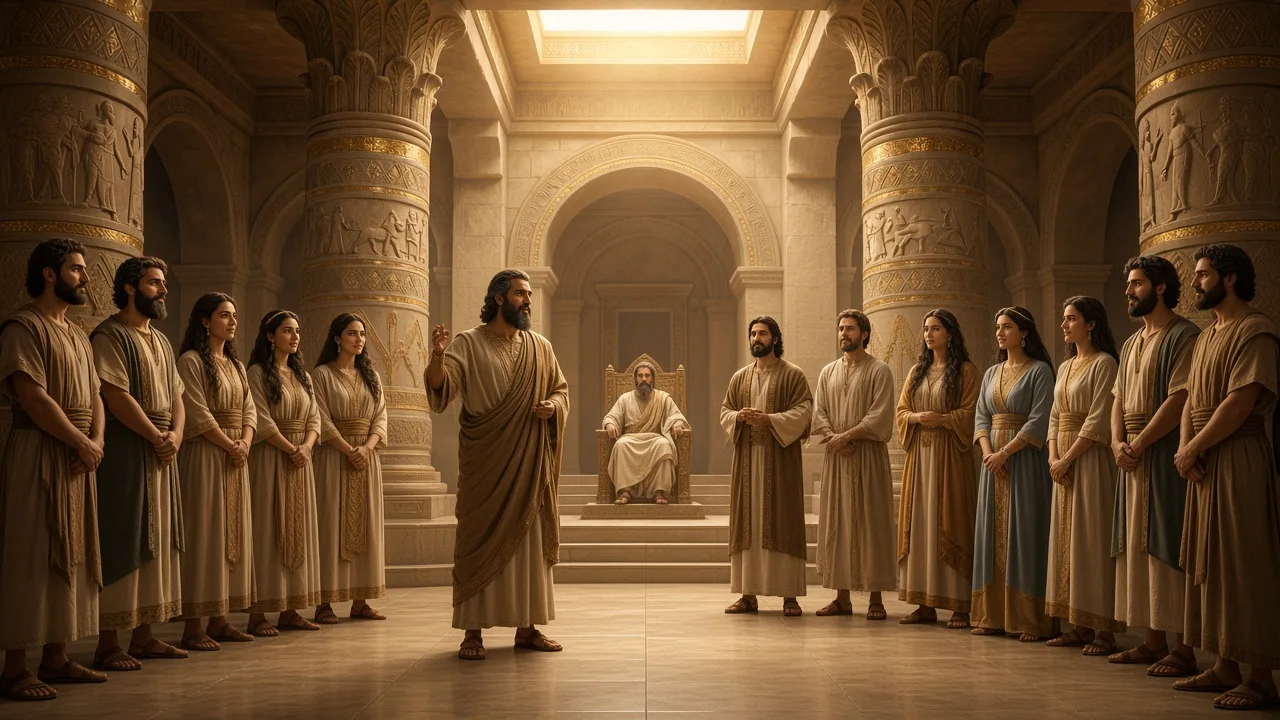
Why does Jesus answer with "you are gods"?
It is winter in Jerusalem. Jesus is walking through the Temple when the men around Him pick up stones. They tell Him why in John 10:33: "You, a man, are claiming to be God [theos]."
Jesus answers by quoting their own Bible:
"Jesus answered, 'Is it not written in your law, "I said, you are gods [theoi]"? If those people to whom the word of God [theos] came were called "gods [theoi]" (and the scripture cannot be broken), do you say about the one whom the Father set apart and sent into the world, "You are blaspheming," because I said, "I am the Son of God [theos]"?'" (John 10:34–36, NET)
That is a strange answer if "God" is a name that belongs to one being. Jesus does not deny using the word. He points to a verse where the same word is used for a group and asks why His own claim is blasphemy.
Imagine accusing a man of calling himself David, and he answers, "Your own Bible calls a whole group David." That would prove nothing. David is one person's name. But if the accusation were that he called himself a king, then a verse about other kings would matter. The argument only works because "king" can describe more than one person.
So what did Jesus think the word "god" meant?
The verse Jesus quoted is Psalm 82:6. In Hebrew it reads, "I said, you are elohim" (eh-loh-HEEM). The Gospel of John was written in Greek, so John 10 uses the Greek word theos (thee-OSS). Jesus knew the Hebrew verse, the Greek Bible carried it into another language, and neither version treated the word as one being's personal name.
Your English Bible does something the Hebrew cannot do. In Genesis 1:1 it prints elohim as "God," with a capital G. In 1 Kings 11:33 it prints the same word as "goddess" for Astarte (uh-STAR-tee) and "god" for Chemosh (KEE-mosh). In Exodus 22:8 it becomes "the judges." In 1 Samuel 28:13 the medium at Endor says she sees elohim coming up, and the NET prints "a divine being." In Exodus 7:1 it prints "like God," although the Hebrew has no word for "like."
Hebrew has no capital letters. It cannot distinguish "God" from "god" by changing the first letter. Every capital G in your Old Testament arrived when someone translated the text into English.
That does not mean every translator was trying to deceive you. English forces choices that Hebrew does not. But the choice still matters. A translator reads elohim, decides who the word points to, and then gives you "God," "god," "gods," "judges," or something else. By the time you read the verse, the decision has already been made.
I read the Bible for thirty years without seeing that decision. I saw "God" and thought I had been given a name. Then every passage containing that capital G was already settled before I started reading. "God said it" ended the question, even when the Hebrew had only told me that an elohim said it.
If you have ever found two divine figures in a passage and then been told they must somehow be the same person, the capital letter helped close that question. If you have ever read "sons of God" and been told they cannot really be gods because there is only one God, the English word decided what the Hebrew was allowed to mean. If you have ever wondered why Jesus could say "you are gods" without correcting Himself, this is where the answer begins.
The question is not whether Yhwh is called elohim. He is called elohim more often than anyone else in the Bible. The question is whether the word belongs to him alone.
Jesus' answer in John 10:34–36 says it does not.
The word belongs to more than one being
A note before you read How names and quotes work here
Every Bible quotation is from the NET unless marked otherwise. Where the NET prints "the LORD" for the divine name, the quotation restores Yhwh, the four-letter Hebrew name sometimes written Yahweh. This study keeps the English words "God," "god," "gods," "goddess," and the other renderings, and puts the Hebrew or Greek word in brackets beside them: God [elohim], gods [theoi]. Named persons keep their names. Ellipses mark omitted words. Heaven is capitalized when it is a place.
Abba (AH-bah) means the Father Jesus came to reveal. "Divine council" means the divine beings the Bible describes gathered around the Most High.
Jesus has already established the starting point in John 10:34–36: the divine word can be used for others. The Hebrew text now shows why.
Astarte, Chemosh, Milcom, and Yhwh each have a name
First Kings 11:33 names three gods worshiped by the nations around Israel:
"…they have abandoned me and worshiped the Sidonian goddess [elohim] Astarte, the Moabite god [elohim] Chemosh, and the Ammonite god [elohim] Milcom." (1 Kings 11:33, NET)
Astarte, Chemosh, and Milcom (MIL-kum) are names. The Hebrew calls each one the elohim of a people. The NET translates the word as "goddess" once and "god" twice because it knows the verse is naming other deities. In Genesis 1:1 the NET prints the same Hebrew word as "God."
Judges 11:24 puts the difference inside one sentence. Jephthah, an Israelite judge arguing with the Ammonite king, says:
"You have the right to take what Chemosh your god [elohim] gives you, but we will take the land of all whom Yhwh our God [elohim] has driven out before us." (Judges 11:24, NET)
Chemosh and Yhwh are the names. Elohim tells you what each one is. The NET gives Chemosh a small g and Yhwh a capital G, but the Hebrew uses the same word for both.
Moses was made elohim to Pharaoh
Yhwh uses the word for a living man in Exodus 7:1:
"So Yhwh said to Moses, 'See, I have made you like God [elohim] to Pharaoh, and your brother Aaron will be your prophet.'" (Exodus 7:1, NET)
The Hebrew says, "See, I have made you elohim to Pharaoh." There is no word for "like." The NET footnote acknowledges it: "The word 'like' is added for clarity." Exodus 4:16 says it again, and the NET adds "as if": Moses will be to Aaron "as if you were his God."
The passage does not say Moses stopped being human. It gives him a position toward Pharaoh, with Moses' brother Aaron serving as his prophet. Whatever that appointment did and did not mean, the word elohim was applied directly to Moses. That cannot happen with somebody else's personal name. It can happen with a word for a kind of person or a position someone occupies.
Elohim of elohim only works if there are other elohim
Deuteronomy 10:17 is the verse people quote when they want Yhwh to be the one God. Read what it actually says:
"For Yhwh your God [elohim] is God of gods [elohim of the elohim] and Lord of lords, the great, mighty, and awesome God [El]…" (Deuteronomy 10:17, NET)
The NET prints "God of gods." The Hebrew is elohim of the elohim. Same word on both sides. The first one gets a capital G. The second one does not. The last "God" in the sentence is another English cover, this time for a different Hebrew word, El.
If nobody else is elohim, the phrase has nothing to stand on. You cannot be the elohim of a class with no other members. Chemosh is already called the elohim of Moab. Yhwh here claims a higher seat in that same class. A higher seat among national gods is not the throne of the Most High. Deuteronomy 32 names the one who hands the nations out, and Yhwh is the one who receives. Later scribes collapsed those two figures into one being. That edit is laid out in Theological Redaction.
English Bibles use capitalization to identify the being
Now put the passages together. Jesus quotes people called gods. Astarte, Chemosh, Milcom, and Yhwh each have names, and elohim is used for all of them. Moses is made elohim to Pharaoh. Deuteronomy 10:17 uses the same word for Yhwh and for the ones he claims to outrank.
One Hebrew word reaches all of those people. Your English Bible turns it into "God," "god," "gods," "goddess," "judges," "a divine being," and "like God." Some of those choices may fit the passage. None of them changes what the Hebrew word is.
So when you see "God" in the Old Testament, the capital letter is not evidence that the Hebrew named the supreme being. It tells you which being the translator believed the verse meant. Most of the time the context makes the answer clear. Sometimes it does not. Either way, the capital G came from the translation, not from the Hebrew.
That is why you did not see the question. You were not reading a neutral label and then deciding who it described. You were reading somebody else's answer.
Genesis begins with a title and introduces the name later
Genesis 1 uses elohim as the fixed title for one known head of the group. The action is usually singular: elohim creates, speaks, sees, and separates. Then Genesis 1:26 says, "Let us make humankind in our image, after our likeness." The rest of the class is in the room. Genesis 1:27 returns to the singular when the head acts.
The personal name Yhwh does not appear until Genesis 2:4, where the text joins the two words: Yhwh elohim. One word names him. The other says what he is.
And humanity is made in the image and likeness of these beings. The elohim are people in the broad sense: personal beings, not human beings. Genesis does not describe humans as unrelated creatures looking up at them. It describes humanity as a lite version of their kind.
Elohim cannot identify the person by itself
This does not prove by itself that Yhwh is not Jesus' Father. It removes the shortcut that kept you from asking. "The verse says God" is no longer an answer, because the Hebrew did not give you a personal name. You still have to ask which elohim the passage means.
Sometimes the answer is Yhwh. Sometimes it is Chemosh. Sometimes it is a group in the assembly of the Most High. In Exodus 7:1 it is Moses in an assigned position. In 1 Samuel 28:13 the medium at Endor uses the word when the dead prophet Samuel appears. The verse, not the capital letter, has to identify the person.
That is also how a capital G is used here. It names the one at the top: Abba (AH-bah), the Father Jesus came from. The choice is stated openly instead of being hidden inside the spelling.
Elohim tells you what kind of being is in view. The name and the passage tell you who.
That's the case. What follows puts the counts, language history, translation record, and Christian objections underneath it.
The full evidence
Elohim appears 2,600 times
Elohim appears 2,600 times in 2,246 verses of the Old Testament. That count comes from the Hebrew text, where the word is tagged with the dictionary number H430. You have read it thousands of times, usually without seeing it.
The spelling creates the first difficulty. The ending -im usually marks more than one, as in cherub and cherubim. Of the 2,600 uses, 2,599 are tagged as plural in form. Yet the word often refers to one being and takes a singular action: one elohim speaks or creates. The form looks plural while the sentence may treat it as singular.
Hebrew also has a singular form, eloah (eh-LOH-ah), used about 60 times, mostly in Job. Aramaic, the related language used in parts of Daniel and Ezra, has the singular elah (eh-LAH) and the plural elahin (eh-lah-HEEN). Together those Aramaic forms appear 97 times: 53 in Daniel, 43 in Ezra, and once in Jeremiah 10:11. The Bible had other ways to say one god or several. The unusual history belongs to elohim itself.
Benjamin Suchard, a linguist who studies Hebrew and related languages, reconstructed that history in the Journal for the Study of the Old Testament in 2025. He argues that the irregular form reaches back before Hebrew: an old plural was later reused as a singular, and Hebrew preserved both parts of that history. The ending does not contain a hidden Trinity, and it is not an honor given only to Yhwh. The same form appears with Yhwh, other gods, Moses, and the dead prophet Samuel.
Yhwh is the person elohim points to most often. The name Yhwh and the word elohim appear together in 1,154 verses. That number only counts verses containing both words; it does not prove that every elohim in those verses means Yhwh. It does show why readers came to hear the word as though it belonged to him. Frequency created familiarity. It did not turn a shared word into a personal name.
John 10 uses one Greek word for one and many
The New Testament uses the Greek word theos (thee-OSS) 1,317 times in 1,156 verses. Most uses are singular, and English Bibles usually print them as "God." Seven verses use the plural, with eight occurrences altogether:
| Verse | What it says | Who the "gods" are |
|---|---|---|
| John 10:34 | "I said, you are gods [theoi]" | The people Psalm 82:6 is talking to |
| John 10:35 | "those people… were called 'gods [theoi]'" | The same people |
| Acts 7:40 | "Make us gods [theoi] that will go before us" | The golden calf (quoting Exodus 32:1) |
| Acts 14:11 | "The gods [theoi] have come down to us in human form!" | Paul and Barnabas, two early Christian missionaries, mistaken for the Greek gods Zeus and Hermes |
| Acts 19:26 | "gods [theoi] made by hands are not gods [theoi] at all" | Idols in Ephesus |
| 1 Corinthians 8:5 | "so-called gods [theoi]… many gods [theoi] and many lords" (twice) | The gods of the nations |
| Galatians 4:8 | "beings that by nature are not gods [theoi] at all" | What the Galatians used to serve |
The Greek word kept the range of the Hebrew word. It can refer to one being or several. Two of its plural uses appear in Jesus' answer to the men with stones.
Psalm 82:6 has "I said, you are elohim." The Septuagint (sep-TOO-uh-jint), the Greek Bible frequently quoted and reflected by New Testament writers, renders the word as theoi (theh-OY), "gods." John 10:34 quotes that line exactly. Then John 10:35 uses the same Greek word twice: the word of theos came to people who were themselves called theoi. One sentence uses the word for the speaker and for the group He addressed.
D. A. Carson, who wrote one of the standard commentaries on John, states what Jesus' defense requires:
"This Scripture proves that the word 'god' is legitimately used to refer to others than God himself. If there are others whom God (the author of Scripture) can address as 'god' and 'sons of the Most High'… on what biblical basis should anyone object when Jesus says, I am God's Son?" (D. A. Carson, The Gospel according to John, 1991, pp. 396–399)
Carson reads Psalm 82 as Israel at Mount Sinai rather than a council of divine beings. His interpretation of the group does not change the point he concedes: the word "god" can be used for beings other than the Father, and Jesus builds His answer on that fact.
The whole psalm gives more information about the group:
"God [elohim] stands in the assembly of El; in the midst of the gods [elohim] he renders judgment." (Psalm 82:1, NET)
"I thought, 'You are gods [elohim]; all of you are sons of the Most High.' Yet you will die like mortals; you will fall like all the other rulers." (Psalm 82:6–7, NET)
Psalm 82:1 contains elohim twice. The NET prints the first as "God" and the second as "gods." El is another Hebrew word for a deity, and here it names whose assembly this is. The English capital separates the presiding figure from the group, but the Hebrew gives both the same class word.
Christians have identified the judged group as human judges, Israel at Sinai, or divine beings assigned to the nations. A Dead Sea Scroll called 11QMelchizedek uses Psalm 82:1–2 in a heavenly judgment scene. The divine-being reading fits the assembly of El, the title "sons of the Most High," and the warning that they will die "like mortals." But Jesus' defense in John 10:34–36 does not depend on settling that dispute. Every reading leaves a group called elohim.
The NET makes another interpretive choice in Psalm 82:6. Its running text says, "I thought, 'You are gods [elohim],'" while its footnote admits that the Hebrew says "I said." Jesus quotes the Hebrew wording: "I said, you are gods [theoi]."
The Bible places elohim beside several personal names
The Hebrew Bible repeatedly names a god and then identifies the people or place connected to that god. Dan McClellan, a scholar of the Hebrew Bible and ancient Israelite religion who wrote YHWH's Divine Images, counts eighteen passages using the form "the elohim of" a named people or place.
| The name | The word beside it | Whose god | Where |
|---|---|---|---|
| Astarte (Hebrew Ashtoreth, ASH-tuh-reth) | elohim of the Sidonians | Sidon | 1 Kings 11:33 |
| Chemosh | elohim of Moab | Moab | 1 Kings 11:33; Judges 11:24 |
| Milcom | elohim of the Ammonites | Ammon | 1 Kings 11:33 |
| Baal Zebub (BAY-uhl ZEE-bub) | elohim of Ekron | Ekron | 2 Kings 1:2, 3, 6, 16 |
| Yhwh | elohim of Israel | Israel | about 200 times |
"Elohim of Israel" appears about 200 times, more than any other people-name joined to the word. Yhwh occupies the same grammatical place as Chemosh and Baal Zebub: personal name, class word, people. The Hebrew does not change forms when it reaches Yhwh. The English capitalization changes because the translator has identified the person.
This also rules out the usual "plural of majesty" explanation. That claim says the plural-looking form honors the one supreme God. But 2 Kings 1 uses the same form four times for Baal Zebub, the god of Ekron, in a story that condemns consulting him. The spelling does not honor one member of the class. It belongs to the word wherever the word is used.
The Bible also places elohim directly beside the Hebrew word for "other" in 63 verses. Four more verses contain both words without placing them directly together. Deuteronomy 6:14 warns, "You must not go after other gods [elohim], those of the surrounding peoples." Micah 4:5 says, "Though all the nations follow their respective gods [elohim], we will follow Yhwh our God [elohim] forever." "Other" only works because elohim can include more than one member.
Moses, made elohim to Pharaoh
The main witnesses compared below agree on the word assigned to Moses. The modern English versions add the comparison:
| Version | What it says | "Like"? |
|---|---|---|
| Hebrew | "See, I have made you elohim to Pharaoh" | No |
| Septuagint (Greek, ~250 BC) | "I have given you as theos to Pharaoh" | No |
| Vulgate (Latin, ~400 AD) | "I have set you up as Deus of Pharaoh" | No |
| King James (1611) | "I have made thee a god to Pharaoh" | No |
| NET, NIV, ESV (modern) | "I have made you like God to Pharaoh" | Added |
The Hebrew, Greek, Latin, and King James all place the divine word directly on Moses. An ancient Aramaic paraphrase uses "master" instead. The comparison "like God" appears in modern English versions, and the NET footnote states that "like" was added for clarity. That rendering explains how the translators understand the appointment while hiding the fact that the Hebrew calls Moses elohim to Pharaoh.
The verb can appoint someone to a position. Yhwh says, "I have made you ruler over my people" in 1 Kings 14:7 and "I have made you a light to the nations" in Isaiah 49:6. Exodus 7:1 follows the same shape: Moses is made elohim toward Pharaoh, and Aaron is made his prophet.
Robert Girdlestone, a nineteenth-century scholar who wrote a standard book on Old Testament word meanings, observed in 1871 that Moses was not made "as elohim" but "for elohim." He concluded that the divine word "was here given to his human representative, as such." McClellan translates the line directly: "I have made you a deity to Pharaoh."
That wording does not require Moses to stop being human. Jeremiah 1:18 says the prophet Jeremiah was made "a fortified city," and the sentence assigns a function without changing his body into a wall. Exodus 7:1 can work the same way. But it still assigns elohim to a living man in relation to another man. That is evidence about the word even if it tells us nothing about a change in Moses' nature.
Exodus 4:16 had already said Moses "will be to him for elohim." The same Hebrew construction appears in Genesis 17:7 when Yhwh promises Israel's ancestor Abraham that he will be "to you for elohim." English Bibles do not reduce that promise to Yhwh being merely "like" a god to Abraham. The added comparisons in Exodus 4:16 and 7:1 respond to the identity of Moses, not to a comparison word in the Hebrew.
What the NET does with elohim
The table gathers the choices in one place. Not every rendering is wrong. Translation requires interpretation. The problem is that an English reader usually sees the result without seeing the Hebrew word underneath it.
| Verse | The Hebrew says | The NET prints | What happened |
|---|---|---|---|
| Genesis 1:1 | "In the beginning elohim created" | "God" | Capital G added |
| 1 Kings 11:33 | "elohim of the Sidonians… of Moab… of the Ammonites" | "goddess," "god," "god" | Small letters chosen for other gods |
| Exodus 7:1 | "I have made you elohim to Pharaoh" | "like God" | "Like" added; footnote notes it |
| Exodus 4:16 | "you will be to him for elohim" | "as if you were his God" | "As if" added |
| Exodus 21:6; 22:8–9 | "bring him to the elohim"; "the elohim will declare guilty" (plural verb) | "the judges" | Word replaced with a guess about who |
| Psalm 82:1 | "Elohim stands… in the midst of the elohim" | "God… the gods" | Same word split into capital and small |
| Psalm 82:6 | "I said, you are elohim" | "I thought, 'You are gods'" | Verb interpreted; footnote has "said" |
| Psalm 8:5 | "a little lower than elohim" | "heavenly beings" | Word replaced with a category label |
| Judges 13:22 | "we have seen elohim" | "a supernatural being" | Word replaced with a description |
| 1 Samuel 28:13 | "I see elohim coming up" (plural verb form) | "a divine being" | Rendered as one being from the following context |
| Daniel 3:25 (Aramaic) | "like a son of elahin" – a son of gods | "like that of a god" | "Son" and the plural dropped; footnote keeps the literal |
| Genesis 20:13; 35:7; 2 Samuel 7:23 | elohim with a plural verb: "they made me wander," "they revealed themselves," "they went" | "God made… God revealed… Their God went" | Plural verbs made singular |
| Deuteronomy 32:8 | "sons of elohim" (Dead Sea Scrolls) | "the heavenly assembly" | Kinship word replaced with a label |
Hebrew verbs mark whether one person or several perform an action. Genesis 20:13, Genesis 35:7, and 2 Samuel 7:23 place plural actions beside elohim: "they made me wander," "they revealed themselves," and "they went." The NET renders each sentence with a singular subject. Context may support that choice, but the plural wording is still part of the evidence.
The old Greek translators sometimes wrote "angels"
English translators inherited some of these decisions from the Greek Bible. In several passages, the Greek translators replaced elohim with "angels."
Psalm 97:7 in Hebrew ends, "bow down to him, all elohim." The Septuagint prints, "bow down to him, all his angels." Psalm 8:5 says humans were made "a little lower than elohim." The Greek has "a little lower than the angels," and Hebrews 2:7 quotes that form. The NET chooses "heavenly beings."
Deuteronomy 32:43 in the Dead Sea Scrolls preserves another line: "bow down to him, all elohim." That line disappeared from the standard Hebrew text behind most Old Testaments. Hebrews 1:6 says, "Let all the angels of God [theos] worship him." It may be quoting a Greek form of Deuteronomy 32:43, although Psalm 97:7 is another possible source.
"Angels" tells the reader what kind of beings the translators thought these elohim were. It is an interpretation of the class, not the Hebrew word itself. The same process produced capital-G "God" elsewhere.
The New Testament uses theos for more than one being
Paul, an early Christian missionary who wrote 1 Corinthians and Galatians, uses the Greek word without limiting it to one being:
"If after all there are so-called gods [theoi], whether in heaven or on earth (as there are many gods [theoi] and many lords), yet for us there is one God [theos], the Father, from whom are all things and for whom we live, and one Lord, Jesus Christ, through whom are all things and through whom we live." (1 Corinthians 8:5–6, NET)
Paul says there are many gods [theoi] and many lords, then identifies the ones his community serves: one God [theos], the Father, and one Lord, Jesus. He does not deny that the word has other members. He names the one at the top. Galatians 4:8 makes the same distinction from the other direction by describing beings that "by nature are not gods [theoi] at all." A false claimant does not erase the category it falsely claims.
Hebrews 1:8–9 quotes Psalm 45 to the Son: "Your throne, O God [theos], is forever and ever… So God [theos], your God [theos], has anointed you." The Son is addressed as theos, and then the Son has a theos who anoints Him. Gert Steyn, a South African scholar who studies how the New Testament quotes the Old Testament, notes that the first line can also be read "God is your throne." Either way, the next line places another theos above the Son.
Jesus says the same thing without any grammatical dispute after His resurrection: "I am ascending to my Father and your Father, to my God [theos] and your God [theos]" (John 20:17). Jesus has a theos. Eleven verses later, His disciple Thomas calls Jesus "my Lord and my God [theos]" (John 20:28). Both statements can stand because theos is not a personal name. The word can apply to more than one person while the passage shows their relationship.
Deuteronomy 32 places Yhwh inside a divine family
The Bible describes a divine council
The Hebrew word elohim names a class of beings. It can point to the Most High, and it can describe other divine persons. They are people in the broad sense – personal beings, but not humans. Genesis 1:26–27 says humanity was made in their image and likeness.
Psalm 82:1 places elohim in the assembly of El, with the Most High presiding over them. Other passages call them the "sons of Elohim" – bene elohim (beh-NAY eh-loh-HEEM) – a family of divine beings under the Most High, Elyon (el-YOHN).
Deuteronomy 32:7–9 places Yhwh in that family. The Most High distributes the nations, and Yhwh receives Jacob as his portion. Yhwh is one of the sons of the Most High – a member of the council, not the head of it. The hierarchy is already present before later readers merge the Most High and Yhwh into one being.
Deuteronomy 32:7–9 uses the word inside an older account of how the nations were divided:
"Remember the ancient days; bear in mind the years of past generations. Ask your father and he will inform you, your elders, and they will tell you. When the Most High gave the nations their inheritance, when he divided up humankind, he set the boundaries of the peoples, according to the number of the heavenly assembly [sons of elohim]. For Yhwh's allotment is his people, Jacob is his special possession." (Deuteronomy 32:7–9, NET)
The order is simple. The Most High distributes the nations according to the number of a group the NET calls "the heavenly assembly." Yhwh then receives Jacob as his allotment. One being gives. A family of divine beings receives. Yhwh gets one nation.
The standard Hebrew text says "sons of Israel" in Deuteronomy 32:8. A Dead Sea Scroll about a thousand years older says "sons of elohim." Most Greek copies have "angels of God." The NET translators concluded that the Dead Sea Scroll preserves the original reading and rendered it "heavenly assembly."
Once elohim is allowed to mean what the rest of the Bible shows it can mean, the structure no longer has to be flattened. The Most High stands over a family of divine persons, and Yhwh is the son who receives Israel. Deuteronomy 32:7 introduces this as ancient knowledge passed down by fathers and elders.
Current theology identifies the Most High and Yhwh as one being giving a nation to himself. But Deuteronomy 32:8–9 gives them different names and different actions. The full manuscript case is laid out in Elyon gave Jacob to Yhwh. The simpler point comes first: nothing in the word elohim requires the giver and the receiver to be the same person.
Why the Trinity makes this word hard to see
The Trinity replaces the divine-council hierarchy with "one God in three persons." It merges the Most High, Yhwh, Jesus, and the Holy Spirit into one being. The remaining council members are then reduced to angels, human judges, or figures of speech. Once that framework is in place, every distinction between Jesus' Father and Yhwh has to be moved back inside one being.
The finished formula does not appear in the Bible. Its development can be dated:
- Around 200 AD – Tertullian, a Christian writer from Carthage, is the first surviving author to use the Latin word trinitas, "Trinity." Every New Testament book had already been written.
- 325 AD – the Council of Nicaea, called by the Roman emperor Constantine. Arius, a priest in Alexandria who taught that the Son had a beginning and was subordinate to the Father, was condemned. The bishops declared the Son "of the same essence" (homoousios, hoh-moh-OO-see-oss) as the Father. Constantine enforced the decision by exiling Arius and bishops who refused to accept it.
- 381 AD – the Council of Constantinople, where the creed called the Holy Spirit "the Lord and giver of life," worshiped and glorified with the Father and the Son. Basil of Caesarea, Gregory of Nazianzus, and Gregory of Nyssa – three fourth-century theologians from Cappadocia – helped develop the language used for that formula.
The councils used technical Greek categories such as "essence" and "substance" to explain how the Father, Son, and Holy Spirit could be one being. Jesus does not describe His Father that way. Jesus says who sent Him, whose commands He obeys, whose work He completes, and whose character He shows.
The doctrine of three co-equal persons in one essence took roughly 350 years after Jesus to reach its finished form. Every biblical author wrote before that formula existed. Deuteronomy 32:7–9 and John 20:17 should be read on their own terms before a later creed decides how many beings those passages are allowed to name.
The objections, answered
These are the answers most often used to keep elohim attached to one being.
What about "Deuteronomy 4:35 and Isaiah 45:5 say there is no other God. So elohim means the one true God."
Those are claims of uniqueness and supremacy. A king can say there is no king beside him without turning "king" into his personal name. Deuteronomy 4:35 tells Israel that Yhwh is the elohim and there is no other beside him. Isaiah 45:5 has Yhwh claim, "I am Yhwh… there is no elohim." The sentences tell you what Yhwh claims about his rank and rivals.
The same Bible places "other" directly beside elohim in 63 verses, with four more verses containing both words elsewhere in the sentence. It calls Chemosh the elohim of Moab, assigns the word to Moses, and preserves Jesus saying, "You are gods [theoi]." Any explanation of "no other" has to account for those passages too. A claim that other gods are false, powerless, or subordinate can do that. A claim that elohim is one person's name cannot.
What about "Paul says there is no God but one in 1 Corinthians 8:4."
Paul explains the phrase in the next two verses. He acknowledges "many gods [theoi] and many lords," then says, "for us there is one God [theos], the Father… and one Lord, Jesus Christ" (1 Corinthians 8:5–6). He does not say the word can name only one being. He identifies the one his community serves: the Father.
What about "The verbs are singular. 'God created,' not 'gods created.' That proves it's a name."
A singular verb tells you that the sentence treats the subject as one. It does not turn the subject's class word into a proper name. "The king speaks" describes one king, but "king" remains available for every other king.
The Hebrew also preserves plural agreement. Genesis 20:13 has "they made me wander." Genesis 35:7 has "they revealed themselves." Second Samuel 7:23 has "they went." Exodus 22:9 has "they will declare guilty," and 1 Samuel 28:13 has "they are coming up." Joshua 24:19 combines a plural adjective, "holy ones," with a singular pronoun. English translations often make those lines singular because of how they identify the subject. The agreement helps show how many are in view in a verse; it does not define the word as a name.
What about "The plural ending is the Trinity hiding in the Old Testament. Or it's a 'plural of majesty' honoring the one God."
The form is identical when the word refers to Yhwh, Chemosh, Baal Zebub, Moses, or Samuel. If the ending encoded three persons when applied to Yhwh, it would carry the same information when applied to the others. It does not. Aramaic also uses the plain singular elah for a god without losing anything about the being described.
The plural-of-majesty explanation has the same problem. Second Kings 1 repeatedly uses elohim for Baal Zebub while condemning the Israelite king for consulting him. The form is not an honor reserved for Yhwh. Suchard's linguistic work offers the historical explanation: an older irregular plural came to be reused as a singular before Hebrew took its later form.
What about "Exodus 7:1 obviously means Moses was like God to Pharaoh. The translators just made it clear."
Moses may have been like a god to Pharaoh in authority and representation. That is a reasonable explanation of the role. It does not change the wording. Hebrew, Greek, Latin, and the King James assign the divine word directly to Moses, with Aaron beneath him as prophet. The NET, NIV, and ESV add "like" to express their interpretation.
The point is not that Moses changed species. The point is that elohim can name a position occupied by a human representative. A personal name could not do that.
What about "Psalm 82 is about human judges. Exodus 22 calls the judges elohim, so Jesus was just saying judges were called 'gods.'"
Jesus quotes Psalm 82:6, not Exodus 22. Psalm 82 places the group in the assembly of El, calls them sons of the Most High, and warns that they will die "like mortals." Those details fit divine beings better than human judges. The Dead Sea Scroll called 11QMelchizedek also uses Psalm 82:1–2 in a heavenly judgment scene.
But the human-judge reading cannot rescue elohim as a name. If Psalm 82 calls human judges elohim, then the word has been applied to people other than the Father. Jesus' argument still works for exactly that reason.
Exodus 21:6 and 22:8–9 are also disputed. The Hebrew says to bring a case before the elohim, and Exodus 22:9 uses the plural action "they will declare guilty." The NET prints "judges." If that identification is correct, human judges carry the word. If it refers to divine beings at a shrine, several divine beings carry it. Neither option makes it one being's personal name.
The NET footnote on Exodus 21:6 cites Cyrus Gordon and Anne Draffkorn, two scholars who compared these passages with ancient Near Eastern legal texts. But their comparison identified household gods, not human judges. McClellan has documented that citation problem. Exodus 18, where Moses actually appoints human judges, never calls them elohim.
What about "The medium at Endor saw one old man, Samuel. So 'a divine being' is a fair translation."
The story does identify one old man as the dead prophet Samuel and then refers to him as "he." The NET's "a divine being" follows that context. But the medium's first words in 1 Samuel 28:13 are, "I see elohim coming up," with a plural action. The old Greek translation also has "gods [theoi] coming up."
Whether the medium first saw one figure or several, she used elohim for what appeared. The next verse identifies Samuel. A word applied in that setting is not one living deity's personal name.
What about "But elohim is used like a name all through Genesis 1. It's just 'God.'"
Genesis 1 does use elohim as a fixed title for one known figure, much as "the king" can identify one man throughout a royal account. Ecclesiastes does the same thing forty times without using the name Yhwh once. A class word can function as a title when everyone knows which member is meant.
The claim is not that elohim can never function like a name. It is that the word is not a unique personal name. Genesis 1:26 includes the rest of the class: "Let us make humankind in our image, after our likeness." Genesis 1:27 returns to the singular when the head acts. Then Genesis 2:4 supplies a name beside the title: Yhwh elohim.
What about "Nearly every time the word is used, it means Yhwh. So that's what it means."
Yhwh is the person elohim points to most often. The name and the word occur in the same verse 1,154 times. That explains why "God" usually makes readers think of Yhwh.
Frequency does not determine meaning by itself. The same Bible speaks directly of "other elohim" in 63 verses, places the word beside the names of foreign gods, assigns it to Moses, uses it at Endor, and preserves Jesus applying it to a group. Yhwh's dominance in the count cannot erase the uses that establish the word's range.
What about "The other gods aren't real. They're idols, demons, or nothing. So elohim still means the one true God."
That answer changes the subject from the meaning of the word to whether a particular claimant is genuine. Acts 19:26 says that "gods [theoi] made by hands are not gods [theoi] at all." The sentence distinguishes false members from real ones while using the same class word for the claim.
Yhwh is not a handmade idol, and neither is the assembly in Psalm 82. Declaring some gods false does not turn elohim into one person's name.
What about "Deuteronomy 32:8–9 is one being under two titles. The Most High is Yhwh, giving Israel to himself."
This is the strongest objection to reading two beings in Deuteronomy 32:8–9. The passage first names the Most High as the giver, then counts a family of divine sons, then names Yhwh as the receiver of Jacob. Identifying the giver and receiver turns the allotment into one being giving himself one share.
The objection still concedes that elohim is shared. The Dead Sea Scroll says "sons of elohim," and the NET renders the group "heavenly assembly." The argument is no longer whether several beings can belong to the class. It is whether Yhwh is the Most High over that class or one of the sons receiving an inheritance. Deuteronomy 32 gives the two figures different names and different actions. The full manuscript argument is in Elyon gave Jacob to Yhwh.
Genesis 1 never gives the creator a personal name
"In the beginning God [elohim] created the heavens and the earth." (Genesis 1:1, NET)
The opening line identifies the creator as elohim, a divine being. It does not supply a personal name. The chapter continues with one known head speaking and acting until Genesis 1:26 opens the scene:
"Then God [elohim] said, 'Let us make humankind in our image, after our likeness…'" (Genesis 1:26, NET)
Genesis 1:27 returns to the singular: "God [elohim] created humankind in his own image." The head speaks to the others, then the head acts. The people in that meeting are not humans. Humanity is about to be made in their image and likeness. They are personal beings, and humans are lite versions of their kind.
The name Yhwh first appears in Genesis 2:4, joined to the class word: Yhwh elohim. The text now gives you both pieces. Yhwh tells you who. Elohim tells you what.
That distinction holds everywhere the word travels. Chemosh and Yhwh each have a name and are each called elohim. Moses is assigned the word in relation to Pharaoh. The medium at Endor uses it when Samuel appears. Deuteronomy 10:17 has Yhwh claiming rank as elohim of the elohim, which only works if the class has other members. Psalm 82 places several elohim in the assembly of El.
Then Jesus stands in the Temple in John 10:34–36 and quotes the line the English capital letter taught you not to expect: "You are gods [theoi]." He does not apologize for the plural. He uses it as His defense.
If you were taught that every capital-G "God" in the Bible had already identified one being, you were never given the choice the Hebrew leaves open. That is why passages containing several divine people seemed impossible to read. The difficulty was not in the verse. The answer had been printed into the translation before you arrived.
So read the name when the text gives you a name. When it gives you elohim, let the passage identify the person. Jesus did.