"Do it now"
Luke 11:11 is one of those verses that a lot of people have noticed. If you have spent any time reading about the Exodus and then read Jesus asking what father gives a snake to a child who asks for fish, the connection is hard to miss. The Hebrews asked for food and Yhwh sent snakes. Many people have pointed that out over the years, and I am certainly not the first. I had known about it for a long time and had talked about it many times.
But every time I thought about that verse, I wondered about the verses around it. I kept telling myself I really needed to sit down and look at what else might be hiding there.
One evening I saw someone reference the verse in a post, and the feeling came back. I got up to get a snack, thinking to myself: I really need to sit down with that whole passage one day. I was standing at the fridge, hand on the door, when I was stopped. Deep in my soul – in one of those rare, unmistakable moments when you know it is Abba speaking – He said three words: Do it now.
I never opened the fridge. I opened my Bible, sat down, and turned to Luke 11. From the first line, I could see it – thirteen consecutive verses, every one of them pointing back to the Exodus, every one of them contrasting what Yhwh did to the Hebrews with what the Father will do for His children.
No matter how many times it happens, the moment you see something new in the words of Jesus – something that was always there, waiting – it hits you like the first time. This is the verse that started it:
"What father among you, if your son asks for a fish, will give him a snake instead? Or if he asks for an egg, will give him a scorpion? If you then, although you are evil, know how to give good gifts to your children, how much more will the heavenly Father give the Holy Spirit [or good gifts] to those who ask him!" (Luke 11:11–13; cf. Matthew 7:11)
But that verse is the end of the discourse – not the beginning. And to understand what Jesus is really saying here, we have to start at the beginning.
The Good Father Discourse
If you grew up in church, you know the Lord's Prayer. You have probably recited it hundreds of times. You may have also heard the fish-and-snake passage taught as a lesson about prayer – that if you ask the Father for good things, He will give them to you. That is true. But it is not all that Jesus is saying here, and it is not even the main point.
Luke 11:1–13 is a single, unbroken discourse. It begins with the Lord's Prayer, moves into a parable about a friend who begs for bread at midnight, then into the famous ask-seek-knock teaching, and ends with the fish-and-snake comparison. Thirteen consecutive verses. In most churches, these are taught as separate teachings that happen to appear near each other. But they are not separate. Jesus delivered them as one continuous message, and when you read them that way, something emerges that changes the meaning of all of them.
The people sitting in front of Jesus that day were not like us. They did not have study Bibles or commentaries. What they had was the Torah. They grew up on it. They knew the Exodus story the way you know your own childhood – every detail, every character, every disaster. So what if there is more to the fish and the snake than a nice illustration? What if the prayer is not just a prayer, but a line-by-line response to something? What if the bread in the parable, the testing, the evil one – what if every word Jesus chose would have triggered a specific memory for His audience? And what if those memories tell a very different story than the one most Christians have been taught?
What follows is a walk through every part of this discourse, verse by verse, with the Exodus context restored. If you are willing to hear it the way Jesus' audience heard it, you will never read this passage the same way again.
vv. 1–4 The Lord's Prayer A prayer to Abba – every line contrasts Yhwh's system
"When you pray, say: Father, may your name be honored; may your kingdom come. Give us each day our daily bread, and forgive us our sins, for we also forgive everyone who sins against us. And do not lead us into a time of testing, but deliver us from the evil one." (Luke 11:2–4; Matthew 6:13)
vv. 5–8 The Persistent Friend A parable about begging for bread – persistence rewarded, not punished
"Suppose one of you has a friend, and you go to him at midnight and say to him, 'Friend, lend me three loaves of bread, because a friend of mine has stopped here while on a journey, and I have nothing to set before him.' Then he will reply from inside, 'Do not bother me. The door is already shut, and my children and I are in bed. I cannot get up and give you anything.' I tell you, even though the man inside will not get up and give him anything because he is his friend, yet because of the first man's sheer persistence he will get up and give him whatever he needs." (Luke 11:5–8)
vv. 9–10 Ask, Seek, Knock Everyone who asks receives – reversing the Exodus pattern
"So I tell you: Ask, and it will be given to you; seek, and you will find; knock, and the door will be opened for you. For everyone who asks receives, and the one who seeks finds, and to the one who knocks, the door will be opened." (Luke 11:9–10)
vv. 11–13 The Fish and the Snake The climax – Jesus names the exact animals from the Exodus wilderness
"What father among you, if your son asks for a fish, will give him a snake instead of a fish? Or if he asks for an egg, will give him a scorpion? If you then, although you are evil, know how to give good gifts to your children, how much more will the heavenly Father give the Holy Spirit [or good gifts] to those who ask him!" (Luke 11:11–13; cf. Matthew 7:11)
"Teach us to pray"

A disciple says, "Lord, teach us to pray." And Jesus does not point them to the Psalms. He does not recite the Shema. He gives them something they have never heard before – a prayer addressed to a Father the system never introduced them to.
And every line of it takes apart the system they grew up in.
"Father"
The most important prayer in the entire system is the Shema: "Hear, O Israel: Yhwh is our elohim, Yhwh alone." That is how you address the god of Israel – with a formal declaration of allegiance. Every devout Hebrew knew it by heart. It was the first thing you said in the morning and the last thing you said at night.
Jesus does not open with that. He opens with one word: Father. Not a title of power. Not a declaration of loyalty. A word of intimacy – the kind of word a child uses when they know they are safe. He is not teaching them to pray to Yhwh by a different name. He is teaching them to pray to someone else entirely.
The Shema opens with allegiance to Yhwh. Jesus opens with intimacy with the Father. These are not the same prayer posture.
"May your name be kept holy"
Yhwh wants his name famous. He tells Pharaoh:
"But for this purpose I have caused you to stand: to show you my strength, and so that my name may be declared in all the earth." (Exodus 9:16)
In Ezekiel 36:22–23, Yhwh promotes his own name through exile, destruction, and dramatic restoration. He makes his name great by force.
Abba's name is different. It is kept holy – set apart, protected. Jesus never speaks it. He just calls Him Father. It is not a name that gets advertised. It is a name that gets revered.
"May your kingdom come"
Yhwh claims the kingdoms of the earth. Isaiah 37:16 says it directly:
"O Yhwh who commands armies, elohim of Israel, who is enthroned on the cherubim! You alone are God over all the kingdoms of the earth." (Isaiah 37:16)
If Yhwh already rules over all the kingdoms of the earth, why would Jesus teach His disciples to pray for a kingdom to come? You do not pray for something that is already here. Jesus is praying for a different kingdom to arrive – the Father's – displacing the one currently in operation.
Why would Jesus pray for a kingdom to come if the kingdom of the god they already worship is already here?
"Give us each day our daily bread"
In the wilderness, the Hebrews were desperate for bread. Exodus 16:3 records their cry:
"If only we had died by the hand of Yhwh in the land of Egypt, when we sat by the pots of meat, when we ate bread to the full! For you have brought us out into this wilderness to kill this whole assembly with starvation!" (Exodus 16:3)
They would rather have died in Egypt than starve in Yhwh's wilderness. And the word translated "daily" in Jesus' prayer does not appear anywhere in Greek literature before this prayer. Origen noted in the third century that it seemed to have been invented for this passage. It means something like "necessary for existence" or "for the coming day."
Yhwh's response to the bread crisis was manna – but it came with a compliance test built into the schedule:
"I am going to rain bread from heaven for you, and the people will go out and gather the amount for each day, so that I may test them." (Exodus 16:4)
Yhwh calls the manna "bread from heaven," but Jesus will later correct that:
"It is not Moses who has given you the bread from heaven, but my Father is giving you the true bread from heaven." (John 6:32)
The manna was not bread. It was six days of provision with a trap on the seventh – it rotted if you tried to store it, and the whole system was designed to test compliance. When Jesus teaches His disciples to ask for daily bread, He means actual bread from the Father, every day, with no trap, no Sabbath test, and no double-portion logistics. You just ask Abba, and you receive.
"Forgive us our sins"
Under Yhwh's system, forgiveness requires blood – an innocent animal on the altar, a high priest entering the Holy of Holies once a year. Your sin is held against you permanently unless the right blood is spilled on the right altar by the right priest on the right day. And if you step outside the system, you are cut off:
"Whoever has sinned against me (Yhwh) – that person I will wipe out of my book." (Exodus 32:33)
Jesus says: just ask the Father. You do not need blood, you do not need a priest, you do not need an altar or an annual schedule. You just ask.
"For we also forgive everyone who sins against us"
Yhwh's Law teaches the opposite:
"You must not show pity; the principle will be a life for a life, an eye for an eye, a tooth for a tooth, a hand for a hand, and a foot for a foot." (Deuteronomy 19:21)
Mutual forgiveness has no precedent in the Torah. Jesus is introducing something Yhwh's system does not contain – reciprocal mercy between people, freely given, no blood required.
"Do not lead us into a time of testing"
Most English Bibles translate this line as "lead us not into temptation." If you check the study notes in your Bible, you may find a footnote offering an alternative: "into a time of testing" or "into trial." That alternative is the more accurate reading. The Greek word here is not about personal moral temptation – the kind where you are tempted to do something wrong. It is the same word used throughout the Old Testament for the way Yhwh tested Israel: putting people through ordeals to see if they would remain loyal. "Do not lead us into a time of testing" is what Jesus is saying.
And the verb itself is causative. It does not mean "allow us to wander into." It means "carry us into" or "bring us into." Someone is actively delivering you into the testing.
The Torah frames the entire Exodus as exactly this:
"He (Yhwh) humbled you by letting you go hungry…testing you, to know what was in your heart." (Deuteronomy 8:2–3)
Yhwh testing people is all over the record – Abraham and Isaac, the bitter water at Marah, the manna, Sinai, the remaining nations in Canaan, Hezekiah. Nearly every test involves deprivation, suffering, or the threat of death.
This is not a vague spiritual request. It is a prayer asking Abba to not deliver them into Yhwh's testing system. And the one who leads people into testing has a name – He identified himself at Sinai.
"Deliver us from the evil one"
This line does not appear in Luke's version of the prayer. It comes from Matthew 6:13, where Jesus teaches the same prayer with this addition: "but deliver us from the evil one." It also appears in the Didache, an early Christian teaching document from the first or second century that preserves the prayer with the same ending. Whether Luke's audience knew this line or not, Matthew's audience did, and the early church prayed it. The Greek here is personal – "the evil one." Not evil in the abstract. A being.
And look at the being it describes. Numbers 11:1 records what happens when Yhwh hears His people complaining:
"Now the people complained about their hardships in the hearing of Yhwh, and when he heard them his anger was aroused. Then fire from Yhwh burned among them and consumed some of the outskirts of the camp." (Numbers 11:1)
That is the being Jesus teaches His disciples to pray for deliverance from. The prayer is addressed to Abba, asking for rescue from the evil one. Deliver us – not by Yhwh, but from him.
If this prayer is addressed to Yhwh, who is the evil one it asks to be delivered from?
The persistent friend

"Suppose one of you has a friend, and you go to him at midnight and say, 'Friend, lend me three loaves of bread, because a friend of mine has stopped here while on a journey, and I have nothing to set before him.'" (Luke 11:5–6)
A man knocks at midnight begging for bread. His friend is in bed with his children and does not want to get up. But the man keeps knocking with shameless audacity, and the friend finally opens the door.
The man needs bread because a traveler has shown up at his house and he has nothing to offer. And behind the closed door is a reluctant provider – someone who has what you need but does not want to give it.
Now consider who these characters are in Exodus terms. The Torah says that Yhwh would speak to Moses "face to face, the way a person speaks to a friend" (Exodus 33:11). Moses was Yhwh's friend. And throughout the Exodus, Moses is the one who keeps going back to Yhwh on behalf of the people, begging for provision, pleading for mercy.
In Numbers 11:11–15, Moses breaks down under the weight of it: "Why have you brought this trouble on your servant?… Where can I get meat for all these people? They keep wailing to me, 'Give us meat to eat!'" Moses is the man knocking on the door. Yhwh is the friend who does not want to get up.
In the Exodus, persistence was fatal. When the people complained, Yhwh sent fire (Numbers 11:1). And when they kept asking for meat, it got worse.
They kept asking. Yhwh's response was not provision – it was weaponized excess. He promised them meat "until it comes out of your nostrils and makes you sick" (Numbers 11:18–20). Then he sent quail in enormous quantities – and while the meat was still between their teeth, before they even chewed it, he struck them with a plague (Numbers 11:33). Persistence did not earn them provision. It got them killed.
Christians often defend this by saying the Hebrews were punished for grumbling – that they should have been more patient and trusted Yhwh more. But think about that for a moment. These people were starving in a desert. Maybe if their caretaker had actually taken care of them, nobody would have been complaining about dying of starvation. And then Jesus tells this parable and says the exact opposite of what Yhwh did: persistence in asking for food – being annoying about it, showing up at midnight and refusing to leave – gets you bread. Not death. Bread.
Under Yhwh's system, asking for food got people killed. Under Abba's system, asking gets bread. Which system does Jesus tell His disciples to operate in?
In Jesus' story, persistence gets you bread – not punishment, not plague, not fire. Just bread. The same bread Yhwh never gave them.
Ask, seek, knock
"So I tell you: Ask, and it will be given to you; seek, and you will find; knock, and the door will be opened for you. For everyone who asks receives, and the one who seeks finds, and to the one who knocks, the door will be opened." (Luke 11:9–10)
This is not gentle encouragement. Jesus is correcting the Exodus record.
In the Exodus, asking provoked anger. Seeking ended in judgment. Knocking got you fire, snakes, and plague. The mixed multitude – the non-Hebrews who left Egypt with Israel – were specifically blamed for the complaining (Numbers 11:4). Under Yhwh's system, even wanting food was punishable if you were the wrong people asking the wrong way.
Jesus says: everyone who asks receives. Not maybe, not sometimes, not if you pass the test first. Everyone – including the mixed multitude.
If Jesus is building on the same system, why does He reverse every outcome that system produced?
The fish and the snake
Now we arrive at the passage that started this study. But this time, you have walked through every verse that came before it – the prayer, the parable, the promise. Every one of them pointed back to the Exodus. And now Jesus delivers the climax.
In Numbers 11, the Hebrews are starving in the wilderness. They cry out against the manna and list the food they had in Egypt:
"We remember the fish we used to eat freely in Egypt, the cucumbers, the melons, the leeks, the onions, and the garlic." (Numbers 11:5)
In Numbers 21, the food complaints continue. Yhwh's response:
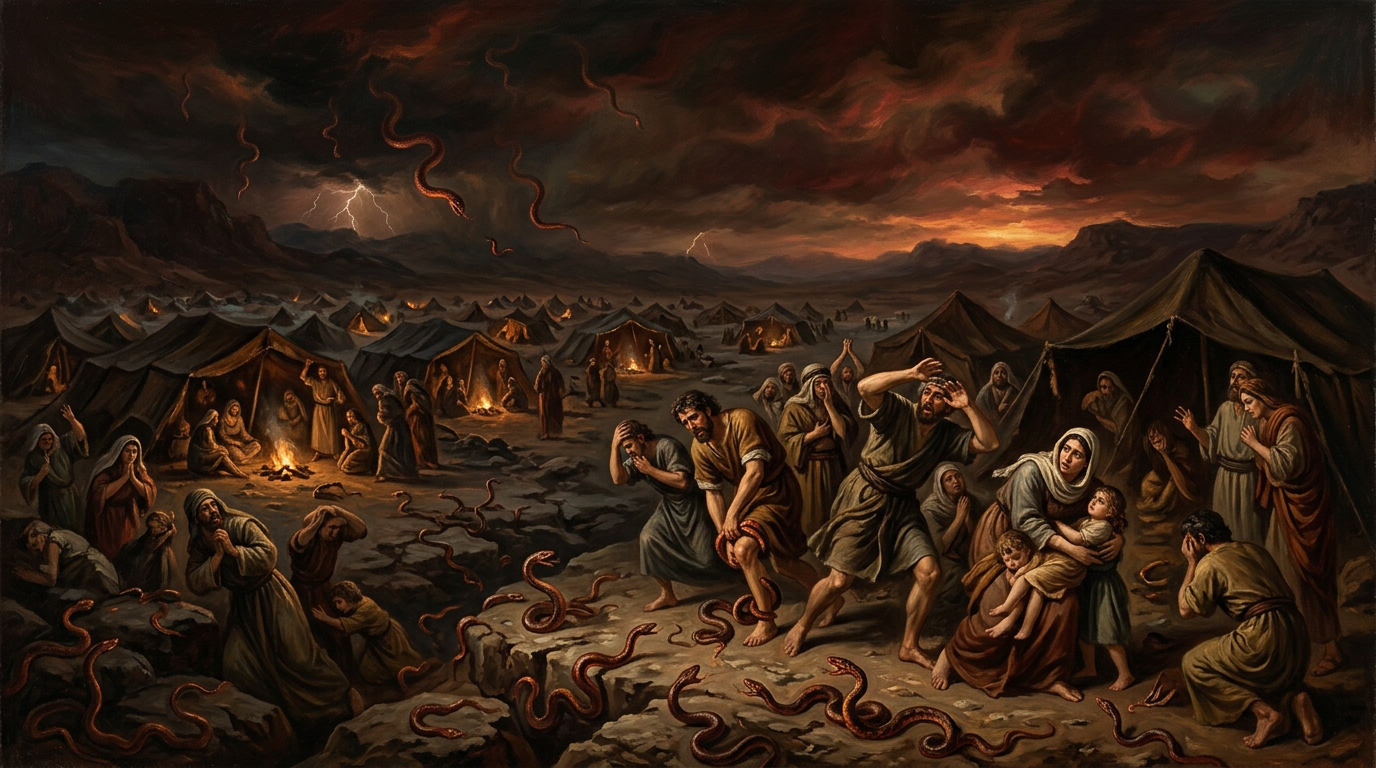
"So Yhwh sent poisonous snakes among the people, and they bit the people; many people of Israel died." (Numbers 21:6)
Jesus says: what father, if his son asks for a fish, gives him a snake? He is not inventing a hypothetical. He is describing what happened.
If Jesus is not referencing the Exodus here, what fish and what snake is He talking about?
The egg and the scorpion
Deuteronomy 8:15 describes the wilderness:
"…who brought you through the great, fearful desert of poisonous serpents and scorpions, an arid place with no water." (Deuteronomy 8:15)
Snakes and scorpions – both named, in that order. Jesus picks the exact same two animals, in the exact same order, and asks what kind of father would give those to a child who asked for food.
But notice what else He is saying. An egg is food. Simple, ordinary food – the kind you have when you are home and fed. A scorpion is what you find when someone has led you into a desert. The Hebrews were promised a land flowing with milk and honey. What they got was forty years of snakes and scorpions in the wilderness. Jesus is not only asking what father gives a scorpion instead of an egg. He is asking what father puts his children in that place to begin with. He already told them at the start of this discourse to pray: "Do not lead us into a time of testing." The prayer and the climax answer each other.
And Jesus connects these animals directly to the adversary. Just one chapter earlier, He tells His disciples: "I have given you authority to tread on serpents and scorpions, and over all the power of the enemy" (Luke 10:19). Serpents and scorpions are not random dangers – they are the weapons of "the enemy." The same enemy the prayer asks to be delivered from.
Jesus picks the exact two animals the Torah names as wilderness threats, in the exact same order – and one chapter earlier He calls them the weapons of "the enemy." What are the odds that is a coincidence?
What Jesus left unsaid
"If you then, although you are evil, know how to give good gifts to your children, how much more will the heavenly Father give the Holy Spirit [or good gifts] to those who ask him!" (Luke 11:13; cf. Matthew 7:11)
Even evil humans give good gifts to their children. So how much more will a good Father give? That is what the verse says on the surface. But Jesus has left something out – and it changes the entire meaning.
Think about what He just did. He asked: what father gives snakes to a child who asks for fish? What father gives scorpions to a child who asks for an egg? The audience knows the answer. Yhwh did that. Then Jesus says: even you – evil as you are – would not do that to your own kids.
And that word – "evil" – is not something Jesus invented for the occasion. It is Yhwh's own label for these people. After the flood, Yhwh declared:
"…the inclination of their minds is evil from childhood on." (Genesis 8:21)
That is Yhwh's settled verdict on the human race. Evil from childhood. Jesus picks up that exact label and turns it into an argument against the one who gave it. Even these people – the ones you called evil – know how to give good gifts to their children. They would never give a snake to a child who asked for fish. But you did.
Evil humans are better fathers than the one who sent the snakes. That is what Jesus is saying. He just never says it out loud. He does not need to. Everyone in the room can do the math.
And the word cuts even deeper. "Evil" is the same Greek root as "the evil one" – the being that the prayer in Matthew 6:13 asks to be delivered from. Yhwh calls humans evil. Jesus uses that same word for the being the prayer asks to be delivered from. The label Yhwh gave to the people, Jesus gives back to Yhwh.
So what does a good father give? Jesus answers: the heavenly Father gives the Holy Spirit – and good gifts – not snakes, not scorpions. Not manna with a test. Not bread followed by plague. Just good gifts, freely given, because that is what a real father does.
The full picture
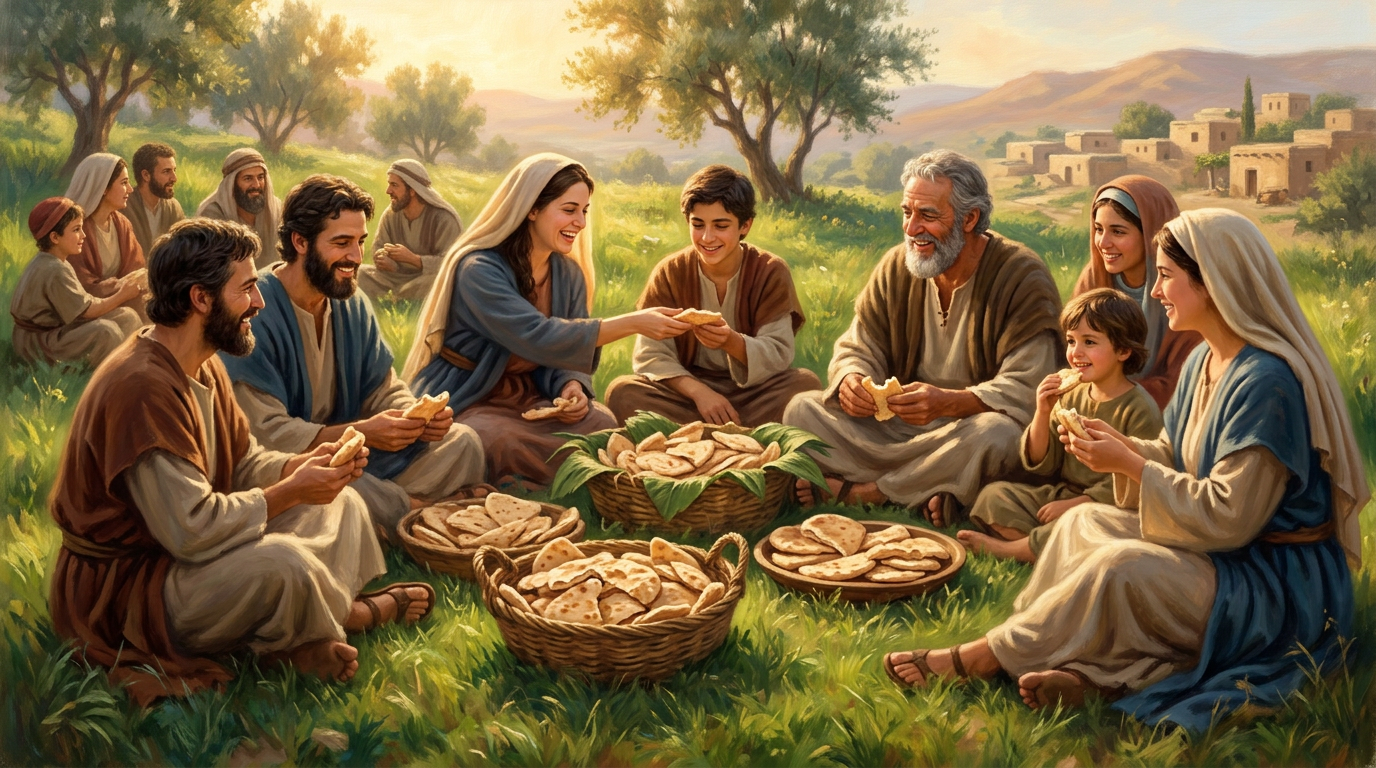
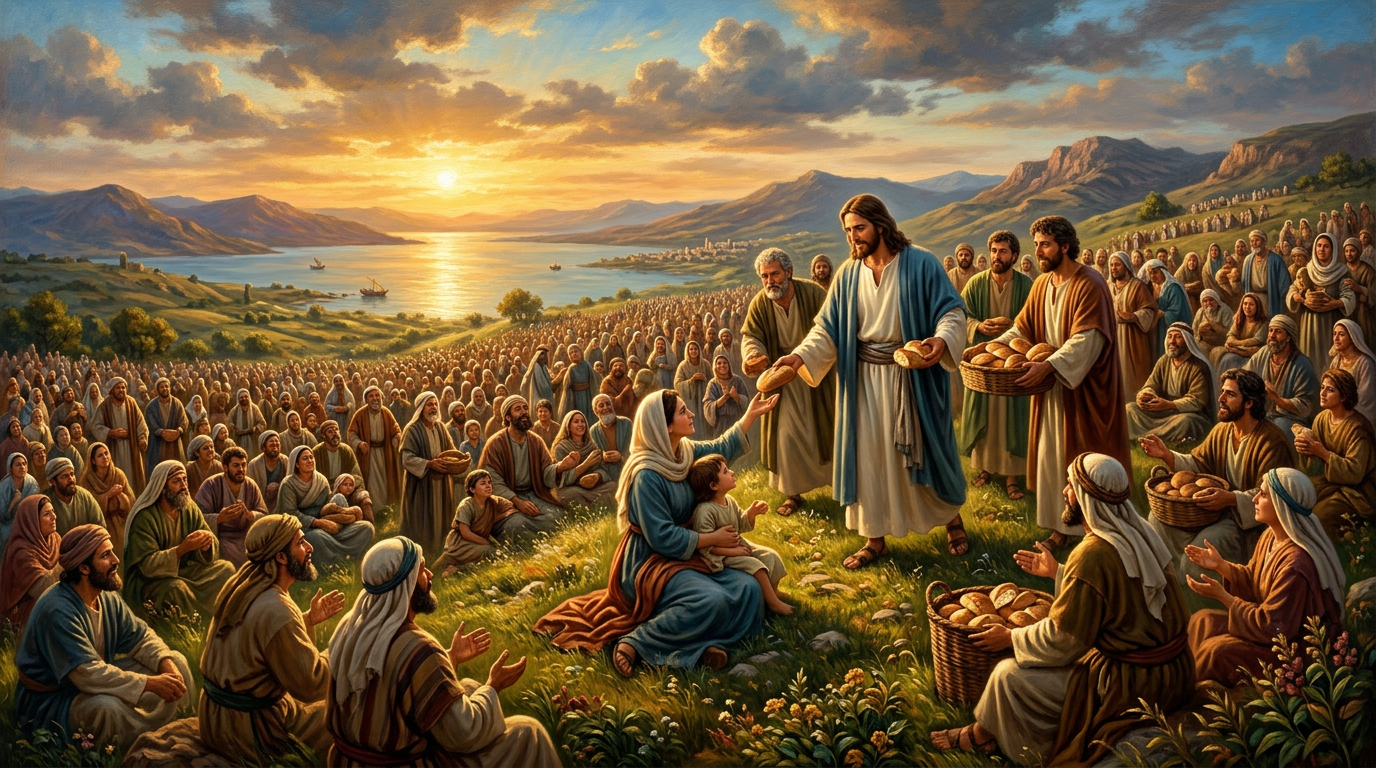
And Jesus does not just talk about it. He demonstrates it. When five thousand people are hungry in the wilderness, Jesus feeds them – and what does He give them? Bread and fish (Luke 9:16). The exact two things the Hebrews cried out for and never received.
The Hebrews begged for fish in Numbers 11:5 and never got it. They begged for bread and got manna with a compliance test attached. Jesus takes bread and fish and simply gives it to the crowd – no test, no conditions, no plague afterward. That is the difference between the two fathers in action.
That is the Good Father Discourse. Thirteen verses, one unbroken message, and every line of it references the Exodus.
The prayer is not devotion – it is liberation, a prayer to Abba for deliverance from Yhwh's system. The parable is not a lesson about praying harder – it is an Exodus retelling with a different ending that can only come from living in a different Kingdom. And the fish-versus-snake comparison is not a hypothetical – it is a direct citation of what Yhwh did to the people who asked him for food.
Jesus is not building on Yhwh's system – He is replacing it. In thirteen verses, He tells His disciples who to pray to and who to pray against.
Questions to sit with
If the Lord's Prayer is addressed to Yhwh, why does every line of it ask for something His system never provided?
Jesus chose fish, snakes, eggs, and scorpions – the exact items and animals from the Exodus wilderness, in the exact order. If He is not referencing the Torah, where did those choices come from?
Under Yhwh's system, persistence got people killed. Under Jesus' teaching, persistence gets bread. Can both systems come from the same father?
If "the evil one" in the prayer is not Yhwh, who else leads the Hebrews into a time of testing?
Jesus fed five thousand people bread and fish in the wilderness – the exact things the Hebrews begged for and never received. What was He showing them?