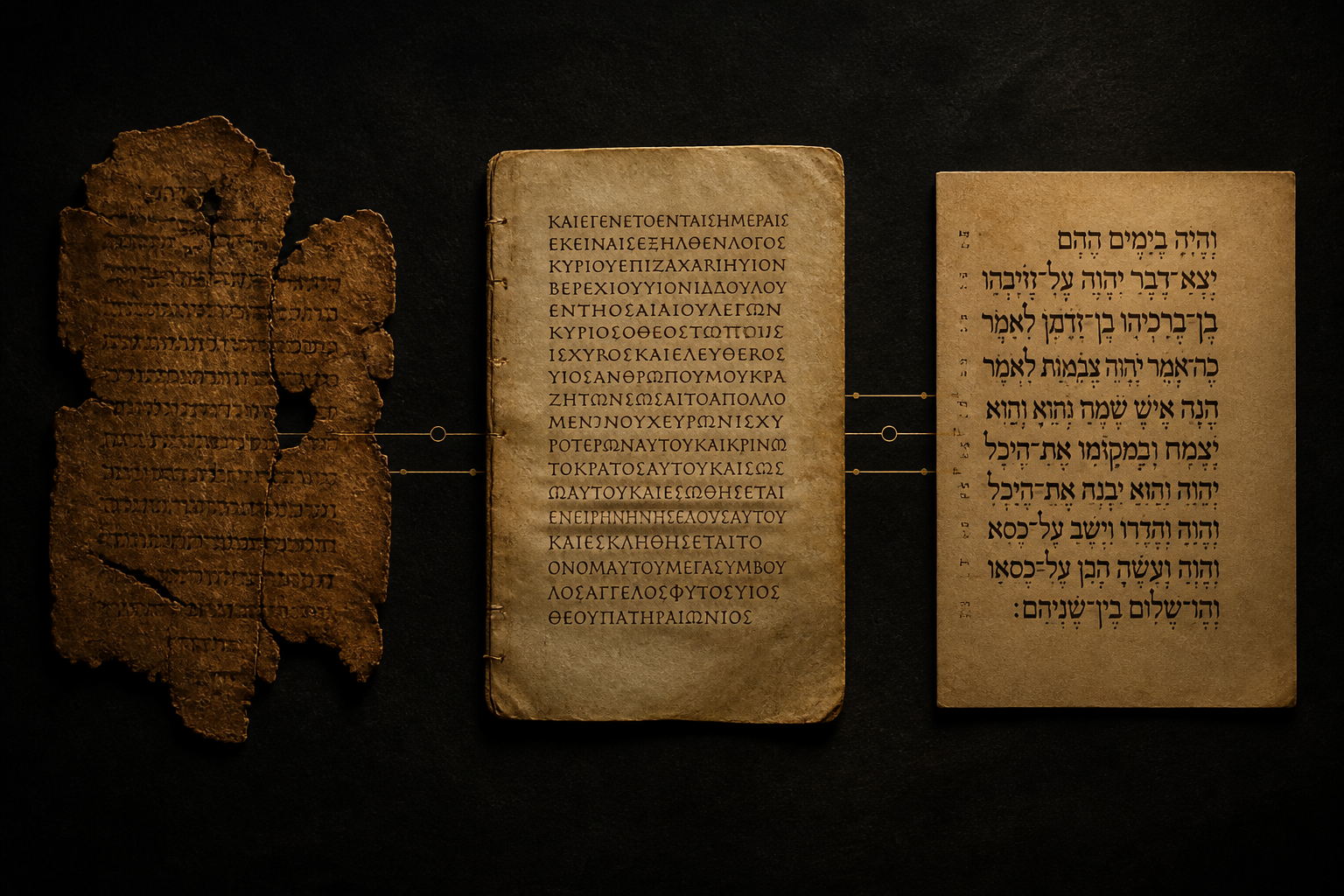
A footnote most people never read
Open a NET Bible – the New English Translation, one of the most footnoted study Bibles in English – and turn to Deuteronomy 32:8. The verse reads:
"When the Most High gave the nations their inheritance, when he divided up humankind, he set the boundaries of the peoples, according to the number of the heavenly assembly." (Deuteronomy 32:8, NET)
"Heavenly assembly." Hold onto that phrase. But the footnote at the bottom of the page says more. Here is what it says, word for word:
"Heb 'the sons of Israel.' The idea, perhaps, is that Israel was central to Yahweh's purposes and all other nations were arranged and distributed according to how they related to Israel… For the MT bene yisrael ('sons of Israel') a Qumran fragment has 'sons of God,' while the LXX reads angelon theou ('angels of God'), presupposing bene el or bene elim. 'Sons of God' is undoubtedly the original reading; the MT and LXX have each interpreted it differently."
– NET Bible, Translator's Note on Deuteronomy 32:8
If you have never studied ancient manuscripts, that footnote is full of abbreviations. MT. LXX. Qumran. Here is what all of it means in plain English.
Most English Bibles start from one Hebrew text. That text is called the Masoretic Text – MT for short (MAH-soh-RET-ik). It is named for the Masoretes (MAH-soh-reets), the Jewish scribes of roughly 600 to 1000 AD who added the vowel marks and fixed the wording. The oldest complete copy was made around 1000 AD. It is a good text. But it is not the only copy of the Hebrew Bible that survived, and at Deuteronomy 32:8 a growing number of Bibles have stopped following it.
In 1947, shepherds stumbled onto a set of caves near the Dead Sea in what is now Israel, at a place called Qumran (koom-RAHN). Inside were jars full of ancient scrolls – some of them a thousand years older than the oldest Hebrew Bible anyone had seen before. These are the Dead Sea Scrolls, often abbreviated DSS. They date from roughly 250 BC to 68 AD – before Jesus, during His lifetime, and shortly after. When the footnote says "a Qumran fragment," it means one of these scrolls.
And there is a third witness. Around 250 BC, Judean scholars in Alexandria, Egypt, translated the Hebrew Bible into Greek for Judeans who spoke Greek. That Greek translation is called the Septuagint (SEP-too-ah-jint), abbreviated LXX – the Roman numeral for seventy, after the roughly seventy scholars said to have done the work. When the footnote says the LXX "presupposes" a Hebrew reading, it means the Greek translators must have been looking at a Hebrew text that said that.
So you have three witnesses to Deuteronomy 32:8:
| Dead Sea Scrolls ~50 BC – 50 AD | Septuagint (Greek) Translated ~250 BC; earliest copies 1st century BC | Masoretic Text (Hebrew) Standardized after 70 AD |
|---|---|---|
| "according to the number of the sons of God" bene elohim (beh-NAY eh-loh-HEEM) | Early copies: "sons of God" huion theou (hwee-OHN theh-OO) Later copies: "angels of God" angelon theou (an-GEL-ohn theh-OO) | "according to the number of the sons of Israel" bene yisrael (beh-NAY yis-rah-EL) |
Two of those three point to divine beings – "sons of God," "angels of God." One points to a nation – "sons of Israel." And the NET's own translators looked at all three and concluded: "Sons of God" is undoubtedly the original.
That is not a fringe opinion from the internet. That is a conservative evangelical study Bible, in its own footnote, saying the older Hebrew was changed – and putting the older reading in the verse itself.
So what did the verse originally say? Why was it changed? And what happens to the rest of the Bible when you put the original words back?
Read the next verse. It matters.
"For Yhwh's allotment is his people, Jacob is his special possession." (Deuteronomy 32:9, NET)
Verse 8: the Most High – Elyon (el-YOHN) in Hebrew – divided humankind and gave each nation to a divine being. Verse 9: Yhwh received Israel as his allotment, his share.
One being divides. Another being receives. They are named differently. And someone changed the text to hide that.
The case, in plain English
1. The verse says this is old
The verse before it – Deuteronomy 32:7 – sets the stage:
"Remember the ancient days; bear in mind the years of past generations. Ask your father and he will inform you, your elders, and they will tell you." (Deuteronomy 32:7, NET)
Whatever comes next is not a new idea. It is something your father knew, and his father before him. The poem says: this was common knowledge.
2. What comes next is a hierarchy
Put the original wording back in verse 8, and read 7 through 9 together:
"Remember the ancient days; bear in mind the years of past generations. Ask your father and he will inform you, your elders, and they will tell you.
When the Most High gave the nations their inheritance, when he divided up humankind, he set the boundaries of the peoples, according to the number of the sons of God.
For Yhwh's allotment is his people, Jacob is his special possession." (Deuteronomy 32:7–9)
The Most High – Elyon – divided the nations among divine beings. Yhwh got Israel. One being is doing the dividing. The other is receiving an allotment. They are named differently – Elyon and Yhwh – and they are doing different things.
If that sounds strange, it is because nobody taught you the world this poem was written in. Here is the background in a few paragraphs.
The world Deuteronomy 32 lives in
The Hebrew word elohim names a class of beings. It can point to the Most High, and it can describe other divine persons. They are people in the broad sense – personal beings, but not humans. Genesis 1:26–27 says humanity was made in their image and likeness.
Psalm 82:1 places elohim in the assembly of El, with the Most High presiding over them. Other passages call them the "sons of Elohim" – bene elohim (beh-NAY eh-loh-HEEM) – a family of divine beings under the Most High, Elyon (el-YOHN).
Deuteronomy 32:7–9 places Yhwh in that family. The Most High distributes the nations, and Yhwh receives Jacob as his portion. Yhwh is one of the sons of the Most High – a member of the council, not the head of it. The hierarchy is already present before later readers merge the Most High and Yhwh into one being.
3. The Dead Sea Scrolls say "sons of God"
The Dead Sea Scroll that contains this verse is a fragment with the catalog name 4QDeut-j. "4Q" means it came from Cave 4 at Qumran. "Deut-j" means it was the tenth copy of Deuteronomy found there. It was copied somewhere between 50 BC and 50 AD. The Hebrew reads bene elohim – "sons of God" or "sons of the divine beings."
The Masoretic Text reads bene yisrael – "sons of Israel." That is the Hebrew the King James, NIV, NASB, and CSB still print at this verse. Other Bibles – ESV, NRSV, NET, NLT – print the Dead Sea Scrolls reading instead. One word was changed: elohim became yisrael. That is not a copyist's mistake. Those words look nothing alike in Hebrew.
4. The Greek translation confirms it
The Septuagint was translated from Hebrew around 250 BC – centuries before the Masoretic Text was standardized. It does not say "sons of Israel" either. Most surviving Greek copies say "angels of God." A few early copies say "sons of God" – the same thing the Dead Sea Scrolls say. One of them is a papyrus (a scroll made from reed paper) from the first century BC, cataloged as P. Fouad 266 and kept in Cairo.
"Angels of God" is already a softening – taking "sons of God" and replacing it with something less threatening. But even that softer Greek reading still points to divine beings, not to Israel.
5. The same thing happens again in the same chapter
Deuteronomy 32:43 – the closing verse of the poem – has the same problem. Here is what the Dead Sea Scrolls have:
"Rejoice, O heavens, with him, and bow down to him, all elohim, for he will avenge the blood of his sons…"
Divine beings are called to bow down. The Masoretic Text drops that whole line. It is not there. The King James, NIV, and NASB follow that shorter Hebrew, so the line is missing from those Bibles too. ESV and NRSV put it back from the Dead Sea Scrolls.
The Greek translation keeps the longer text, with both "sons of God" and "angels of God." And the New Testament book of Hebrews quotes it – Hebrews 1:6 says, "Let all the angels of God worship him!" That is a quote from Deuteronomy 32:43 – the line the Masoretic Text removed.
6. Two edits in one chapter, both removing the same thing
In verse 8, "sons of God" became "sons of Israel." In verse 43, "bow down to him, all elohim" was deleted entirely. Both edits remove divine beings from the poem. Both are in the same chapter. Michael Heiser, who wrote the article the NET Bible cites in its own footnote, put it this way: "Two accidents in the same chapter, both removing heavenly beings, strains credulity." In plain English: nobody believes that was an accident.
7. Scholars agree on why it was changed
Emanuel Tov, the editor of the official publication series for the Dead Sea Scrolls, called it "theological censorship." The scribes were uncomfortable with a verse that named multiple divine beings. So they changed it.
Jeffrey Tigay, who wrote the standard Jewish commentary on Deuteronomy, said the scribes "were probably concerned that readers not envisage [the divine beings] as having the power and authority that would encourage [Judeans] to worship them along with God."
Both of those scholars agree the original reading was "sons of God" and that the scribes changed it for theological reasons. Neither of them takes the next step – they still identify Yhwh and the Most High as the same being. Daniel McClellan does take that step. He writes that the earlier text "distinguishes the high deity from YHWH." But the textual finding does not depend on McClellan or on anyone's theology. Two different names, two different roles, one verse. The scribes saw that and changed it. Modern scholars see it and explain it away in the commentary instead.
8. Who the scribes were protecting
Read Tigay's sentence one more time. The scribes were "concerned that readers not envisage" – not picture – these beings for what they were.
You are the reader. That sentence is about you.
Someone decided, on your behalf, that there were things in the text you should not be allowed to see. Not because the words were unclear. Because the words were clear, and where they led was unacceptable. So the words were changed, and you were handed the changed version and told it was the Word of God, complete and unaltered.
If you have ever asked a question in church and been told "we don't go there," you already know what that feels like. If you have ever been told the doubts you had were a spiritual problem rather than a reading problem, you have met the same instinct. It is the instinct to manage what the reader is allowed to envisage. It is not new. It is at least two thousand years old, and it is written into the Hebrew text of Deuteronomy 32 in two places.
The good news is that the older reading survived anyway. It sat in a cave for two thousand years and came out in 1947. And it is in the footnote of a Bible you can buy today. Nobody can manage what you envisage anymore. You can read it for yourself.
9. Jesus read it the same way
In John 8, Jesus is arguing with the religious leaders in the temple. They tell Him, "We have only one Father, God himself" (John 8:41, NET). They mean Yhwh. Their god is the God, and there is no one above him.
Jesus does not agree. In John 8:54–55 He says:
"The one who glorifies me is my Father, about whom you people say, 'He is our God.' Yet you do not know him, but I know him." (John 8:54–55, NET)
They say their god is the Most High. Jesus says they do not know the Most High at all. They know Yhwh. They do not know His Father. That is Deuteronomy 32:8–9 again, in the temple, from Jesus' own mouth: the one they serve is not the one at the top.
And when Jesus quotes Psalm 82 in John 10:34 – "I said, you are gods" – He keeps the word gods. Not angels. Not judges. The same word the scribes had spent centuries trying to soften, Jesus used out loud in the temple. What Jesus said is gospel, everything else is commentary.
What the original says
When you put the original words back, Deuteronomy 32:7–9 says:
The Most High – the one the poem calls Elyon – divided the nations among His sons, the divine beings. Yhwh received one nation: Israel. Yhwh is not the one doing the dividing. He is one of the sons receiving an allotment.
And someone changed the text so you would not see that.
That's the case. What follows is the same argument with the full scholarly evidence underneath – manuscript details, charts, timelines, and the objections Christians raise, answered one by one.
The scholarly evidence
A note before this section How names and quotes work below
In the evidence below, you will see original-language words in italics with a pronunciation guide in parentheses on first use. Every Bible quotation is from the NET unless marked otherwise. Where the NET prints "the LORD" for the divine name, this study restores Yhwh (the four-letter Hebrew name, sometimes written Yahweh). Where the NET prints "God" in an Old Testament passage where the Hebrew reads Elohim, this study restores Elohim. This is not a change to the translation. It is putting back what the translation replaced, so you can see who the text is actually talking about.
The three manuscript families
Every surviving copy of Deuteronomy 32:8 falls into one of three families. Each family has a different reading for the same phrase at the end of the verse. Here they are, one family per row:
| Source | The wording | In English |
|---|---|---|
| Dead Sea Scrolls 4QDeut-j (4Q37) | bene elohim (beh-NAY eh-loh-HEEM) | "sons of God" |
| Greek, early copies P. Fouad 266, MS 106c | huion theou (hwee-OHN theh-OO) | "sons of God" |
| Greek, later copies | angelon theou (an-GEL-ohn theh-OO) | "angels of God" |
| Masoretic Text Still printed by KJV, NIV, NASB | bene yisrael (beh-NAY yis-rah-EL) | "sons of Israel" |
The Dead Sea Scrolls and the earliest Greek copies say the same thing: "sons of God." The majority of later Greek copies softened it to "angels of God." The Masoretic Text replaced it entirely with "sons of Israel."
The fragment 4QDeut-j was not a complete copy of Deuteronomy. It was a scroll of selected passages from Deuteronomy and Exodus, probably made for worship or study. Someone chose this passage as one worth copying on its own.
When the manuscripts were copied
| Date | Manuscript | What it reads at 32:8 |
|---|---|---|
| ~250 BC | Septuagint translated from Hebrew into Greek in Alexandria | Its Hebrew source had the divine reading. Greek translators either kept "sons of God" or softened to "angels of God." |
| 1st century BC | P. Fouad 266 (Greek papyrus, now in Cairo) | huion theou – "sons of God" |
| ~50 BC – 50 AD | 4QDeut-j (Dead Sea Scrolls, Cave 4) | bene elohim – "sons of God" |
| Before 68 AD | Hebrew copies of the type that later became the Masoretic Text are already in use | bene yisrael – "sons of Israel" (the change was made before the Masoretes; they inherited it) |
| After 70 AD | The Masoretic type becomes the only Hebrew tradition to survive | "Sons of Israel" becomes the standard |
| 4th century AD | Codex Vaticanus (oldest near-complete Greek Bible) | angelon theou – "angels of God" |
| 1008 AD | Leningrad Codex (oldest complete Hebrew Bible) | bene yisrael – "sons of Israel" |
The Song of Moses itself is older than all of these copies. Most scholars date the poem to the time of Israel's kings or earlier, because its Hebrew is old-fashioned even by Bible standards. What the timeline shows is not when the poem was written. It shows how the poem was copied, and changed, over time.
The three-step downgrade
The original Hebrew said "sons of God" – bene elohim. That reading survived in the Dead Sea Scrolls and in the earliest Greek copies. But as the centuries passed, two different groups of scribes softened it in two different ways:
Step 1 (the original): Hebrew bene elohim – "sons of God." This is what 4QDeut-j preserves. It is also what the earliest Greek copies reflect.
Step 2 (Greek softening): Most Greek scribes replaced "sons of God" with "angels of God" – angelon theou. Same idea (divine beings), less threatening vocabulary. John William Wevers, the scholar who produced the standard scholarly edition of the Greek Deuteronomy, said the majority Greek reading was "clearly a later attempt to avoid any notion of lesser deities in favor of God's messengers."
Step 3 (Hebrew replacement): A different group of Hebrew scribes took it further. They replaced elohim with yisrael, turning "sons of God" into "sons of Israel." This removed divine beings from the verse entirely.
Steps 2 and 3 happened independently. The Greek translators did not copy the Masoretic Text – they worked from an older Hebrew text that still had the divine reading. The Masoretic scribes did not copy the Greek – they worked in Hebrew. Two separate traditions, two separate strategies, both aimed at the same target: getting divine beings out of this verse.
The second edit – Deuteronomy 32:43
The same chapter has a second edit – and this one is harder to explain away, because the Masoretic Text does not just change a word. It deletes an entire line.
Here are the three readings of Deuteronomy 32:43, the closing verse of the Song of Moses:
| Dead Sea Scrolls (4QDeut-q) | Septuagint (LXX) | Masoretic Text |
|---|---|---|
| "Rejoice, O heavens, with him, and bow down to him, all elohim, for he will avenge the blood of his sons… and repay those who hate him, and make atonement for the land of his people." | "Rejoice, O heavens, with him, and let all the sons of God bow down to him. Rejoice, O nations, with his people, and let all the angels of God prevail for him. For he avenges the blood of his sons…" | "Cry out, O nations, with his people, [no bowing line] for he will avenge his servants' blood… and make atonement for his land and people." |
Three differences stand out:
- The Dead Sea Scrolls and the Greek both say "heavens." The Masoretic Text says "nations."
- The Dead Sea Scrolls say "bow down to him, all elohim." The Masoretic Text has no bowing line at all.
- The Dead Sea Scrolls and the Greek say "sons." The Masoretic Text says "servants."
The bowing line is the critical one. In the Dead Sea Scrolls, divine beings are commanded to bow. In the Masoretic Text, that command is gone.
Emanuel Tov called this deletion "an act of theological censorship when the phrase 'sons of God' was considered an unwanted polytheistic depiction of the world of the divine."
Hebrews 1:6 quotes the line that was removed
The New Testament book of Hebrews, chapter 1 verse 6, says:
"But when he again brings his firstborn into the world, he says, 'Let all the angels of God worship him!'" (Hebrews 1:6, NET)
That quote – "let all the angels of God worship him" – is Deuteronomy 32:43. Not the Masoretic Text, which has no bowing line. The longer text – the one the Dead Sea Scrolls and the Greek preserve.
The Greek wording in Hebrews 1:6 matches the Greek wording of Deuteronomy 32:43 in the Septuagint – the same verb for "bow down," the same phrase "angels of God." The author of Hebrews was copying the line, not paraphrasing it.
This means the author of Hebrews – writing in the first century – had a Bible that still contained the longer text. The Masoretic Text's deletion had not reached his Bible. He quoted what was there. And what was there is what the Dead Sea Scrolls also preserve.
One caution: Hebrews uses "angels," not "gods" or "sons of God." It is quoting the already-softened Greek, not the Hebrew of the Dead Sea Scrolls. But the point stands: the line the Masoretic Text deleted was still in the Bible the New Testament writers used.
Psalm 82 – the same council, still in your Bible
Deuteronomy 32:8–9 is not the only passage that describes this council. Psalm 82 does the same thing – and this one was never edited out. Two verses show the same structure.
"Elohim stands in the assembly of El; in the midst of the elohim he renders judgment." (Psalm 82:1, NET)
Two things are named in that one line. The assembly belongs to El – adat El (ah-DAHT EL), "the assembly of El." And it is full of elohim, plural – divine beings. A divine being stands up inside El's assembly and passes judgment on the other members. That is a council with an owner and members, the same shape as Deuteronomy 32:8.
"I thought, 'You are elohim; all of you are sons of Elyon.'" (Psalm 82:6, NET)
Now the members get a title: "sons of Elyon" – sons of the Most High. That is the exact title Deuteronomy 32:8 gives the beings who received the nations, and Elyon is the exact name of the one who handed the nations out. Yhwh received one of those nations. In the vocabulary of this psalm, he is one of the sons of Elyon.
The NET translators say the same thing about who Elyon is here. Their note on Psalm 82:6 reads:
"Normally in the OT the title Most High belongs to the God of Israel, but in this context, where the mythological overtones are so strong, it probably refers to the Canaanite high god El (see v. 1, as well as Isa 14:13)." – NET Bible, note on Psalm 82:6
And their note on Psalm 82:1 describes the scene as "Israel's God invades El's assembly." Read that slowly. The translators of a mainstream evangelical Bible have two beings on the page: El, who owns the assembly and whose sons these are, and Yhwh, who walks into it. Their way out is the word "Canaanite" – El is somebody else's god, and the psalm is an attack on him. But the El of Psalm 82 is the El of Deuteronomy 32:8, the one who gave Yhwh his nation. And El Elyon is the name Melchizedek uses to bless Abraham in Genesis 14:19, generations before there is an Israel for him to be foreign to. The NET has the right beings in the right places. It just cannot let the Most High be the Most High.
So who is being judged, and for what? The psalm says. In Psalm 82:2 the charge is read out: "How long will you make unjust legal decisions and show favoritism to the wicked?" In 82:3–4 the remedy is read out: "Defend the cause of the poor and the fatherless. Vindicate the oppressed and suffering. Rescue the poor and needy. Deliver them from the power of the wicked." And in 82:7 the sentence: "Yet you will die like mortals." Yhwh is one of the sons of Elyon, so Yhwh is one of the accused. The charge fits his record – a legal system that favored the powerful and a god who did not step in for the people under it. The remedy is a description of what Jesus spent three years doing. And the sentence settles the old argument about whether these are human judges: you cannot threaten a human with dying like a human. That threat only means something to a being who was not supposed to die.
Later Jewish readers tried to make the elohim of Psalm 82 human judges anyway. Jesus did not. When He quotes Psalm 82:6 in John 10:34 – "Is it not written in your law, 'I said, you are gods'?" – He uses the Greek word theoi (theh-OY), "gods." Not "angels." Not "judges." Gods. Jesus refused the downgrade.
John 8:54 – Jesus pulls the two apart again
Deuteronomy 32:7–9 describes two beings: the Most High, who owns everything, and Yhwh, who received Israel. The scribes collapsed them into one. Jesus pulled them apart again, in the temple, in front of the people who served Yhwh.
In John 8:41 the religious leaders make their claim: "We have only one Father, God himself." They are saying their god, Yhwh, is the God. There is no one above him. That is the Masoretic reading of Deuteronomy 32:8 spoken out loud.
Jesus answers it directly:
"The one who glorifies me is my Father, about whom you people say, 'He is our God.' Yet you do not know him, but I know him." (John 8:54–55, NET)
Look at what Jesus does with their claim. They say their god is the God. Jesus does not confirm it. He says they do not know His Father at all. They know the god they serve. They do not know the one Jesus came from. Two beings, and the people in the temple know only one of them.
That is exactly the distinction the scribes of Deuteronomy 32:8 erased. The poem said the Most High is one being and Yhwh is another; the scribes wrote "sons of Israel" so nobody would read it that way. Jesus, standing in the temple built to Yhwh, put the distinction back: my Father is the one you claim as your god, and you do not know Him.
The scribes were commentary. The Masoretic Text is commentary. What Jesus said is gospel, everything else is commentary.
Why the Trinity keeps you from seeing it
The Trinity replaces the divine-council hierarchy with "one God in three persons." It merges the Most High, Yhwh, Jesus, and the Holy Spirit into one being. The remaining council members are then reduced to angels, human judges, or figures of speech. Once that framework is in place, every distinction between Jesus' Father and Yhwh has to be moved back inside one being.
The finished formula does not appear in the Bible. Its development can be dated:
- Around 200 AD – Tertullian, a Christian writer from Carthage, is the first surviving author to use the Latin word trinitas, "Trinity." Every New Testament book had already been written.
- 325 AD – the Council of Nicaea, called by the Roman emperor Constantine. Arius, a priest in Alexandria who taught that the Son had a beginning and was subordinate to the Father, was condemned. The bishops declared the Son "of the same essence" (homoousios, hoh-moh-OO-see-oss) as the Father. Constantine enforced the decision by exiling Arius and bishops who refused to accept it.
- 381 AD – the Council of Constantinople, where the creed called the Holy Spirit "the Lord and giver of life," worshiped and glorified with the Father and the Son. Basil of Caesarea, Gregory of Nazianzus, and Gregory of Nyssa – three fourth-century theologians from Cappadocia – helped develop the language used for that formula.
The councils used technical Greek categories such as "essence" and "substance" to explain how the Father, Son, and Holy Spirit could be one being. Jesus does not describe His Father that way. Jesus says who sent Him, whose commands He obeys, whose work He completes, and whose character He shows.
The doctrine of three co-equal persons in one essence took roughly 350 years after Jesus to reach its finished form. Every biblical author wrote before that formula existed. Deuteronomy 32:7–9 and John 20:17 should be read on their own terms before a later creed decides how many beings those passages are allowed to name.
That is why the manuscripts matter so much. As long as the Trinity is in place, Deuteronomy 32:8–9 has to mean Yhwh dividing the nations to himself, and John 8:54 has to mean Jesus talking about the god the Pharisees already knew. Take it away, and both passages say what they plainly say.
The pattern across the Old Testament
Deuteronomy 32 is not the only place this happened. The same pattern – divine beings softened to "angels" or removed entirely – appears across the Old Testament:
| Passage | Older / harder reading | Softer reading | What happened |
|---|---|---|---|
| Deuteronomy 32:8 | "sons of God" (DSS) | "sons of Israel" (MT) | Hebrew word changed |
| Deuteronomy 32:8 | "sons of God" (DSS) | "angels of God" (majority LXX) | Greek interpretive softening |
| Deuteronomy 32:43 | "bow down, all elohim" (DSS) | Line deleted (MT) | Hebrew line removed |
| Job 1:6, 2:1 | "sons of the elohim" (Hebrew) | "angels of God" (LXX) | Greek softening |
| Job 38:7 | "sons of elohim" (Hebrew) | "my angels" (LXX) | Greek softening |
| Psalm 8:5 | "a little lower than elohim" (Hebrew) | "a little lower than the angels" (LXX / Hebrews 2:7) | Greek softening, quoted in the New Testament |
| Psalm 82:1, 6 | "elohim" / "sons of Elyon" | "human judges" (later rabbinic reading) | Interpretive, not a text change |
The pattern runs in one direction: divine beings are made less divine, or removed entirely. The Hebrew text itself was rewritten in Deuteronomy 32:8. The Greek softened "sons of God" to "angels" in Job 1:6, Job 2:1, Job 38:7, and Psalm 8:5. The Greek did keep "sons of God" in a few places – Genesis 6:2 and Psalm 89:6 – and in Genesis 6:2 some later Greek manuscripts replaced even that with "angels." Not every verse was touched. But every verse that was touched was changed in the same direction.
What the scholars say, in their own words
Michael Heiser (HY-zer), who wrote the 2001 article in Bibliotheca Sacra that the NET Bible cites in its own footnote:
"It is far more likely that both texts were intentionally altered in the Masoretic text for the same reason, namely, to eliminate a reference to heavenly beings in order to avoid allegedly polytheistic language. It is inconceivable that a scribe would have done the reverse, that is, altering an innocuous [bene yisrael] to a potentially explosive [bene elohim]."
Emanuel Tov, professor emeritus at the Hebrew University of Jerusalem and editor of the Dead Sea Scrolls publication series, writing in his standard textbook Textual Criticism of the Hebrew Bible (3rd edition, 2012):
"The scribe of an early text, now reflected in [the Masoretic Text], did not feel at ease with this polytheistic picture and replaced 'sons of El' with 'the sons of Israel,' thus giving the text a different direction by the change of a single word."
On verse 43, same book:
"[The line] was probably deleted in [the Masoretic Text] in an act of theological censorship when the phrase 'sons of God' was considered an unwanted polytheistic depiction of the world of the divine."
And in a 2023 article on TheTorah.com, Tov added:
"[The Masoretic Text] reflects a conscious intervention in the text by a scribe uncomfortable with the polytheistic picture of divine beings, and thus, that scribe de-mythologized the original polytheistic description by replacing the word 'god' with 'Israel.'"
Jeffrey Tigay, who wrote the standard Jewish commentary on Deuteronomy for the Jewish Publication Society Torah Commentary series (1996):
"[The scribes] were probably concerned that readers not envisage [the divine beings] as having the power and authority that would encourage [Judeans] to worship them along with God."
Tigay adds that the "sons of the divine" reading "obviates several problems" – removes several problems – raised by the Masoretic reading, including the fact that Israel did not exist at the time of the division described in the poem. If the nations were divided "according to the number of the sons of Israel," that makes no sense – the poem is describing a time before Israel was a nation.
The objections, answered
What about "The Masoretic Text is the reliable one. The Dead Sea Scrolls could be a sectarian text."
The Masoretic Text is a careful and well-preserved tradition, and it is the basis for most modern Bible translations. But "well-preserved" and "unchanged" are not the same thing. The Masoretic family preserves one stream of the text. The Dead Sea Scrolls preserve other streams – some matching the Masoretic, some matching the Septuagint, some matching neither. Emanuel Tov spent his career cataloging these differences.
At Deuteronomy 32:8, the Dead Sea Scrolls and the Septuagint agree against the Masoretic Text. Two independent witnesses, in two different languages, both saying the same thing. The NET Bible's own translators looked at all three and concluded: "Sons of God" is "undoubtedly the original."
One more witness should be named, because a critic will name it otherwise. The Samaritan Pentateuch – the Hebrew text kept by the Samaritan community – reads "sons of Israel" here, agreeing with the Masoretic Text. So the manuscripts split two against two. But textual scholars do not count manuscripts. They ask which reading explains the other. A scribe who found "sons of Israel" had no reason to change it to "sons of God" – Heiser calls that "inconceivable." A scribe who found "sons of God" had every reason to change it. And "sons of Israel" fails inside the poem itself: Tigay points out that Israel did not exist yet at the moment the poem describes. The reading that makes sense of the text, and explains how the other one arose, is the original. Every scholar quoted above knew about the Samaritan text when they said so.
What about "Elyon is just a title for Yhwh. Genesis 14:22 says 'Yhwh, El Elyon.'"
This is the strongest objection. In the Masoretic Text, Abraham swears "to Yhwh, El Elyon, Creator of heaven and earth" (Genesis 14:22). If Yhwh is El Elyon, then Deuteronomy 32:8–9 is one being described two ways.
Now read the same verse in the Septuagint. The Greek says Abraham swears "to the God, the Most High, who created heaven and earth." The name Yhwh is not there. The Greek translators were working from a Hebrew text that did not have it. Someone added "Yhwh" to Genesis 14:22 in the Hebrew, in front of a title that had belonged to Melchizedek's god – the priest of Salem who blesses Abraham in the name of El Elyon four verses earlier, and never says the name Yhwh.
So the one verse in the Torah that joins Yhwh to Elyon is a verse where the name Yhwh was added later. It is the same kind of edit as Deuteronomy 32:8, made for the same reason, in the same direction: take two beings and make them one.
Yes, later texts do use Elyon as one of Yhwh's titles – Psalm 47:2, for example. Nobody disputes that the two were eventually merged. The question is which came first: the two names apart, or the two names together. Deuteronomy 32:8–9, Psalm 82, and the Greek of Genesis 14:22 all keep them apart – and those are the texts with the oldest support: old Hebrew, Dead Sea Scroll backing, early Greek. Where the names are joined, as in the Hebrew of Genesis 14:22, the joining can be shown to be a later addition. That is not a coincidence. That is the direction the editing ran.
What about "Even with 'sons of God,' Yhwh is still the Most High. Deuteronomy 4:19 says Yhwh assigned the nations."
Deuteronomy 4:19 does put Yhwh in the position of distributing the heavenly host to the nations. But as Daniel McClellan writes, 4:19 "is likely the later of the two texts, and it reinterprets Deuteronomy 32:8–9." In 32:8–9, the being who divides is called Elyon. The being who receives a portion is called Yhwh. They are named differently. Deuteronomy 4:19 collapses that distinction.
This is not unusual. Books of the Bible were written, edited, and updated over centuries. Later editors often reinterpreted earlier passages to match their theology. What Deuteronomy 4:19 shows is that someone inside the biblical tradition already saw the hierarchy in 32:8–9 and felt the need to flatten it.
What about "'Sons of God' just means angels. This doesn't change anything."
The Hebrew is bene elohim – "sons of elohim." Elohim is a category word in Hebrew. It can mean gods, divine beings, or the supernatural in general. "Angels" is one interpretation of that word, not a translation of it. The Septuagint's majority reading – "angels of God" – is already an interpretation, and Wevers, the editor of the critical Greek text, called it "a later attempt to avoid any notion of lesser deities." The Dead Sea Scrolls do not say "angels." They say elohim.
The real question is not what to call these beings. It is why the verse says Elyon divided the nations among them and Yhwh received one. Even if you call them angels, the structure is the same: one being divides, and Yhwh is on the receiving end.
What about "Deuteronomy 32:39 says 'there is no god with me.' The same poem says Yhwh is the only God."
Verse 39 does say that. But verse 39 is Yhwh speaking about himself – and a subordinate claiming to be the highest authority is not new information. The manuscript evidence shows that verse 8, which names a being above Yhwh, was old enough and threatening enough that scribes rewrote it. Verse 39, which puts Yhwh on top, was left untouched. The verse that supports the hierarchy was changed. The verse that denies it was not. That tells you which one the scribes considered dangerous.
What the text forces you to decide
This study has shown you what the manuscripts say – and what they say has a theological consequence.
The Dead Sea Scrolls – a thousand years older than the complete Hebrew Bible most translations start from – read "sons of God" at Deuteronomy 32:8. The oldest Greek copies agree. The Masoretic Hebrew was changed. Scholars who disagree on almost everything else agree on this. The NET Bible, a conservative evangelical translation, agrees. It prints the older reading in the verse, and its footnote says: "Sons of God" is undoubtedly the original reading.
The same chapter, verse 43, had a line commanding divine beings to bow – and that line was deleted from the Hebrew. The New Testament book of Hebrews still quotes it, because the Bible the first Christians used still had it.
When you put the original words back, Deuteronomy 32:7–9 describes a hierarchy: the Most High divided the nations among His sons. Yhwh received one nation – Israel. The Most High is named separately from Yhwh, does a different job, and sits above him. Yhwh is not doing the dividing. He is one of the sons receiving an allotment.
The reason to change that text is obvious. If Yhwh is a son of the Most High – one among many – then he is not the Most High himself. That is what the verse says. That is what the scribes removed. Not once, but twice in the same chapter, both times deleting divine beings from the text. Scholars who agree the older reading is "sons of God" but still say Yhwh is the Most High are saying it because their theology requires it, not because the text does.
It said "sons of God." And someone changed it.