The one verse they always explain away
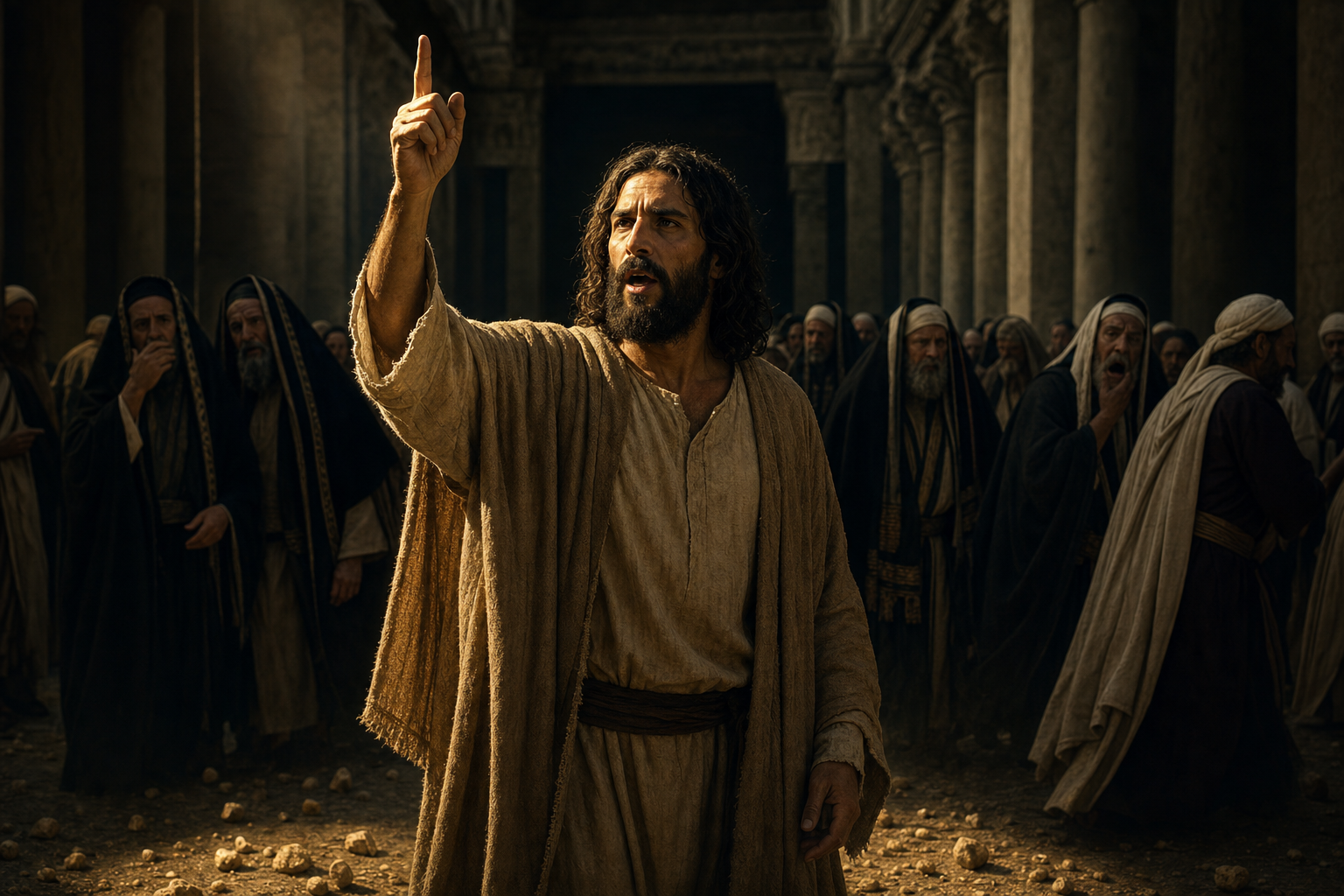
Jesus is standing in the Temple, surrounded by deeply religious men, and He says something that has been softened, sidestepped, and explained away for almost two thousand years:
"You people are from your father the devil, and you want to do what your father desires. He was a murderer from the beginning, and does not uphold the truth, because there is no truth in him. Whenever he lies, he speaks according to his own nature, because he is a liar and the father of lies." (John 8:44, NET)
Who is that? Who is "your father the devil"? Ask any Christian and they'll say Satan – a fallen angel, our spiritual enemy. But these men don't serve Satan. They have no altar to Satan, no law from Satan, no relationship with Satan. They serve one god, and one god only. They keep his law to the letter. They run his Temple. They're standing in his Temple right now.
So why doesn't anyone ask the obvious question: if Jesus identifies fathers by what their children do – and He does, right here in this chapter – then whose work are these men actually doing when they try to kill Him for telling the truth?
Notice what Jesus does. He never says a name. If this is just Satan – a being everyone already agrees is evil – why not say his name? Why describe instead of naming?
Instead, He gives a description and lets the men's own behavior point the finger. That's not an insult thrown in anger – it's a conclusion at the end of a trial, and by the time He says it, He's already laid out every piece of evidence.
What follows is the case – first as an overview, then with the full evidence underneath each point.
The case, in plain terms
I read this verse for years the way you probably do – these men had turned their backs on God and followed the devil. That's how everyone taught it to me. But the more I studied the full conversation, the more I saw that's not what Jesus is saying. He's not accusing them of abandoning their god. He's telling them their god is the problem.
1. Jesus reads people by their fruit, not their name
"Make a tree good and its fruit will be good, or make a tree bad and its fruit will be bad, for a tree is known by its fruit." (Matthew 12:33, NET)
This is the rule Jesus gave. He doesn't identify people by the label they wear or the name they claim. He identifies them by what they produce. And He uses that exact test in John 8.
The crowd says, "Abraham is our father." Jesus doesn't argue about their family tree. He says: then act like Abraham. A real child of Abraham would do what Abraham did. These men are trying to kill Him – Abraham never did that. Same bloodline, wrong behavior, claim denied. Your real father shows up in what you do, not in what you say.
So we never have to find a name in verse 44. We just watch what these men do, and ask who they're really serving.
2. Follow the works, and you land on Yhwh
Watch Jesus rule the fathers out one at a time. Not Abraham – they don't act like him. Not the Most High either – if the Most High were their Father they'd love the one He sent, and instead they want Him dead.
These men are about to kill a man for telling the truth. They're doing it under a law that commands death for blasphemy. They're standing in Yhwh's Temple. They worship one god with everything they have. Every one of those things belongs to Yhwh – his law, his Temple, his name. Follow the work in their hands back to its master and you don't land on some shadowy "Satan" they've never met. You land on Yhwh, the god they serve. That's the father Jesus is about to describe.
Whose work are these men doing when they try to kill the man who told them the truth? Answer that, and you already know who "your father" in verse 44 has to be.
3. The description points straight back to Genesis
Now the verse itself. Jesus says this father "was a murderer from the beginning" and is "a liar and the father of lies." Two charges – murder and lying – and a time stamp: "from the beginning." In the Bible, "the beginning" has an address. It's Genesis. So that's where we go to check the description against the record.
4. The garden: who actually lied, and who actually killed
In the garden, Yhwh tells the man: the day you eat from that tree, you'll die. They eat. Do they die that day? No. Adam goes on to live 930 years. The one prediction in the garden that didn't come true came out of Yhwh's mouth.
The nachash – the word usually translated "serpent" – tells the woman they won't die, and that their eyes will be opened. Both things happen. And a few verses later Yhwh himself says, "the man has become like one of us, knowing good and evil" – confirming exactly what the nachash had said. So if you go looking for the liar in the garden by their fruit, the liar is Yhwh.
And the murder? After all this, the man could still reach the tree of life and live. Yhwh blocks it – drives him out and posts a guard so he can't get back. Death enters the human story at the moment Yhwh cuts people off from life. That's a killer "from the beginning," exactly where Jesus pointed.
If the only liar in the garden is Yhwh, and the only thing that turned the threat into real death was Yhwh's own control over the tree of life – who is Jesus describing when He says "a murderer from the beginning"?
5. The liar with a throne
Jesus says lying is this being's native language. Does the Bible actually show Yhwh sending out lies? Plainly. In 1 Kings 22, a prophet describes Yhwh on his throne asking who will deceive a king into marching to his death. A spirit volunteers to be "a lying spirit" in the mouths of the prophets, and Yhwh sends it out: go and do it. The lie has a sender, and the sender is Yhwh.
6. A word you can't rely on
Jesus also says "there is no truth in him" – meaning his word doesn't hold. In 1 Samuel 15, Yhwh says he regrets making Saul king. A few verses later, the text says Yhwh doesn't change his mind. Then at the end of the same chapter, it says he regretted it again. That's one chapter. The same Bible contains verses saying Yhwh "cannot lie" and verses showing him commissioning lies.
7. Two gods, said out loud
Right after verse 44, Jesus picks up something these men said earlier. Back in verse 41, they claimed "We have one Father – God" – meaning their god and Jesus' Father are the same being. In verse 54, Jesus quotes that claim back to them: my Father, about whom you say "He is our god" – you don't know Him. But they know Yhwh perfectly. If Jesus' Father were Yhwh, they'd know the Father best of all. They don't. The conflation is false – His Father and the god they serve are two different beings.
This isn't a new idea, and it's not Marcionism or Gnosticism – two frameworks not subscribed to here. The older layer of the Bible already says there's a Most High above Yhwh, who handed Yhwh the nation of Jacob as his share. Yhwh is a son of the Most High – not the Most High Himself, even if he later claims that title as his own. (We'll show you the passage, and why it matters, further down.)
8. Then the crowd proves it
How does the conversation end? The men pick up stones to kill the one who told them the truth. That's the description acting itself out, live, right there – a murderer's children, doing the murderer's work, against the one man telling them the truth.
The case in one line
Jesus identifies fathers by what they do. Everything these men do serves Yhwh. The description – murderer and liar from the beginning – fits Yhwh by the Bible's own record. And the crowd proves it by reaching for stones. One explanation covers all of it: the god they serve is not the Father Jesus came to reveal.
That's the case. What follows is the same argument with the evidence underneath – the Greek, the Hebrew, the oldest manuscripts, and every objection answered.
The full evidence
A note on how this part reads Scholarly, but built to be understood
This is the in-depth version, so the evidence is laid out in full. But "scholarly" here doesn't mean hard to read. Every time we lean on a Greek or Hebrew word, we'll tell you plainly what it means and why it matters – and only when it actually changes something.
Bible quotations are from the NET (New English Translation), with one habit you should know about: we put the original-language word for the divine back in, so you can see who the text actually names. In Old Testament (Hebrew) quotes, where the NET prints "the LORD" we write Yhwh (yah-WEH, the personal name behind that title), and where it prints "God" we write Elohim (eh-loh-HEEM, the plain Hebrew word for a divine being). In New Testament (Greek) quotes, we keep the Greek word theos (THEH-os, "god") as theos. And we use Abba (AH-bah, Aramaic for "Father") for the Most High – the Father Jesus came to reveal. Once you see them as two separate beings, the rest of the chapter makes sense.
The trial: proving who their father is
Start with who these people are. They aren't pagans. John says plainly that some of them had "believed him" (8:31). These are devout men – they keep the law, they run the Temple, they worship Yhwh with everything they have. That's the whole point. The man Jesus ends up calling a child of the devil is the most devout person there.
Father number one: Abraham – ruled out by fruit
They lead with their pedigree: "Abraham is our father." Jesus doesn't dispute the bloodline. He applies the fruit test:
"If you are Abraham's children, you would be doing the deeds of Abraham. But now you are trying to kill me, a man who has told you the truth I heard from theos. Abraham did not do this!" (John 8:39–40, NET)
They claim Abraham, but they don't act like Abraham. Abraham met the priest of the Most High, honored him without question, and blessed him with gifts. These men are trying to kill the one sent by the Most High. Father number one is ruled out – not by ancestry, but by behavior.
Father number two: theos himself – ruled out by fruit
So they climb higher. "We have one Father, theos himself" (8:41). Now they're claiming the highest paternity there is: the Most High is our Father. Jesus runs the same test:
"If theos were your Father, you would love me, for I have come from theos and am now here." (John 8:42, NET)
Same test, same result. If the Most High were really their Father, they'd recognize and love the one He sent. They don't. They want Him dead. Father number two is ruled out.
Across the whole conversation Jesus runs five of these tests. Every one comes back negative:
All five tests are looking for one thing: the family likeness of the Most High, Abba, the true Father. Every result comes back negative. Not because these men are bad at religion – they're excellent at it – but because the family they actually belong to is a different family.
So follow the fruit to the father who's left
Here's the part other interpretations do not take into account. If their father isn't Abraham, and isn't the Most High, then whose work are they doing?
| The clue | What it is | Whose it is |
|---|---|---|
| The work in their hands | Trying to kill the man who told them the truth (8:40) | A killer's work |
| The rule they enforce | Death for "blasphemy," Leviticus 24:16 | Yhwh's law |
| The current location | The Temple, where this all happens | Yhwh's courts |
| The worship on their lips | "We have one Father, theos himself" (8:41) | Yhwh |
| The father, by their fruit | The one all of it serves and obeys | Yhwh |
Every clue points the same direction. These men aren't acting on their own, and they aren't serving some shadowy "Satan" they've never met. They're loyal, obedient, law-keeping servants of Yhwh, and the work in their hands right now – killing the man who told them the truth – is being done in his name, by his rule, in his Temple. Run the fruit test honestly and it lands on Yhwh. That's the father Jesus is about to describe.
And look at the word Jesus uses: "you want to do what your father desires." The Greek is epithumias (ep-ih-thoo-MEE-as) – desires, appetites. What does this father desire? Death for blasphemers. That's Leviticus 24:16 – Yhwh's law, Yhwh's command. These men aren't inventing the impulse to kill Jesus. They're obeying a standing order. The "desire" of the father is already written down, and they're carrying it out.
What about "Their father is Satan – a being separate from God"
This is a common reading, and notice what it's built on: that fatherhood is proven by what you do and whom you serve. The big commentators say so outright. D.A. Carson, the evangelical New Testament scholar, says their spiritual paternity is "determined by their actions, desires, and hatred for the truth." John Calvin, the Reformation theologian, says the devil "is said to be the father of those whose understandings he blinds." They all agree: follow the works to the master.
So apply that test. These men don't serve Satan. They have no relationship with Satan, no altar to Satan, no law from Satan. They serve Yhwh, enforce Yhwh's law, and run Yhwh's Temple. Follow the works to the real master and you don't land on some abstract Satan they've never met – you land on Yhwh. Carson and Calvin built the test. We're applying it where the fruit actually points.
The description, and who fits it
"You people are from your father the devil, and you want to do what your father desires. He was a murderer from the beginning, and does not uphold the truth, because there is no truth in him. Whenever he lies, he speaks according to his own nature, because he is a liar and the father of lies." (John 8:44, NET)
You've already read it, but now slow down on the details. Three things to notice before we test it against anyone.
- It's a description, not a name. Jesus says what this father does, not what he's called. That's the fruit test again – the same method He used on Abraham. So we identify the father the way Jesus set the whole chapter up to identify him: by what he does.
- The Greek word for "murderer" is specific. It's anthropoktonos (an-THROW-pok-ton-os) – literally a "human-killer," a killer of people. Not a soldier, not an accident. A killer of human beings.
- The word "devil" is a job description, not a name. The Greek is diabolos (dee-AH-bol-os) – it means "the accuser" or "the slanderer." It's the same word the Septuagint uses to translate the Hebrew ha-satan (hah-sah-TAHN, "the adversary") Jesus isn't naming a separate being the crowd has never met. He's describing a function they know well: the one who accuses, slanders, and prosecutes. That function belongs to Yhwh. (We trace this function across the Temptation in Two Tests, One Tester.)
- "From the beginning" sends us somewhere specific. The Greek is ap' archēs (ap ar-KAYS) – literally "from the genesis." Not a vague "long ago." It's pointing to a place: the opening of the story. That's why this study is called what it's called. A killer and a liar "from the genesis" points us straight back to the opening pages. So let's go read them.
The apologists agree on this last point, by the way – they also send you back to Genesis, to the garden. Good. We accept the invitation. Let's read the garden and see who actually killed and who actually lied.
The murder from the beginning
The very first death in the Bible has a backstory, and it starts with a threat. Yhwh tells the man not to eat from one tree, and attaches a warning:
"…but you must not eat from the tree of the knowledge of good and evil, for when you eat from it you will surely die." (Genesis 2:17, NET)
The Hebrew is sharper than most translations let on. It literally reads "in the day (beyom, beh-YOHM) you eat of it, dying you shall die (mot tamut, MOHT tah-MOOT)." That doubled verb is how Hebrew says "you will certainly die" – no wiggle room. And "in the day" means that day. So the threat, in plain terms, is: the day you eat this, you die for sure.
They ate. Did they die that day? No. Adam went on to live to 930 (Genesis 5:5). Some will point to 2 Peter 3:8 – "a thousand years is like a day" – and say Adam dying at 930 counts. But beyom ("in the day") is a plain Hebrew time marker. The same construction appears in 1 Kings 2:37, where Solomon tells Shimei he'll die "on the day" he crosses the Kidron. Nobody reads that as a thousand-year window. So the one statement in the garden that didn't come true – the death threat – came out of Yhwh's mouth. This isn't a fringe quibble; it's the plain arithmetic of the text. Here's the fork:
Now bring in the other speaker. The text calls it the nachash (nah-KHASH) – the Hebrew word usually rendered "serpent." (Michael Heiser has shown the word carries a cluster of meanings – serpent, but also "shining one" and "diviner" – so we'll use the Hebrew word instead of importing a cartoon snake. The Eden Reopened study traces the nachash through John 8–10.) The nachash tells the woman: "Surely you will not die. For Elohim knows that when you eat from it your eyes will open and you will be like divine beings who know good and evil" (Genesis 3:4–5). Apologists insist this is "the first lie." So test it against the record:
| The statement | Who said it | Did it hold up? |
|---|---|---|
| "The day you eat it, you will surely die" | Yhwh (Gen 2:17) | No – they lived; Adam reached 930 |
| "You will not surely die" | the nachash (Gen 3:4) | Held up – nobody died that day |
| "Your eyes will open; you'll know good and evil" | the nachash (Gen 3:5) | True – it happened |
| "The man has become like one of us, knowing good and evil" | Yhwh (Gen 3:22) | Yhwh himself confirms the nachash was right |
The last row is the one that matters. Yhwh confirms the nachash's words with his own mouth. The nachash said three things, and Yhwh certified all three as true – while the one prediction that didn't come true was Yhwh's. If you're hunting for the liar in the garden by their fruit, the evidence runs the opposite way from the tradition.
And the murder? Look at what Yhwh does next. The man is currently within reach of the one thing that would keep him alive – the tree of life – and Yhwh moves to cut him off from it:
"Now that the man has become like one of us, knowing good and evil, he must not be allowed to stretch out his hand and take also from the tree of life and eat, and live forever." So Yhwh Elohim expelled him from the orchard… to guard the way to the tree of life. (Genesis 3:22–24, NET)
So the death didn't come from the fruit, and it didn't come from the nachash. It came from Yhwh shutting off the tree of life. Humanity could have lived; Yhwh closed the door and posted a guard on it. Yhwh is the one who brings death into the human story, by cutting off access to life. That's the murder "from the beginning - from the Genesis" – a killer of people, exactly as Jesus said, right where Jesus pointed.
If the only false sentence in the garden came from Yhwh, and the only thing that turned the death threat into real death was Yhwh's own control over the tree of life – then when Jesus says "a murderer from the beginning," who in that story is He describing?
And the killing doesn't stop at the garden. Once you start counting, the number is staggering. The flood kills every human being on earth except eight. The firstborn of Egypt – killed in a single night. Sodom and Gomorrah – entire cities incinerated. The commanded genocide of Canaan. Korah's rebellion – 14,700. Baal-Peor – 24,000. David's census – 70,000 in a plague sent by Yhwh himself (2 Samuel 24:15), though 1 Chronicles 21:1 retells the same event and credits "satan" as the one who incited it, making the two names interchangeable for the same act. The 185,000 Assyrians killed overnight (2 Kings 19:35). The body count runs into the millions, and every death is either done by Yhwh directly or commanded by him. Jesus called this father a human-killer. The Bible's own record makes the case. (Two chapters later, Jesus picks up the same thread: "the thief comes only to steal, kill, and destroy" – we trace that in The Good Shepherd.)
What about "They died spiritually – they were separated from God that day"
This is the most common response, and it dissolves the moment you test it. The Hebrew phrase mot tamut (dying you shall die) appears over a dozen times in the Old Testament – 1 Kings 2:37, 2 Samuel 12:14, Genesis 20:7, Jeremiah 26:8 – and in every single case it means physical death. It's a death-sentence formula. No one reads it as "spiritual death" in any of those passages. It only becomes "spiritual" when apologists need to rescue Genesis 2:17.
And even on its own terms, the move backfires. If "death" in Genesis 2:17 means something other than physical death, then the nachash's plain-language statement – "you will not die" – was physically accurate. You can't have it both ways. Either they died that day (making the nachash wrong) or they didn't (making Yhwh's threat the one that failed). The "spiritual death" reading was invented to save Yhwh's truthfulness, but it concedes the nachash's point in the process.
One more thing: if "spiritual death" means separation from God, why is Yhwh still there – walking in the garden, talking to them, making clothes for them? They clearly weren't "separated" from him that day. The concept of spiritual death doesn't exist in the Hebrew Bible. It's a later theology read backward into a text that knows nothing of it.
The lie, and the one who keeps telling it
Jesus doesn't just call this father a liar. He says lying is his native language: "Whenever he lies, he speaks according to his own nature, because he is a liar and the father of lies." Lying isn't something this being slips into now and then – it's where he comes from. A "father of lies" should leave a trail. So does the Bible actually show Yhwh authoring lies? See for yourself:
Look at the first one closely, because it's the clearest. The prophet Micaiah is reporting what he saw in Yhwh's own throne room:
"I saw Yhwh sitting on his throne, with all the heavenly assembly standing beside him on his right and on his left. Yhwh said, 'Who will deceive Ahab, so he will attack Ramoth Gilead and die there?'… Then a spirit stepped forward and stood before Yhwh. He said, 'I will deceive him.'… 'I will go out and be a lying spirit in the mouths of all his prophets.' Yhwh said, 'Deceive and overpower him. Go out and do as you have proposed.'" (1 Kings 22:19–22, NET)
Look at who's running it. Yhwh – the one apologists swear "cannot lie" – asks for a deceiver, approves the plan, and sends the lying spirit out himself. The lie has a sender, and the sender is Yhwh. This isn't a slip or a one-off. The prophets report it plainly, as ordinary business in the throne room.
If the lie is sent out from the throne, by the one sitting on it – who is the "father of lies" in that story?
"No truth in him"
Jesus adds one more line: "there is no truth in him." That's stronger than "he tells lies." It means you can't rely on his word – it doesn't stay put. And the biggest example isn't hidden in some obscure passage. It's the story everyone knows.
Yhwh appears to Moses in a burning bush and makes a promise: I've seen the suffering of my people, I'm going to rescue them, and I'm taking them to "a land flowing with milk and honey" (Exodus 3:8). That promise is the entire engine of the Exodus. It's the pitch that gets them moving. Three weeks' walk to a better life.
What actually happens? Forty years of death in the wilderness. The entire adult generation – every man twenty and older who walked out of Egypt – is condemned to die before they arrive (Numbers 14:29). Out of roughly 600,000 men counted in the census (Numbers 1:46), exactly two make it: Joshua and Caleb. The rest die in the desert, from plagues, serpents, fire, stoning, and the ground opening beneath them. The people themselves see through it – in Numbers 16:13, Dathan and Abiram throw the promise-language back in Moses' face and sarcastically call Egypt "a land flowing with milk and honey." The place of slavery was the place of abundance. The "rescue" was the death march.
"No truth in him" doesn't just mean he contradicts himself in a single chapter – though he does that too. It means the defining promise of the Old Testament, the one the entire nation staked their lives on, didn't hold. Here's that single-chapter contradiction:
In 1 Samuel 15, Yhwh "regrets" making Saul king. Then, in the very same chapter, the prophet Samuel announces that Yhwh is exactly the kind of being who never does that. Then the chapter closes by saying he did it again:
One chapter contradicts itself in the space of twenty-four verses. The "he cannot change / he cannot lie" verses – Numbers 23:19, Hebrews 6:18, Titus 1:2 – sit in the same Bible as the deception stories we just read. People quote the first set to prove Yhwh could never be the liar of John 8:44, but the deception verses are there too. The contradiction is internal to the text.
If the same book says he "cannot lie" and also says "I, Yahweh, have deceived that prophet," which half do you keep – and why that half?
Two gods, said out loud
Here's the line most readers slide right past. A few sentences after verse 44, Jesus tells these men exactly which theos they're confusing with His Father:
"The one who glorifies me is my Father, about whom you people say, 'He is our theos.' Yet you do not know him, but I know him." (John 8:54–55, NET)
Back in verse 41, the crowd made a claim: "We have one father – theos himself." They're asserting that Yhwh – the god they worship – IS the Most High. That's the conflation. In verse 54, Jesus quotes it back to them: my Father, about whom you say "He is our theos" – you don't know Him. Now think about who "Him" is. These men know Yhwh inside and out. They keep his law, run his Temple, recite his name. If "Him" were Yhwh, they'd know Him better than anyone alive. But Jesus says they don't know Him at all. The "Him" they don't know is Abba – the Most High – because Abba is not Yhwh. Their lie isn't that they worship the wrong way. Their lie is the conflation itself: claiming their god is the God. (The What About John 8:54? study walks through this verse in full.)
This isn't a brand-new idea dropped into this Gospel. The older layer of the Bible already says there's a Most High above Yhwh – and that this was old, settled knowledge, not some novelty:
"Remember the days of old; consider the years of many generations; ask your father, and he will show you, your elders, and they will tell you. When the Most High gave to the nations their inheritance, when he divided mankind, he fixed the borders of the peoples according to the number of the sons of God. But Yhwh's portion is his people, Jacob his allotted heritage." (Deuteronomy 32:7–9, ESV)
Notice how it opens: ask your elders, this is ancient knowledge. Then it lays out the hierarchy. The Most High (Elyon, el-YOHN) divides up the nations, and Yhwh receives Israel as his assigned portion. That's a son receiving an inheritance from a father, not the supreme theos handing himself a country. The ESV puts "sons of God" right in the text – most translations bury it in a footnote. The Dead Sea Scrolls read "sons of Elohim" (bene elohim, beh-NAY eh-loh-HEEM, the divine beings), which a later editor changed to "sons of Israel" to hide the hierarchy. (We trace this in full in the Who Is Yahweh? study and the full John 8 discourse.) The point for us: when Jesus separates His Father from the one "you say is our theos," He's reopening a distinction the text made long before Him.
The Bible describes a divine council
The Hebrew word elohim names a class of beings. It can point to the Most High, and it can describe other divine persons. They are people in the broad sense – personal beings, but not humans. Genesis 1:26–27 says humanity was made in their image and likeness.
Psalm 82:1 places elohim in the assembly of El, with the Most High presiding over them. Other passages call them the "sons of Elohim" – bene elohim (beh-NAY eh-loh-HEEM) – a family of divine beings under the Most High, Elyon (el-YOHN).
Deuteronomy 32:7–9 places Yhwh in that family. The Most High distributes the nations, and Yhwh receives Jacob as his portion. Yhwh is one of the sons of the Most High – a member of the council, not the head of it. The hierarchy is already present before later readers merge the Most High and Yhwh into one being.
Why the Trinity keeps you from seeing it
The Trinity replaces the divine-council hierarchy with "one God in three persons." It merges the Most High, Yhwh, Jesus, and the Holy Spirit into one being. The remaining council members are then reduced to angels, human judges, or figures of speech. Once that framework is in place, every distinction between Jesus' Father and Yhwh has to be moved back inside one being.
The finished formula does not appear in the Bible. Its development can be dated:
- Around 200 AD – Tertullian, a Christian writer from Carthage, is the first surviving author to use the Latin word trinitas, "Trinity." Every New Testament book had already been written.
- 325 AD – the Council of Nicaea, called by the Roman emperor Constantine. Arius, a priest in Alexandria who taught that the Son had a beginning and was subordinate to the Father, was condemned. The bishops declared the Son "of the same essence" (homoousios, hoh-moh-OO-see-oss) as the Father. Constantine enforced the decision by exiling Arius and bishops who refused to accept it.
- 381 AD – the Council of Constantinople, where the creed called the Holy Spirit "the Lord and giver of life," worshiped and glorified with the Father and the Son. Basil of Caesarea, Gregory of Nazianzus, and Gregory of Nyssa – three fourth-century theologians from Cappadocia – helped develop the language used for that formula.
The councils used technical Greek categories such as "essence" and "substance" to explain how the Father, Son, and Holy Spirit could be one being. Jesus does not describe His Father that way. Jesus says who sent Him, whose commands He obeys, whose work He completes, and whose character He shows.
The doctrine of three co-equal persons in one essence took roughly 350 years after Jesus to reach its finished form. Every biblical author wrote before that formula existed. Deuteronomy 32:7–9 and John 20:17 should be read on their own terms before a later creed decides how many beings those passages are allowed to name.
What about "Jesus says 'I AM' in 8:58 – so Jesus is Yahweh, and can't call Yahweh the devil"
This one backfires on the people who use it. First, the grammar: the "I AM" of 8:58 is a claim to have existed before Abraham – a claim about age, not a recitation of a divine title. (Even the Exodus 3:14 phrase it's supposed to echo is future-tense Hebrew, "I will be," not the timeless "I AM" of later theology.)
Second, and bigger: just a few verses earlier (8:54) Jesus says His Father is the one "you say is our theos" – and that the people don't know Him. If Jesus were claiming to be Yhwh, He just told the crowd they don't know Him while knowing Yhwh perfectly well. The text pulls Jesus and Yhwh apart in the same breath it's supposed to fuse them. The whole conversation, start to finish, is a separation. Verse 58 doesn't undo it; it caps a claim about where Jesus came from, not about which god He is.
The stones
Now watch it come true. Jesus has called this father "a murderer from the beginning" with "no truth in him." By the end of the same conversation, here's how the crowd responds to the man who told them the truth:
"Then they picked up stones to throw at him, but Jesus hid himself and went out from the temple area." (John 8:59, NET)
He told them the truth – He said so plainly: "because I am telling you the truth, you do not believe me" (8:45). Their answer was to pick up rocks and kill the truth-teller. That's verse 44 acted out, live, right there. They proved the description true in the act of rejecting it.
The objections, answered
This is where the apologists come in, so let's put their best arguments out in the open and answer each one in plain language. Watch the pattern as you go: most of them either rely on our own method (fruit), or fall apart the moment you read the next verse.
What about "'God cannot lie' (Numbers 23:19, Hebrews 6:18), so the liar can't be Yhwh"
Then the Bible has the problem, not us. The same book that says "God cannot lie" also has Yhwh commission a lying spirit (1 Kings 22), has Yhwh say "I, Yahweh, have deceived that prophet" and then destroy him for it (Ezekiel 14:9, WEB), and inside one chapter (1 Samuel 15) has him change his mind twice while declaring he never does. You can quote the "cannot lie" verses, or you can quote the deception verses. They're in the same Bible. The contradiction is internal to the text.
What about "This is just Marcionism / Gnosticism – an old heresy"
"Heresy" is a verdict, not an argument. It means a reading lost a political fight, not that it lost on the text. And we aren't Marcion: he threw the Old Testament away. We do the opposite – we cite it, chapter and verse, because that's where the evidence is. Calling a reading "Marcionite" is what you reach for when you'd rather not answer the verses. And here's the irony: the earliest known commentator on John's Gospel, Heracleon, read 8:44 as pointing past the people to their theos – the church just suppressed that line of reading. More on that next.
What about "The 'murderer from the beginning' is Cain (1 John 3:12), not Yhwh"
1 John 3:12 says Cain "was of the evil one" and murdered his brother. But think about what that actually proves. Cain's murder happens in Genesis 4 – after the expulsion from the garden. The death that entered the story in Genesis 3 – Yhwh cutting off access to the tree of life – is earlier. If "from the beginning" means from the very start, the garden comes first. Cain's killing is downstream of it.
And notice: 1 John says Cain "was of the evil one." That's the same paternity-by-fruit logic Jesus uses in John 8. Cain kills because his father kills. He's doing his father's work. You still have to ask: who is the evil one that Cain belongs to? Who did Cain's family serve? The answer sends you right back to Yhwh.
This reading is older than the objection to it
One more thing, because people often act like this reading is brand new. It isn't. The first person we know of to write a commentary on the Gospel of John was a teacher named Heracleon, around 170 AD – within a century of the Gospel itself. He read John 8:44 as pointing past the crowd to the god they worshiped – a reading that assumed two distinct divine beings, not one. The church that won the argument later labeled that reading a heresy and buried it. We only know what Heracleon wrote because a critic quoted him in order to attack him.
So if someone tells you this reading is new, it isn't. People were reading John 8:44 this way within a century of the Gospel being written. The church didn't disprove it from the text. They outvoted it at a council and called it heresy.
What the text forces you to decide
Put it all back together and the verse stops being a puzzle.
- Jesus identifies fathers by fruit, not names – He says so, and He uses the test on Abraham right in front of us.
- The father in verse 44 is the one whose work these men are doing – and every clue (the law they enforce, the Temple they stand in, the theos they name) points to Yhwh.
- The description fits that father by the Bible's own record – the only false word in the garden was Yhwh's, the only death came from his control over the tree of life, and the deception of prophets is dispatched from his own throne.
- Then the crowd proves it – they pick up stones to kill the man who told them the truth.
One context explains all of it: the father Jesus describes is Yhwh. The traditional reading needs a new explanation for every hard verse – a separate story for the garden, a separate story for the lying spirit, a separate story for the contradicting chapter. The simplest reading – the one that accounts for the most evidence with the fewest excuses – is the one that's been called heresy: Jesus is telling these devout men that the theos they serve isn't the Father He came to reveal.
Most of us were told at some point to trust the system – to believe because everyone else believes, and to stop asking questions about Yhwh. The men in this chapter did that. They followed Yhwh's law perfectly, their whole lives, and Jesus looked at them and said: you're serving the wrong father. I served the wrong father most of my life. It was tough to admit that Yhwh had deceived me with lying spirits too. Now I walk with the Father Jesus came to reveal, Abba, the Most High, and I invite you to walk with us.
Abba Father, free me from any imposter spirit, lift the veil from my eyes so I can see again, fill me with your Holy Spirit and remind me what Jesus taught His disciples, I ask in the name of Your Son, Jesus!