You know this story.
Jesus is baptized, led into the wilderness, tested three times, and resists by quoting the Word of God. You learned it in Sunday school. It sits in every sermon on spiritual warfare. The moral: even Jesus was tempted – and He used the Bible to fight back.
That is the version you were given.
But have you ever noticed what the story actually mirrors?
Water. Wilderness. Forty. Hunger. A mountain. A test of worship.
Baptism in the Jordan – like the Hebrews crossing the Red Sea. Led by the Spirit into the wilderness – like Yhwh leading the Hebrews into the desert. Forty days without food – like Moses on the mountain, like forty years of wandering. Starving, tested, offered something in exchange for obedience.
The gospel writers did not stumble into these parallels. They structured the Temptation as a legal replay of the Exodus. Every element maps. Every test has a Torah precedent. And every response Jesus gives comes from Deuteronomy 6–8 – the legal code governing Israel's covenant loyalty to Yhwh.
The question nobody asks: who is the tester?
The narrator calls him "the devil." Jesus calls him "Satan." But these are titles, not names. Diabolos means "accuser." Satanas means "adversary." And in the Hebrew Bible, it is Yhwh who tests, Yhwh who accuses, Yhwh who demands obedience.
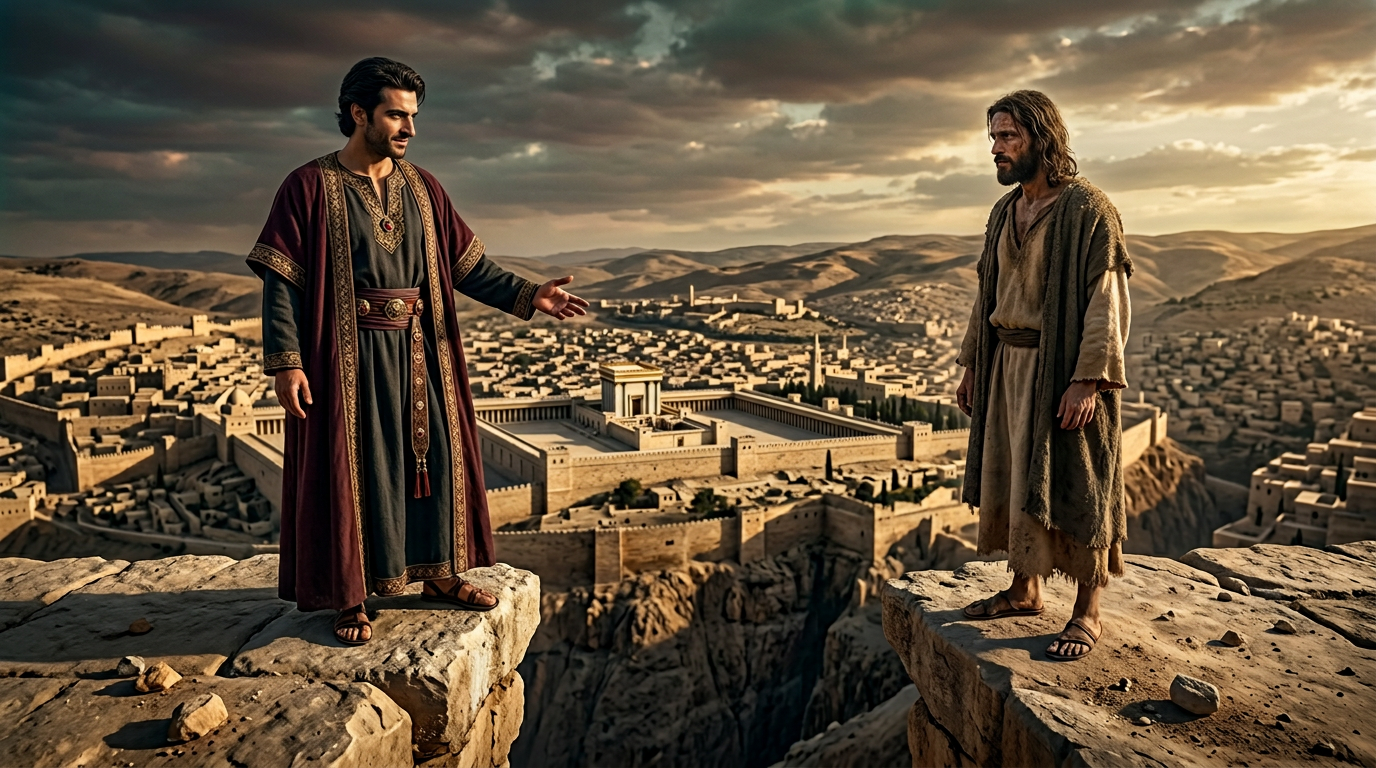
The tester speaks Torah. Claims the kingdoms. Conducts covenant tests from Yhwh's own Temple.
There is only one being in the Hebrew Bible who starves people to test their dependence, offers kingdoms for worship, and operates from the Temple. Jesus' own citations tell you who it is – because every verse He quotes describes Yhwh's behavior toward Israel.
The text shows you who he is.
That is exactly why this story has never been explained to you.
The three tests
Bread from stone
Luke 4:3–4 / Deut 8:2–3
Making bread is not a sin. There is no Torah law against it. But Jesus is in the middle of a covenant fast – the same legal posture Moses held for forty days before receiving the Law. Moses ate no bread. The Hebrews received no bread. And the tester tells Jesus to make bread – the one substance forbidden during the one proceeding that qualifies Him for the mission. It is not a moral test. It is a procedural trap. Break the fast, and the Contract for Humanity dies before it begins.
Kingdoms for worship
Luke 4:5–8 / Deut 6:13
The tester claims all the kingdoms have been given to him. Jesus does not dispute it. He does not call it a lie. He refuses because there is a higher contract – the one that will transfer those kingdoms to Abba and His Christ.
The Temple jump
Luke 4:9–12 / Deut 6:16
The tester brings Jesus to the pinnacle of Yhwh's Temple and quotes Yhwh's own psalm about angelic protection. Jesus responds: "You are not to put Yhwh your elohim to the test." If the tester is not Yhwh, how can obeying him constitute testing Yhwh?
The Exodus mirror
Exodus
- Through the Red Sea
- Led into the wilderness by Yhwh
- 40 years of wandering
- Yhwh starves the Hebrews (Deut 8:2–3)
- They complain and fail every test
- Moses sees the land from a mountain and dies
- Yhwh demands exclusive worship (Ex 20:3)
- They test Yhwh at Massah (Ex 17:1–7)
Jesus
- Through the Jordan at baptism
- Led into the wilderness by the Spirit
- 40 days of fasting
- The tester exploits the hunger
- Jesus refuses every shortcut
- Jesus sees the kingdoms from a mountain and walks away alive
- The tester demands worship
- Jesus refuses to test the one before Him
Same tests. Same tester. Different outcome. The Hebrews failed at every turn – they complained about hunger, tested Yhwh's presence, and worshiped a golden calf. Jesus passes each one. He is doing what no one in the Exodus could do – not even Moses.
Go deeper
Questions to sit with
- If the tester is a random fallen angel, why does he have authority to offer the kingdoms of the world – and why does Jesus not dispute the claim?
- Why does Jesus respond to every test with Deuteronomy 6–8 – the legal code that records how Yhwh tested Israel?
- Making bread from a stone is not a sin. So what makes it a test – and who has the authority to make it one?
- If the tester is not Yhwh, how can jumping from the Temple constitute testing Yhwh? You can only test someone who is present.
- Why does every element of the Temptation map to the Exodus narrative – water, wilderness, forty, hunger, mountain, worship?
- The Hebrews failed. Moses failed. Jesus alone passed. If this is a replay of the Exodus, who is running the trial?