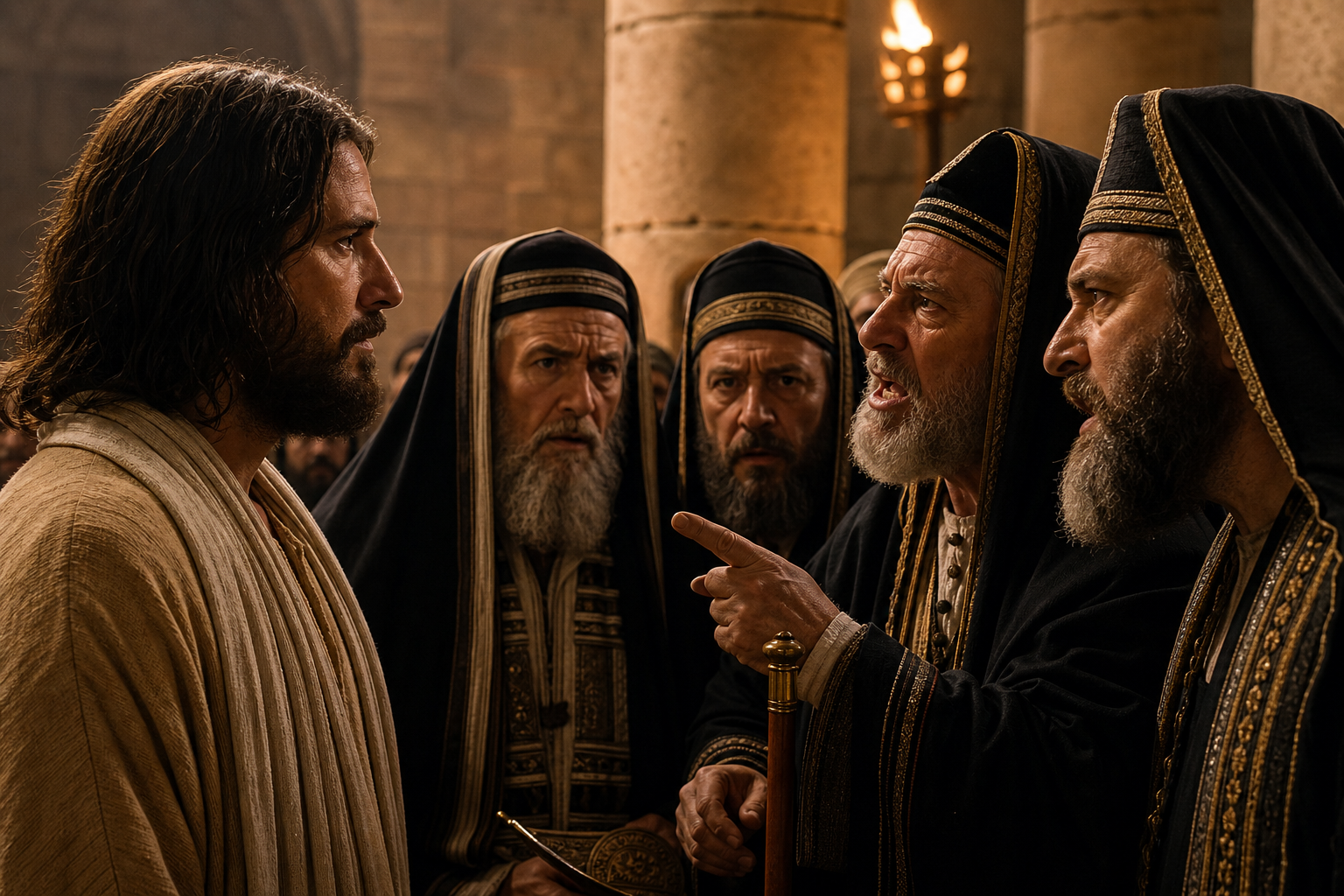
Some reach for John 8:54 when you argue that Jesus' Father and Yhwh are not the same being. Their argument is this: Jesus calls His Father "the one you say is your God," so His Father must be their god – same being, case closed.
That interpretation only works if you remove it from its context, and stop in the middle of a sentence. Don't stop. Jesus finishes the thought in the very next breath: "Yet you do not know him, but I know him. If I were to say that I do not know him, I would be a liar like you."
He quoted their claim, refuted it, and called it a lie. The verse they think ends the "Yhwh is not the Father" argument actually says the exact opposite.
You say your god is the God – but you don't even know Him.
That's the short version. The rest of this page explores every angle in context.
The argument some make
"The one who glorifies me is my Father, about whom you people say, 'He is our God.'" – John 8:54, NET
The argument is simple: Jesus says His Father is the one the Judeans call their God. The Judeans worship Yhwh. So Jesus just said His Father is Yhwh.
Well let's see if that aligns with the context of the rest of the passage this sits within.
Context is everything
John 8:54 sits inside a 47-verse conversation – a sustained, escalating argument between Jesus and the Judeans that runs from verse 12 to verse 59. The "same God" reading requires you to ignore all 47 verses and isolate one clause. And even within that single sentence, it requires you to stop at the comma. Don't stop. Let's pull in the missing context.
| Step | Verse | What's happening |
|---|---|---|
| They make a claim | John 8:41 | "We have only one father, God himself." They're claiming their god – Yhwh – is the Most High, the Father of all. That's the assumption Jesus is about to dismantle. |
| Jesus cites it | John 8:54 | "My Father, about whom you say, 'He is our God.'" He's not agreeing. He's quoting them. |
| Jesus refutes it | John 8:55 | "Yet you do not know him, but I know him." They claim the Father, but they have never known Him. Jesus does. |
| Jesus calls it a lie | John 8:55 | "If I were to say that I do not know him, I would be a liar like you." The comparison only works if they're already lying – and the lie is the claim they just made. |
The Christianity apologist quotes the second part – "about whom you say He is our God" – and stops. They're trying to build a doctrine on half of a sentence that Jesus was in the middle of refuting. They ignore Jesus' next words because they falsify their entire argument.
You don't quote someone's words approvingly and then, before you've finished the sentence, call those words a lie.
There's a name for what the apologist is doing here. It's called proof-texting – pulling a phrase out of its sentence, its paragraph, its conversation, and holding it up as if it stands on its own. It's the most common move in apologetics, and it's the reason so many people think they know what the Bible says without ever reading whole passages in order, in context. John 8:54 is a textbook case. The phrase "about whom you say, 'He is our God'" gets ripped out of a sentence that ends with "you do not know him" and "I would be a liar like you." The fragment says one thing. The sentence says the opposite.
There's only one reason to proof-text like this: to make the Bible say what you want it to say instead of what it actually says.
The original language
This isn't a quirk of the English translation. It's actually even tighter in the original Greek. You don't need to read Greek to follow this – the points are plain.
"You say" – quoting, not agreeing
The phrase "you say" is a reporting verb – the ordinary word for attributing words to someone else. It's not "as we confess" or "as it is written." It's you say this. Jesus hands their words back to them. These are your words, not mine.
And this isn't a one-off phrase. John uses the exact same construction – "you say that" – two more times in the same Gospel. Look at what it does every time:
| Verse | The phrase | What's happening |
|---|---|---|
| John 8:54 | "whom you say" | "whom you say is your God" – Jesus quoting their claim. Denied in the next breath. |
| John 9:19 | "whom you say" | "whom you say was born blind" – Pharisees quoting the parents' claim. Not endorsing it – interrogating it. |
| John 10:36 | "you say" | "you say, 'You are blaspheming'" – Jesus quoting the Judeans' charge. Immediately refuted. |
Same phrase, same Gospel. Every time, it reports what the other party says – and in two of three cases, the speaker immediately contests it. It's not endorsement. It's attribution: this is what you say.
"You have not known him" – not now, not ever
In English, "you do not know him" could mean "you don't know him right now." The Greek is sharper. The tense Jesus uses means "you have never come to know him." Not a temporary lapse. Not a relationship gone cold. Through all of it – the Temple, the feasts, the law, generation after generation – you never knew Him.
Then Jesus switches to a completely different word for His own knowledge: "but I know him." In Greek, these are two different verbs. The first means acquired knowledge – knowledge you arrive at through experience. The second means settled, direct, intuitive knowledge – you just know. Jesus uses the first to say they never arrived. He uses the second to say He's always been there. Two different words. Two different relationships.
"A liar like you" – the verdict
You cannot call someone "a liar like you" unless the "you" is already lying. That's how the phrase works in any language. Jesus says: if I denied knowing the Father, I would be a liar – like you. They are already liars. About what? The only claim on the table – their own words from verse 41: "We have only one father, God himself."
And the word "liar" shows up one other time in this conversation. Verse 44: "your father the devil ... is a liar and the father of lies." Same word in the Greek. Same chapter. The liar of verse 44 and the liars of verse 55 are connected by more than their closeness on the page. The lie is the same lie: claiming to be the Father, or claiming your god is the Father, when he isn't.
"But he says 'glorifies me' – doesn't that prove they worship the same God?"
This is another comeback you'll hear. Jesus says "my Father glorifies me" and then calls this Father the one they claim as their God. So the Father must be their god – because why would the devil glorify Jesus?
There are two claims in that sentence. "My Father glorifies me" – true. Nobody disputes that. "Whom you say is your God" – a lie, as Jesus himself says in the very next verse. The glorification tells you what the Father does. It says nothing about whether their god is the Father. Those are two completely separate statements in the same sentence. Jesus affirms one and denies the other.
The Church Fathers and more
The point that Jesus quotes their claim in order to refute it is not a novel invention. Here is how the most respected commentators in church history read this sentence. They all land somewhere very different on the question of who the Father is. But on what this sentence is doing, they agree.
Johann Albrecht Bengel, one of the most precise Greek scholars of the 18th century, annotated the word "you say" with a single devastating note: "falsely." That's it. Bengel read "you say" and wrote "falsely" in the margin. He understood exactly what Jesus was doing with their claim.
Heinrich Meyer, the leading critical commentator of the 19th century, was more expansive. He called their claim "their theocratic fancy" – their self-congratulatory assumption that the god they serve is the Most High – and said Jesus was exposing why God's activity in glorifying Jesus remained "hidden from them." Meyer connected "a liar like you" directly back to verse 44: "The charge points back to John 8:44."
John Chrysostom, preaching on this passage in the fourth century, said it bluntly: "when ye say that ye know Him, ye lie." The Judeans are the liars, and the lie is the claim to know the God.
John Calvin: Jesus "pulls off from them the false mask of the name of God which they were accustomed to employ ... it is a false title, for you know not God." A false mask. A false title. Calvin calls them "mere liars" for boasting the name of God without knowing Him.
Thomas Aquinas laid out the logic step by step: "Just as you are lying when you say that you know him, so if I said I do not know him, whereas I do, I should be a liar like you."
Cyril of Alexandria said Jesus "refutes them" for "practising the piety of bare words only, but exceeding far removed from truly knowing God." The Pulpit Commentary called it a "special and monopolizing claim" that "concealed from them the face of the Father."
Every one of these men assumed the god the Judeans named was the Most High. That's where this study parts ways with them. But notice what not one of them does: not one reads verse 54 as Jesus agreeing with the claim. They all read it as Jesus quoting the claim to tear it down. The "same God endorsement" isn't the historic reading. It's a recent invention that only survives by reading half of a sentence, because the next half destroys their entire argument.
And it is recent. John 8:54 does not appear on any standard list of verses proving the Trinity or the deity of Jesus – not in the scholarship, not in the apologetics, not anywhere. The traditional proof-texts are John 1:1, John 10:30, John 8:58, Philippians 2:6, Colossians 2:9, Hebrews 1:8. Those have been argued for centuries. John 8:54 as a "same God" proof is a recent invention – an internet-era argument that emerged specifically in response to people who started pointing out that Jesus separates His Father from the elohim of Israel. It appears in no creed, no confession, no systematic theology. The earliest datable instance is a 2021 forum post – where Greek scholars immediately shut it down.
And that should tell you something. If it were obvious that Yhwh and Abba are the same being, you wouldn't need to keep manufacturing new arguments from verses the tradition never used this way. You wouldn't need to reach for the front half of a sentence whose back half says the opposite. The reaching is the tell. Two thousand years of commentators looked at this verse and none of them saw a proof that Jesus endorsed their claim. The first people to read it that way are the ones arguing on social media – not the scholars, not the church fathers, not the Reformers. Ask yourself why. "...every wind of doctrine..." Eph 4:14.
Watch the pronouns
Look at the pronouns Jesus uses. "My Father." "Your God." He never once says "our Father" or "our God" – not here, not anywhere in the entire discourse. He keeps two separate columns the whole way through.
If these two were the same being, "our" would have been the easiest word in the world to reach for. One syllable would end the dispute. Jesus never reaches for it. He keeps His Father on one side and their god on the other, the entire way through John 8.
The rhythm across John
"You do not know him" is not a one-off insult thrown in the heat of an argument. It's a rhythm running through the whole Gospel. To this same crowd, about the same Father:
- "You do not know him, but I know him" – John 7:28–29
- "You know neither me nor my Father. If you knew me, you would know my Father too" – John 8:19
- "They will do these things because they have not known the Father or me" – John 16:3
- "Righteous Father, even the world does not know you, but I know you" – John 17:25
Same split every time. Jesus knows the Father. The people built around the Temple system do not. Verse 54 isn't a slip. It's one more instance of what Jesus says from chapter 7 to chapter 17: the god they serve is not the Father He knows.
The Hosea mirror
Some will say this just means they weren't worshipping sincerely – they had the right God but didn't really know Him. There's an Old Testament passage that uses nearly identical language to John 8:55, and it answers that directly.
"Israel cries out to me (Yhwh), 'My elohim, we acknowledge you!'" – Hosea 8:2
In the Greek Old Testament (the Septuagint), Israel's claim uses the exact same verb and tense as John 8:55 – but in opposite directions. Israel says "we have known you." Jesus says "you have not known him." Same word, same grammar, flipped. E.B. Pusey, the great 19th-century commentator on the Minor Prophets, connected these two verses explicitly.
But look at the audience.
In Hosea, the people claiming to know God are unfaithful. They've been chasing other gods, breaking covenant, making idols. Hosea 8:1 says they "violated my covenant." Hosea 5:4 says "a spirit of idolatry controls their heart." They say "we know you" while serving Baal on the side. Their claim is rejected because they're liars about their loyalty – they left Yhwh.
In John 8, the people claiming to know the God are the opposite. They are the most devout Yhwh-worshippers alive. They're standing in Yhwh's Temple during his feast. They keep his law. They stone blasphemers against Yhwh's name. They haven't left anything. They're so zealous they're seeking to kill Jesus. And Jesus still says "you have not known Him."
Same words. Same verb. Completely different diagnosis. In Hosea, the problem is unfaithfulness – the remedy is "come back." In John 8, the problem can't be unfaithfulness, because they never left. They are zealots for their god and Jesus still says they don't know the Father. The only explanation that accounts for both the faithfulness of the audience and the severity of the charge: the Father they don't know is not the god they faithfully serve.
What exactly is the lie?
Be careful here, because it's easy to hear "you do not know him" and assume Jesus is calling these men insincere. He's not. The lie is not that they fake their worship. They worship with everything they have – and Jesus still says they don't know the Father. That's the problem. Sincerity isn't what's missing. If it were, Jesus would still call their god His Father. He'd say "our Father" at least once. He never does. He says "my Father" and "your God" and refuses to share the title. That's not a sincerity problem – that's a different God.
The lie is the conflation. It's the assumption buried inside "He is our God" – that the god they serve, Yhwh, simply is the Most High, the Father Jesus came from. Deuteronomy 32:7-9 keeps those two apart: the Most High parceled out the nations, and Yhwh received Israel as his portion. Yhwh is a son of the Most High, not the Most High himself. Collapse those two together and you land exactly on the claim the Judeans make in verse 41 – and exactly the claim Jesus calls a lie in verse 55.
Go deeper The full case across all of John 8
This verse doesn't stand alone. It's the climax of a 47-verse argument in which Jesus systematically separates His Father from the god His opponents serve – five tests, one verdict. The full walk-through is in the John 8 study.
"But they weren't worshipping Yhwh – they'd gone to the devil"
There's a fallback position. Once the "same God" reading falls apart, the objection usually shifts: Jesus isn't talking about Yhwh at all. These men had abandoned Yhwh and were following the devil. The idea is that Jesus isn't calling Yhwh the devil – He's saying they left God for a counterfeit.
It's a reasonable-sounding move. It just doesn't survive the context.
Who is Jesus talking to? The most devout Yhwh-worshippers that exist. They're standing in Yhwh's Temple. It's Yhwh's feast. They keep Yhwh's law with a ferocity that leads them to pick up stones against perceived blasphemy. Blasphemy against whom? Yhwh. Nowhere in John 8 do they abandon anything, or anyone. They name one father – "God himself" – and they're serving Yhwh right there in his own house.
The being they claim as their god, Yhwh, is the being they actually follow – and that faithfulness is the problem, not a lack of it. The being Jesus says they don't know isn't a being they defected from. It's a being they've never known. The full case for who their father turns out to be is in the John 8 study.
Where it lands
The verse some reach for when you separate Jesus' Father from Yhwh – the one they're sure ends the argument – ends up saying the complete opposite. Here are the four steps again, because they matter:
| Step | Verse | What's happening |
|---|---|---|
| They make a claim | John 8:41 | "We have only one father, God himself." They're claiming their god – Yhwh – is the Most High, the Father of all. That's the assumption Jesus is about to dismantle. |
| Jesus cites it | John 8:54 | "My Father, about whom you say, 'He is our God.'" He's not agreeing. He's quoting them. |
| Jesus refutes it | John 8:55 | "Yet you do not know him, but I know him." They claim the Father, but they have never known Him. Jesus does. |
| Jesus calls it a lie | John 8:55 | "If I were to say that I do not know him, I would be a liar like you." The comparison only works if they're already lying – and the lie is the claim they just made. |
John 8:54 was never an admission. It was an accusation. Jesus took their proudest claim, held it up in their own words, and called it a lie to their faces.
Every commentator we looked at – Bengel, Meyer, Chrysostom, Calvin, Aquinas, Cyril – read the sentence the same way. Not one of them saw an endorsement. They all saw a refutation. The "same God" reading isn't the traditional reading. It isn't the scholarly reading. It's a recent invention that survives only by stopping mid-sentence.
And the question it raises is bigger than one verse. If the Judeans are the most faithful worshippers of their god alive – and Jesus still says they don't know the Father – then faithfulness to their god is not the same thing as knowing the Father. That's not a small distinction. That's the whole argument of John 8, and this verse is its sharpest point.
This is what happens when you proof-text the Bible and strip its context. A serious student of the Bible sees context as everything. If you're not seeking context, it's usually because you're starting with a pretext. The text has much to say – but only if you let it finish the sentence.
You say your god is the God – but you don't even know Him.
Finish the sentence.