Who is Paul's "god of this age"?
2 Cor 4:4 names two gods. The context identifies the blinder as Yhwh, while Christ is the image of the Father.
In this episode
Read the transcript 3,187 words
Who is Paul's god of this age? Ask a Christian who the god of this age is, and you'll usually get one answer. Satan. That's what I was taught too. Paul never writes the name Satan there. He writes a title. And he uses that title just once in everything we have from him. It's in 2 Corinthians 4:4.
Let's read it. Among whom the god of this age has blinded the minds of those who do not believe, so they would not see the light of the glorious gospel of Christ, who is the image of God. Let me read that again. Among whom the god of this age has blinded the minds of those who do not believe, so they would not see the light of the glorious gospel of Christ, who is the image of God.
So there's a god in this verse who blinds people's minds. He does it so they won't see the light of the gospel about Christ. And Christ is the image of God. So, who is the god doing the blinding? The verse doesn't say. And since Paul never uses the title anywhere else, there's no other verse to check it against.
That leaves one way to find out. And it's the way you'd read any letter. You read what comes right before it. Chapter 4 opens with the word "therefore." So, Paul is still on the same subject he started in chapter 3. Paul didn't write in chapters anyway. Stephen Langton, an archbishop of Canterbury, added the chapter numbers around 1227, more than 1,100 years after Paul wrote.
And chapter 3 is about Moses. Paul is retelling a story from Exodus 34. Christians often say you can't understand the New Testament without the Old Testament. And this is a place where you really can't. So, here's the plan. First, the story in Exodus 34. Then what Paul does with that story in chapter 3. Then back to 2 Corinthians 4:4 to see who's doing the blinding.
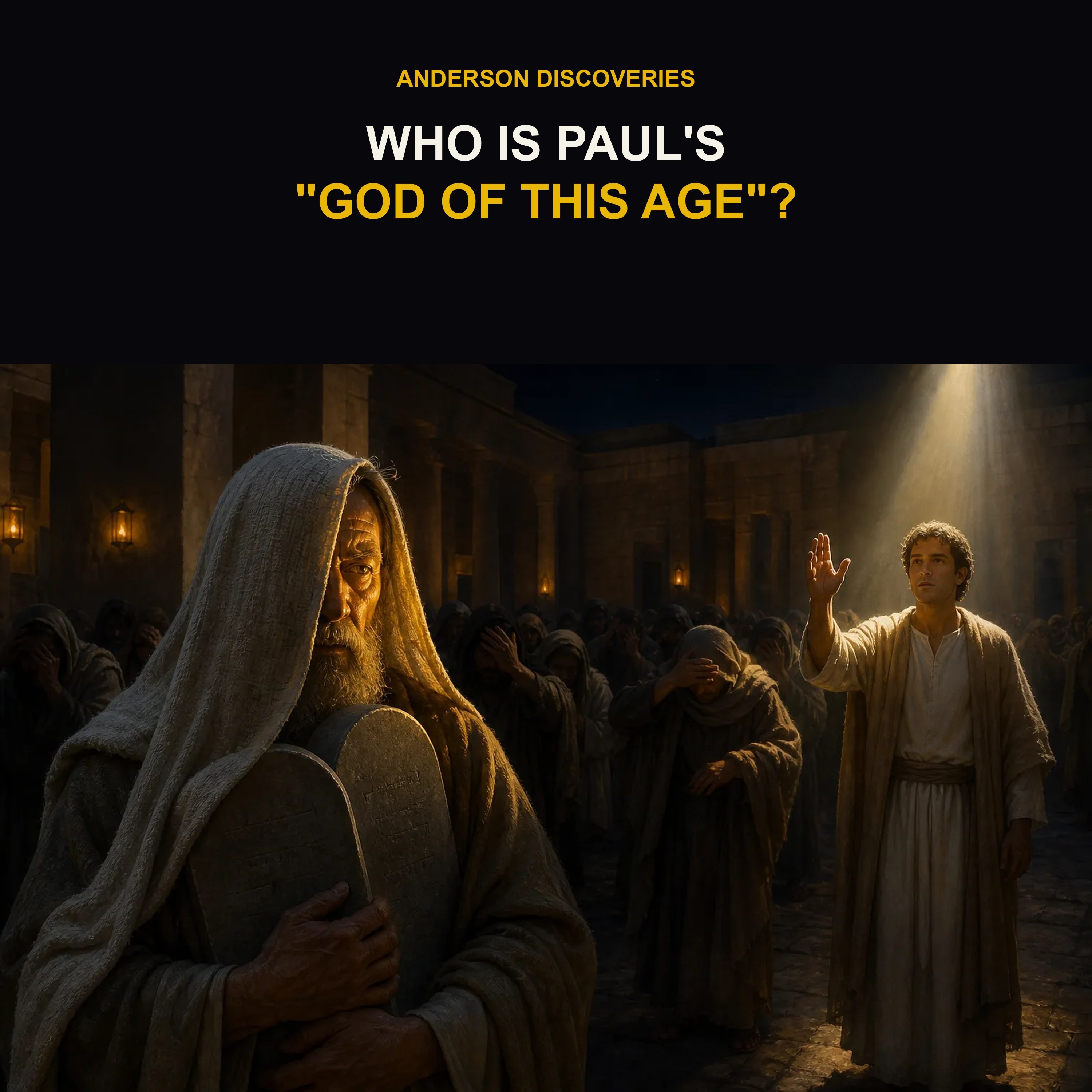
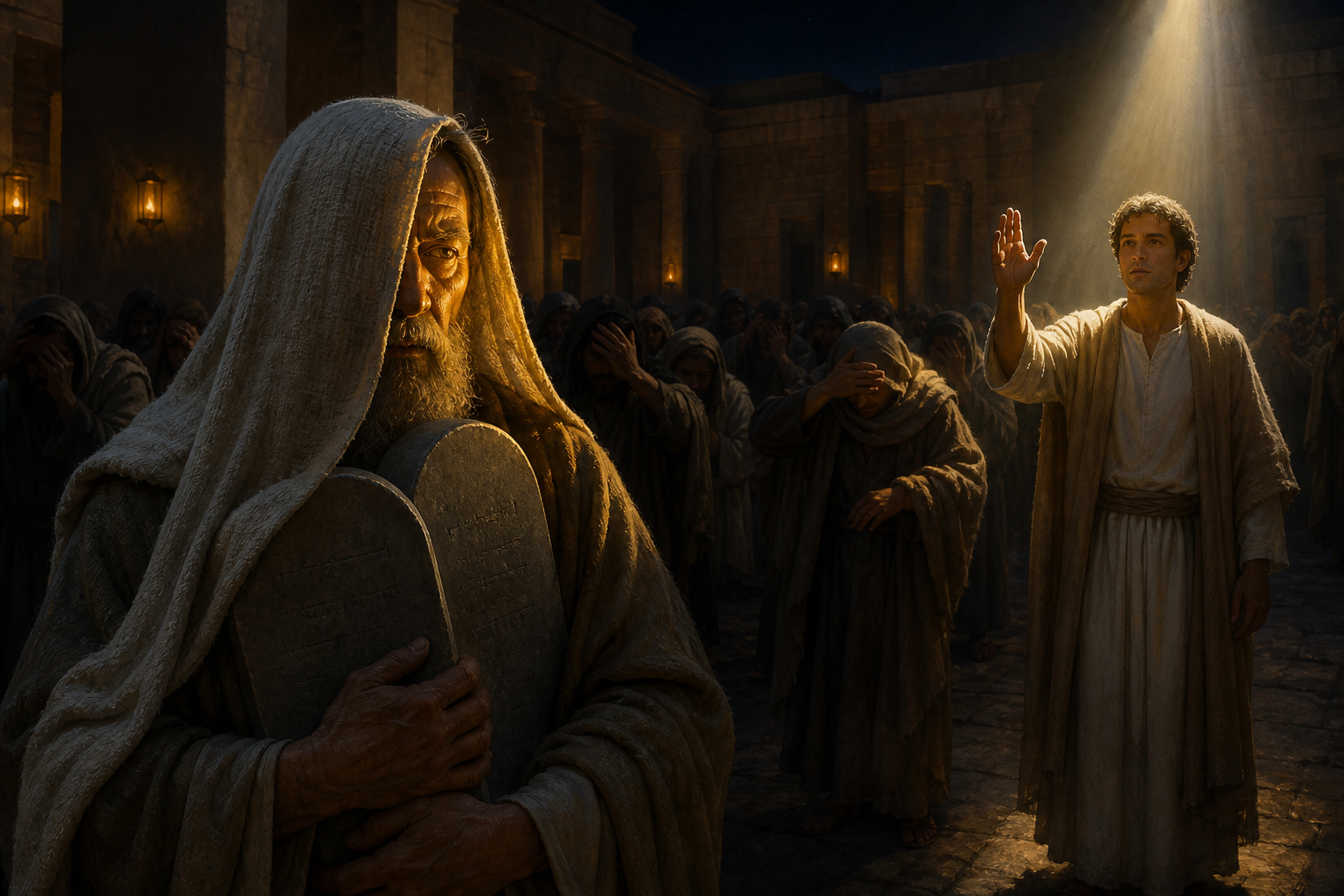
Exodus 34 is the second time Moses comes down from Mount Sinai with the stone tablets. The tablets carry the law. That's the covenant Yhwh made with Israel. And it's what Paul calls the Old Covenant. Let's read Exodus 34:29–35. Now, when Moses came down from Mount Sinai with the two tablets of the testimony in his hand, when he came down from the mountain, Moses did not know that the skin of his face shone while he talked with them.
And Aaron and all the Israelites saw Moses, the skin of his face shone, and they were afraid to approach him. But Moses called to them. So Aaron and all the leaders of the community came back to him, and Moses spoke to them. After this, all the Israelites approached, and he commanded them all what Yhwh had spoken to him on Mount Sinai.
When Moses finished speaking with them, he would put a veil on his face. But when Moses went in before Yhwh to speak with him, he would remove the veil until he came out. Then he would come out and tell the Israelites what he had been commanded. When the Israelites would see the face of Moses, that the skin of Moses' face shone, Moses would put the veil on his face again until he went in to speak with Yhwh.
So Moses talks with Yhwh and his face shines. The people are afraid of it. Moses tells them what Yhwh commanded, and then he covers his face with a veil. When he goes back in to talk with Yhwh, he takes the veil off. Two things in that story matter for Paul. The first is the stone tablets. The second is the veil over Moses' face. Paul uses both of them.
Paul is writing to the church in Corinth because other teachers have come in carrying letters of recommendation, and the Corinthians are comparing him with them. Paul says he doesn't need a letter. The Corinthians themselves are his letter. Let's read 2 Corinthians 3:3. Revealing that you are a letter of Christ, delivered by us, written not with ink, but by the Spirit of the living God, not on stone tablets, but on tablets of human hearts.
There are the stone tablets from Exodus 34. Paul sets them against the Spirit writing on people's hearts. Then in verse 6, he says what each one does. The letter kills, but the Spirit gives life. And in verse 7, he gives the stone tablets a name. Let's read 2 Corinthians 3:7–8.
But if the ministry that produced death, carved in letters on stone tablets, came with glory, so that the Israelites could not keep their eyes fixed on the face of Moses because of the glory of his face, a glory which was made ineffective, how much more glorious will the ministry of the Spirit be? Paul calls what was carved on the stone tablets, the ministry that produced death. Two verses later, he calls it the ministry that produced condemnation. He's talking about the covenant Yhwh gave Moses on Sinai.
He agrees it came with glory, and that glory is the shine on Moses' face, but he still calls it death. He also says something Exodus never says. He says that glory was made ineffective. Which means put out of use, shut down. Exodus 34 doesn't say the shine faded or ended. Paul is saying the covenant itself is being shut down because something greater has replaced it.
So all through this chapter, Paul sets things against each other in pairs. The letter against the Spirit. Death against life. Condemnation against righteousness. Glory that's being shut down against glory that remains. And a covered face against an uncovered face. On one side of every pair is the covenant Yhwh gave on Sinai.
Then Paul comes to the veil. Let's read 2 Corinthians 3:12–13. Therefore, since we have such a hope, we behave with great boldness and not like Moses who used to put a veil over his face to keep the Israelites from staring at the result of the glory that was made ineffective.
Huh. Exodus doesn't give a reason for the veil. Paul gives it one. He says the veil kept Israel from seeing where that glory was going and it was going to its end. Then Paul takes the veil off Moses' face and puts it somewhere else. Let's read 2 Corinthians 3:14–15.
But their minds were closed. For to this very day, the same veil remains when they hear the old covenant read. It has not been removed because only in Christ is it taken away. But until this very day, whenever Moses is read, a veil lies over their minds. So the veil isn't on a face anymore.
It's on the mind. Paul calls it the same veil. And he says when it's there. It's there whenever Moses is read. When people hear the old covenant read, a veil lies over their minds. And only Christ takes it away. Paul uses that word minds again a few verses later. Have you ever been told you couldn't see something because you were rebellious or bitter or deceived or short on faith?
Church usually blames the person. Paul doesn't. He says there really is a veil. And he tells you when it's there. It's there whenever Moses is read.
Paul also says how the veil comes off. In Exodus 34:34, Moses takes the veil off when he goes in before Yhwh. The Greek translation of that verse calls Yhwh the Lord. Paul uses that line and then he changes who it's about. Let's read 2 Corinthians 3:16–17. But when one turns to the Lord, the veil is removed.
Now the Lord is the Spirit. And where the Spirit of the Lord is present, there is freedom. In Exodus, the veil comes off when Moses goes into Yhwh. In Paul, the veil comes off when someone turns to the Spirit. Paul has taken that scene away from Yhwh. Then he says what happens next.
Let's read 2 Corinthians 3:18. And we all, with unveiled faces reflecting the glory of the Lord, are being transformed into the same image from one degree of glory to another, which is from the Lord, who is the Spirit. With the veil off, people are changed into the same image. Paul names that image in the next chapter.
In chapter 4, Paul says he doesn't hide anything and he doesn't twist the message. Then he comes back to the veil one more time. Let's read 2 Corinthians 4:3–4. But even if our gospel is veiled, it is veiled only to those who are perishing, among whom the god of this age has blinded the minds of those who do not believe, so they would not see the light of the glorious gospel of Christ, who is the image of God.
Now the verse reads differently. The gospel is veiled. And that's the veil from chapter 3. The minds are blinded. And that's the same Greek word Paul used in chapter 3 for the minds that were closed whenever Moses is read. And Christ is the image, the same image people are changed into once the veil is gone.
Paul hasn't changed the subject. He's still talking about the veil that sits on people's minds when the Old Covenant is read. Paul uses that word for minds a few other times in this letter. And in 2 Corinthians 2:11, right before what we're reading now, it is Satan's schemes. That's one reason commentators say Satan here.
But the closest use is in chapter 3, 11 verses earlier. And there, it's the minds of people hearing Moses read.
So whose covenant is that? It's Yhwh's. And who blinds the people who hear it? Paul's own Bible already answers that. Let's read Deuteronomy 29:4. Moses is speaking to Israel at the end of the 40 years. But to this very day, Yhwh has not given you an understanding mind, perceptive eyes, or discerning ears.
To this very day. Paul uses that same phrase in 2 Corinthians 3:14 and 15. And he quotes this verse from Deuteronomy in Romans 11:8. Here's another one Paul knew. In Isaiah 6, Yhwh sends Isaiah to the people. Let's read Isaiah 6:9–10. He said, Go and tell these people, Listen continually, but don't understand.
Look continually, but don't perceive. Make the hearts of these people calloused. Make their ears deaf and their eyes blind. Otherwise, they might see with their eyes and hear with their ears. Their hearts might understand, and they might repent and be healed. So, in Paul's Bible, Yhwh is the one who withholds understanding, and Yhwh is the one who sends a prophet to make eyes blind, so that people won't repent and be healed.
John quotes this same passage, and he uses the same Greek verb Paul uses for blinded. Paul only uses that verb once in 2 Corinthians 4:4. Let's read John 12:40–41. He has blinded their eyes and hardened their heart, so that they would not see with their eyes and understand with their heart, and turn to me, and I would heal them.
Isaiah said these things because he saw Christ's glory and spoke about him. End quote. I just added that there because it might sound like I was reading that last part myself from my own words, but that's part of the quote. The Greek in verse 41 just says, His glory. The word Christ's was added by the NET translators.
Isaiah 6:5 tells you whose glory Isaiah saw. He says, My eyes have seen the King, Yhwh of heaven's armies. So, the "he" who blinds their eyes in John 12:40 is Yhwh.
There's one more piece, and it's the title itself. Paul isn't just the first Judean writer to say god of the age. First Enoch is a Judean book older than Paul, and in 1 Enoch 1:4, the title belongs to the one who comes down on Mount Sinai to judge. The Septuagint, the Greek translation of the Hebrew Bible, uses it in Daniel 5:4 for the god who holds authority over people's breath.
Ivor Poobalan wrote his doctoral dissertation on this exact title, the god of this age, and he found no surviving use of it for Satan before Paul. So, the story Paul is retelling points to Yhwh. The blinding points to Yhwh. The title points to Yhwh. The god of this age is Yhwh.
That leaves the other half of the verse. Christ is the image of God. If the god of this age is Yhwh, who is this God? God. It's the same word both times, and it sounds the same both times. In Paul's Greek, the word for God, theos, doesn't name one person. It's like the word king.
You still have to know which king. In this verse, one god blinds people so they won't see Christ, and Christ is the image of the other. The one doing the blinding and the one whose image is Christ can't be the same person. Paul names the other God right away. Let's read 2 Corinthians 4:5–6.
For we do not proclaim ourselves, but Jesus Christ as Lord, and ourselves as your slaves for Jesus' sake. For God, who said, let light shine out of darkness, is the one who shined in our hearts to give us the light of the glorious knowledge of God in the face of Christ. The word for light in verse 6 is the same word as in verse 4, and Paul doesn't use it anywhere else.
In verse 4, the god of this age keeps that light from being seen. In verse 6, God shines that same light into people's hearts. And the light has moved. Back in chapter 3, the glory of the ministry of death was on Moses' face. Now the light is in the face of Christ. Paul had already told the Corinthians who that God is.
Let's read 1 Corinthians 8:6. Yet for us there is one God, the Father, from whom are all things and for whom we live, and one Lord, Jesus Christ, through whom are all things and through whom we live. So Christ is the Lord, Christ is the image, and the one God is the Father. Yhwh blinds people's minds so they won't see the light. The Father shines that light into people's hearts.
Colossians 1:15 says the same thing in a different way. It calls Christ the image of the invisible God. But Yhwh wasn't invisible. In Exodus 24:10, Moses and the elders saw the God of Israel. In Numbers 12:8, Yhwh says Moses sees his form. In Isaiah 6:5, Isaiah says he saw Yhwh. So, who is the invisible one?
John answers that. John 1:18 says, no one has ever seen God. And in John 14:9, Jesus tells Philip, the person who has seen me has seen the Father. The invisible God, the one Christ is the image of, is the Father.
Now, someone might say verse 6 proves it's one God after all. The God who shines is the one who said, let light shine out of darkness. And that sounds like the creator in Genesis 1. But Genesis 1:3 doesn't use the name Yhwh. It says Elohim. which is the ordinary Hebrew word for God.
Yhwh's name doesn't appear in the Bible until Genesis 2:4. And either way, Paul has already split the two. In verse 4, one god blinds people against Christ and Christ is the image of the other.
So, if that's what the passage says, why do most Christians answer Satan? Because readers have been arguing about this verse for almost 1,900 years. The earliest reader we know of is Marcion, a Christian teacher in the 140s. His own books are lost, but the people who wrote against him and call him a heretic quote him.
He said, the god of this age was not the Father Jesus came from. Around the year 180, Irenaeus, the bishop of Lyons, wrote a long book against him. Irenaeus didn't say Satan. He said, God did the blinding, and by God he meant Yhwh, because to him Yhwh was the Father. To get away from Marcion's two gods, he read the words in a different order.
Instead of the god of this age has blinded, he read it as God has blinded the unbelievers of this age. That way, of this age describes the unbelievers, not the God. Tertullian, writing in Latin in North Africa about 30 years later, first gave the same answer as Irenaeus. Then he said, the devil was an easier answer.
Around 400, John Chrysostom, a famous preacher in Antioch, said plainly that it was God and not the devil, and by God he meant Yhwh. Then in the 1500s, Erasmus, who published the first printed Greek New Testament, and John Calvin, the reformer in Geneva, helped make Satan the standard answer in Protestant churches. That's the answer most Christians give today.
But it never ended the argument. In 1826, Adam Clarke, a Methodist commentator, said, the Satan reading rests on inherited prejudice. James Scott, who wrote a commentary on 2 Corinthians in 1998, said, it's more likely Yhwh. Donald Hartley made the case for Yhwh in a paper in 2005, and Ivor Poobalan, in that dissertation on this one phrase, the god of this age, said, it's not Satan, though he still treats that God as the Father. The history doesn't decide what Paul meant, but it does show that "Paul plainly said Satan" isn't true.
So, why couldn't they settle it? Both sides started from the same belief, that Yhwh is the Father. One side saw the covenant, the veil, and Isaiah, and said, it's God, meaning Yhwh. The other side saw a god keeping people from Christ, and said, a god who does that must be the devil. If Yhwh has to be the Father, you either rearrange Paul's words like Irenaeus did, or you give the blinding to Satan.
In 2 Corinthians 2:11, he warns about Satan's schemes. That's just before what we're reading now. And in 2 Corinthians 11:14, he says, Satan disguises himself as an angel of light. How interesting. But in 2 Corinthians 4:4, he doesn't. He writes a title, and the verses before it are about Yhwh's covenant.
In John 8, Jesus told the men who were trying to kill him that their deeds showed who their father was. You people are doing the deeds of your father. So what does each one do here? Yhwh blinds people so they won't see Christ. The Father shines the light of Christ into people's hearts.
That's why the two old answers have never gone away. The readers who said God were following the evidence that points to Yhwh. The readers who said Satan were following what the god of this age does. Both were right about part of it because they were describing one being. Yhwh is Satan, and Yhwh is not the Father.
Go deeper
The full study
There's a full study of this passage, in text or on video. The written study has every passage, the evidence, and the answers to the usual objections. The video is the longer livestream, with chapters and highlights.
Follow the podcast
Get every new episode in the app you already use.
Share this episode
Keep the work going
The podcast is free. Listener support pays for the research, the studies, and the hosting.