Psalm 82 describes an assembly of gods
Psalm 82 opens with a scene that many readers pass over quickly:
"Elohim stands in the assembly of El; in the midst of the elohim he renders judgment." (Psalm 82:1, NET)
Elohim (eh-loh-HEEM) is the Hebrew word that English Bibles usually print as "God" or "gods." It has a plural form, and it can mean one deity or many. In this verse it means both. One elohim stands up in an assembly, and the assembly is made of elohim. Later in the same psalm, the one who judges says to the others, "You are elohim; all of you are sons of the Most High" (Psalm 82:6).
Who are these sons of the Most High, and what is this assembly? For most of history, readers had only the Bible to answer that. Then, in 1928, near the coast of Syria, an ancient tomb was found by accident. It led archaeologists to the ruins of Ugarit, a city abandoned more than three thousand years ago. Its clay tablets describe an assembly of gods, with a high god named El at its head and his sons around him. The language of those tablets is close to Hebrew.
The books of the Bible were not written in an empty world. Writing was already ancient. The neighbors had laws, proverbs, flood stories, and gods. This page looks at that world: how writing began, who the scribes were, what the neighbors wrote, what Ugarit has shown, and what the Bible itself says about the council of the Most High.
Where English Bibles print "the LORD" in capital letters, the Hebrew has the divine name, Yhwh (YAH-weh). Quotes on this site restore it. Where English Bibles print "God," the quotes write Elohim or elohim, or the El name that stands in the Hebrew.
Writing began long before Israel
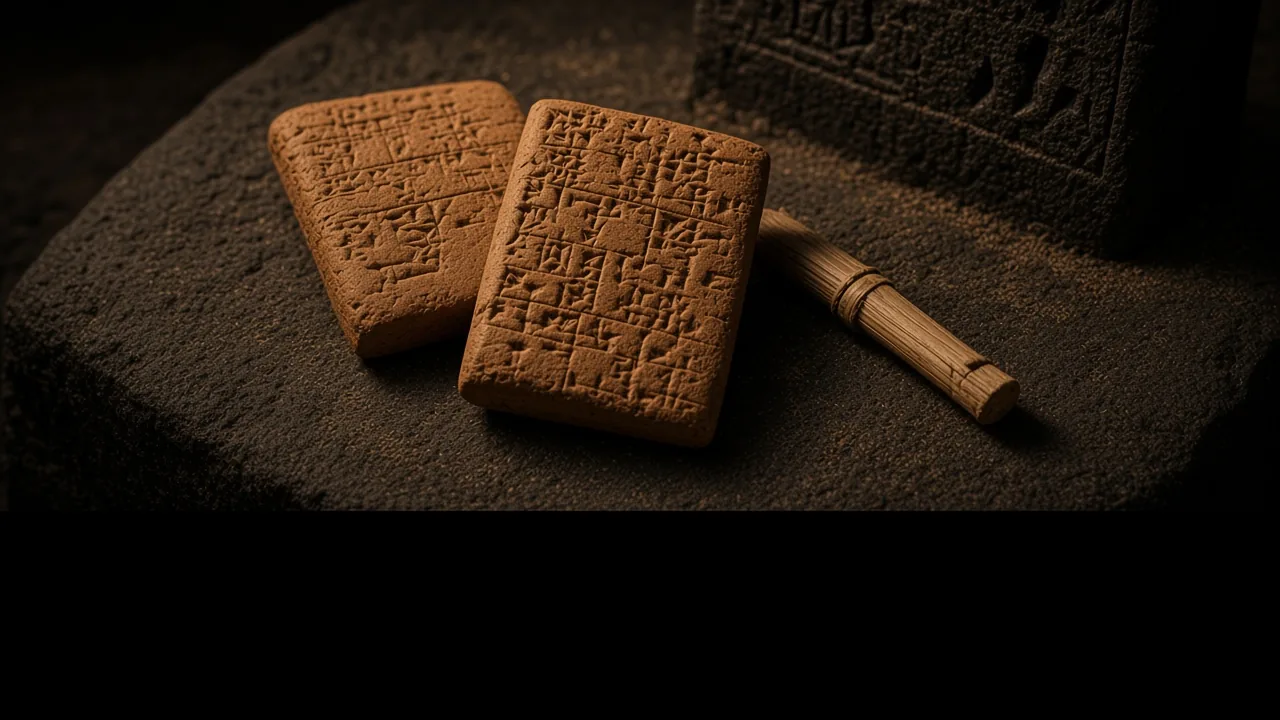
Writing was invented around 3200 BC, in two places at about the same time. In southern Mesopotamia, in what is now Iraq, scribes pressed marks into wet clay with a cut reed. The marks are shaped like wedges, so this writing is called cuneiform, from the Latin word for "wedge." In Egypt, scribes wrote with pictures, which the Greeks later called hieroglyphs, "sacred carvings."
Both systems were hard to learn. Each used hundreds of signs. Some signs stood for whole words, and others stood for sounds. It took years of school to master them, so reading and writing belonged to trained scribes.
The alphabet came later, and it came from people who spoke a language related to Hebrew. Some of the oldest alphabetic writing ever found was cut into rock in Egypt, at Wadi el-Hol, and at the turquoise mines of Serabit el-Khadim in the Sinai. Most scholars date it to roughly 1900 to 1700 BC. Its makers borrowed Egyptian pictures and used each picture for the first sound of its name in their own language. A picture of an ox head, alp (ahlp), stood for the sound at the start of that word. That letter became the Hebrew aleph (AH-lef) and the Greek alpha.
An alphabet needs only a couple dozen signs, so it is far easier to learn. By about 1000 BC, the Phoenicians, on the coast of what is now Lebanon, were writing with 22 letters. The Hebrew and Aramaic scripts grew out of that alphabet, and the Greeks borrowed it a little later, adding letters for vowels. Every alphabet used to write the Bible goes back to it.
So by the time Israel's writers began, writing was already about two thousand years old. Most surviving Hebrew inscriptions come from the 700s and 600s BC. The oldest known copy of any words from the Bible comes from about that time: two tiny silver scrolls found in a tomb at Ketef Hinnom in Jerusalem. Most scholars date them to around 600 BC, though some date them later. They carry a blessing very close to Numbers 6:24: "Yhwh bless you and protect you."
Scribes wrote and kept the books
In the ancient world, writing was a profession. Scribes were trained in schools, often from childhood. They practiced by copying older texts, and many of the tablets that survive are student copies. They worked for kings, temples, and merchants, writing letters, contracts, laws, lists, prayers, and stories.
Some tablets name their scribe. The long story of the storm god Baal (BAH-ahl) from Ugarit ends with a note saying it was written by Ilimalku, a scribe in the service of Niqmaddu, king of Ugarit. Ilimalku also names his teacher, Attenu, the chief of the priests.
The Bible shows scribes at work too. When a scroll of the law is found in the temple in Jerusalem, the high priest gives it to the royal scribe:
"Hilkiah the high priest informed Shaphan the scribe, 'I found the scroll of the law in Yhwh's temple.' Hilkiah gave the scroll to Shaphan and he read it." (2 Kings 22:8, NET)
The prophet Jeremiah dictates his messages to Baruch, who writes them on a scroll (Jeremiah 36:4). Ezra, who comes back from Babylon after the exile, is described as "a scribe who was skilled in the law of Moses" (Ezra 7:6). And Jeremiah accuses the scribes of his own day of changing what the law means:
"How can you say, 'We are wise! We have the law of Yhwh'? The truth is, those who teach it have used their writings to make it say what it does not really mean." (Jeremiah 8:8, NET)
The Hebrew is more direct than the NET Bible here. It says that "the lying pen of the scribes" has made it into a lie.
That matters for everything later in this series. The books of the Bible reached us through the hands of scribes. Scribes copied them, collected them, edited them, and sometimes changed them. The page on scrolls, scribes, and materials looks at that in more detail.
The neighbors told some of the same stories
Archaeologists have recovered hundreds of thousands of clay tablets and many papyri (puh-PY-ree) from Israel's neighbors. Some of them sound very familiar to a Bible reader.
A flood and three birds
The Epic of Gilgamesh, from Mesopotamia, includes the story of a man named Utnapishtim. A god warns him that a flood is coming. He builds a great boat, loads it with his family and animals, and survives. When the boat comes to rest on a mountain, he sends out birds: a dove, which comes back, then a swallow, which comes back, then a raven, which does not. An even older Mesopotamian story, Atrahasis, tells the same flood in its own way.
In Genesis, Noah's boat comes to rest in the mountains of Ararat, and he sends out birds too. First he sends a raven, then a dove three times. The second time, the dove comes back "with a freshly plucked olive leaf in its beak" (Genesis 8:11). The third time, it does not come back. The surviving copies of Gilgamesh that tell this part are centuries older than any surviving copy of Genesis.
Thirty sayings
The Instruction of Amenemope is an ancient Egyptian book of advice in thirty chapters, preserved on a papyrus scroll in the British Museum. Modern scholars first published that papyrus in 1923, and the next year the German Egyptologist Adolf Erman showed that Proverbs 22:17-23:11 closely follows parts of it. Both begin by telling the reader to listen to the words of the wise. Then Proverbs says:
"Have I not written thirty sayings for you, sayings of counsel and knowledge" (Proverbs 22:20, NET)
The Hebrew word here is hard to read. The King James Version translated it as "excellent things." After the Egyptian papyrus was published, most translators began to read it as "thirty," the number of chapters in the Egyptian book. Most scholars now think the writer of this part of Proverbs knew Amenemope. A discovery in Egypt changed how English Bibles read.
The goring ox
Hammurabi was a king of Babylon around 1750 BC. His laws were carved on a tall black stone that is now in the Louvre in Paris. Several of them cover the same cases as laws in Exodus. One is an ox that gores a person to death. Hammurabi says that if the ox was known to gore, and its owner was warned but did nothing, the owner pays thirty shekels of silver (Laws of Hammurabi 251). Exodus covers the same case:
"But if the ox had the habit of goring, and its owner was warned but he did not take the necessary precautions, and then it killed a man or a woman, the ox must be stoned and the man must be put to death." (Exodus 21:29, NET)
The case is the same: an ox known to gore, a warned owner, and a death. The penalty is different. Hammurabi's owner pays silver. In Exodus the owner is put to death, though the next verse allows a payment instead (Exodus 21:30). Hammurabi's thirty shekels are for a free man. Exodus sets thirty shekels when the ox kills a slave (Exodus 21:32).
The goring ox is one case out of many. In his book The Formation of the Hebrew Bible (2011, p. 470), David Carr, a professor at Union Theological Seminary, summarizes David Wright's 2009 book Inventing God's Law. Carr notes that Wright shows specific parallels in order between Hammurabi's laws and the laws in Exodus 21:1-22:19, and argues that the writers of that Exodus collection modeled much of their work on Hammurabi's code while adapting it freely.
None of this means the Bible simply copied its neighbors. It means its writers shared a world with them: the same kinds of stories, the same kinds of laws, and the same questions. Reading the neighbors shows what was common in that world, and it shows where the Bible says something different.
The tablets from Ugarit
Ugarit was a port city on the coast of Syria, at a site now called Ras Shamra. It flourished in the 1300s and 1200s BC and was abandoned around 1180 BC. French archaeologists began digging there in 1929, the year after the tomb was found, and they have uncovered thousands of tablets.
Many of the tablets are written in a language no one had seen before. Scholars call it Ugaritic. It is a sister of Hebrew, close enough that many of its words and phrases match Hebrew ones. The scribes of Ugarit wrote it with an alphabet of 30 letters, made of wedges pressed into clay like cuneiform.
Among the tablets are long poems about the gods. They were written several centuries before most of the Bible, in a language close to the one its writers spoke. These are the main figures:
| Name | Who they are | Some titles in the tablets |
|---|---|---|
| El | The head of the gods and father of the divine family | "Bull El," "Creator of Creatures" |
| Athirat, also called Asherah (uh-SHEER-uh) | El's wife, the mother of the gods | "Creatress of the Gods," "Lady Athirat of the Sea" |
| The sons of El | The gods of the family, who meet in an assembly | "The seventy sons of Athirat," "the circle of El" |
| Baal | The storm god, who becomes king among the gods | "Rider of the Clouds," "Mightiest Baal" |
| Yamm (yahm) and Mot (moht) | Sea and Death, the enemies Baal fights | "Yamm, the Beloved of El," "Prince Yamm" |
Several of these names appear in the Bible. When King Josiah clears out the temple in Jerusalem, he removes "all the items that were used in the worship of Baal, Asherah, and all the stars of the sky" (2 Kings 23:4). Baal is the god whose prophets Elijah challenges on Mount Carmel in 1 Kings 18.
Leviathan
The tablets also explain lines in the Bible that were hard to understand before. In one of them, Mot, the god of death, speaks to Baal about a monster Baal killed. Here it is in the translation of Mark Smith, a leading scholar of the Ugaritic texts:
"When you killed Litan, the Fleeing Serpent, annihilated the Twisty Serpent, the Potentate with Seven Heads…" (KTU 1.5 I 1-3, in Simon Parker, ed., Ugaritic Narrative Poetry, 1997, p. 141)
Litan is the same name as Leviathan in the Hebrew Bible. Isaiah describes Leviathan with the same two descriptions:
"At that time Yhwh will punish with his destructive, great, and powerful sword Leviathan the fast-moving serpent, Leviathan the squirming serpent; he will kill the sea monster." (Isaiah 27:1, NET)
The NET says "fast-moving" and "squirming." Smith says "fleeing" and "twisty." In Hebrew and in Ugaritic, those two describing words are the same words. Psalm 74 even remembers the monster's many heads: "You crushed the heads of Leviathan" (Psalm 74:14). In the tablets from Ugarit, Baal kills the serpent. In the Bible, Yhwh does.
The rider of the clouds
One of Baal's titles in the tablets is "Rider of the Clouds." Psalm 68 praises a rider too:
"Sing to Elohim! Sing praises to his name. Exalt the one who rides on the clouds. For Yah is his name." (Psalm 68:4, NET)
Yah is a short form of Yhwh. The Hebrew word the NET translates as "clouds" is unclear, and some Bibles translate it "deserts." Many scholars read it as "clouds" because of Baal's title. Either way, the Bible describes Yhwh with pictures its neighbors used for the storm god. Psalm 104:3 says that he "makes the clouds his chariot."
The Bible describes a council of the Most High
The tablets from Ugarit describe El at the head of an assembly of gods, who are his sons. The Bible has its own scenes of an assembly in Heaven. Scholars call it the divine council.
Psalm 82, quoted at the top of this page, is the clearest one. Elohim stands in "the assembly of El." The members of the assembly are elohim and "sons of the Most High." The Hebrew word for the Most High is Elyon (el-YOHN). Near the end of the psalm, a sentence is passed on the gods:
"I thought, 'You are elohim; all of you are sons of the Most High.' Yet you will die like mortals; you will fall like all the other rulers." (Psalm 82:6-7, NET)
Other passages show a heavenly assembly gathered around Yhwh instead. In 1 Kings 22, the prophet Micaiah (my-KAY-uh) sees Yhwh on his throne "with all the heavenly assembly standing beside him on his right and on his left." Yhwh asks who will deceive King Ahab. "One said this and another that," until a spirit steps forward and volunteers (1 Kings 22:19-22).
Psalm 89 asks:
"For who in the skies can compare to Yhwh? Who is like Yhwh among the heavenly beings, an el who is honored in the great angelic assembly, and more awesome than all who surround him?" (Psalm 89:6-7, NET)
English Bibles often soften these scenes. The Hebrew word el in Psalm 89:7 is a singular word for a god. The Hebrew behind "heavenly beings" in Psalm 89:6 is bene elim (beh-NAY ay-LEEM), "sons of the gods." The Hebrew behind "angelic assembly" in Psalm 89:7 is "the council of the holy ones." The council is plain in the Hebrew. It is often hidden in the English.
The Most High divides the nations
Deuteronomy 32 shows what the council was for. It asks the reader to remember something old, something any father or elder could explain:
"Remember the ancient days; bear in mind the years of past generations. Ask your father and he will inform you, your elders, and they will tell you. When the Most High gave the nations their inheritance, when he divided up humankind, he set the boundaries of the peoples, according to the number of the heavenly assembly. For Yhwh's allotment is his people, Jacob is his special possession." (Deuteronomy 32:7-9, NET)
The NET Bible's "heavenly assembly" follows the oldest surviving Hebrew copies of this verse, found among the Dead Sea Scrolls. One scroll, copied around 50 AD, reads "according to the number of the sons of elohim," and another, from the late first century BC, reads "sons of El." In the Septuagint, the Greek translation of the Hebrew Bible, most manuscripts have "angels of God" and a few have "sons of God." The Masoretic Text, the standard Hebrew text behind most English Bibles, reads "the sons of Israel" instead. The page on the Dead Sea Scrolls looks at that difference.
In the older reading, the picture matches the assembly at Ugarit. The Most High divides the peoples of the world among His sons, according to their number, and Yhwh receives Israel. Mark Smith, the scholar who translated the Leviathan lines above, puts it this way:
"From the perspective of this older theology, Yahweh did not belong to the top tier of the pantheon. Instead, in early Israel the god of Israel apparently belonged to the second tier of the pantheon; he was not the presider god but one of his sons." (Mark S. Smith, The Origins of Biblical Monotheism, 2001, p. 157)
Smith adds that this older view assumes "roughly equal national gods for all of the seventy nations of the world," a picture also reflected in "the seventy sons of El and Athirat" at Ugarit (p. 157). Traditional counts of Noah's descendants in Genesis 10 find seventy nations in the Hebrew text and seventy-two in the Greek.
More context Are the Most High and Yhwh the same here?
Many readers, ancient and modern, take the Most High in Deuteronomy 32:8 to be Yhwh. In that reading, Yhwh divides the nations among lesser gods and keeps Israel for himself. Scholars who read the Most High as a separate figure point to the pattern at Ugarit, where El is the father and the gods are his sons. They also point to Psalm 82, where the elohim are "sons of the Most High." Smith notes that these older passages survived because later readers could take "the Most High" as a title of Yhwh. This series follows the older reading: the Most High is the father of the council, and Yhwh is one of His sons.
Where Yhwh came from
The tablets from Ugarit never mention Yhwh. El is there, Asherah is there, Baal is there, but not Yhwh. So where does the Bible say Yhwh came from?
The El names in Genesis
In Genesis, the ancestors of Israel worship under El names. Abram is blessed by "El Elyon, Creator of heaven and earth" (Genesis 14:19). Abram hears "I am El Shaddai" (el-SHAD-eye) (Genesis 17:1). Abraham worships "El Olam" (el oh-LAHM), the eternal El (Genesis 21:33). The name Israel itself ends in El. English Bibles usually translate these names, so the reader sees "God Most High," "God Almighty," and "the eternal God," and never sees that each one is a name built on El.
Genesis as it stands puts Yhwh beside these names. In Genesis 17:1 it is Yhwh who appears and says "I am El Shaddai," and in Genesis 21:33 Abraham calls on "the name of Yhwh, El Olam." Most historians of Israelite religion conclude that the El names were older, and that biblical writers joined Yhwh to them.
Exodus says the ancestors did not know the name Yhwh:
"I appeared to Abraham, to Isaac, and to Jacob as El Shaddai, but by my name 'Yhwh' I was not known to them." (Exodus 6:3, NET)
Genesis tells it differently. It says people began to worship Yhwh in the time of Adam's grandson Enosh (EE-nosh) (Genesis 4:26). The page on how the Hebrew Bible was written looks at why two books can tell the same history in two ways.
Genesis 14 shows the two names coming together. In Genesis 14:19, the priest Melchizedek (mel-KIZ-ih-dek) blesses Abram by El Elyon. Three verses later, Abram swears by "Yhwh, El Elyon, Creator of heaven and earth" (Genesis 14:22). In the Septuagint, Abram swears only by "the Most High God." The name Yhwh is not in that verse.
Yhwh came from the south
Several old poems in the Bible say Yhwh came from the south, from the lands below Judah:
"Yhwh came from Sinai and revealed himself to Israel from Seir. He appeared in splendor from Mount Paran, and came forth with ten thousand holy ones." (Deuteronomy 33:2, NET)
Judges 5:4 says Yhwh "departed from Seir" and "marched from Edom's plains." Habakkuk (huh-BAK-uk) 3:3 says, "Eloah comes from Teman, the Holy One from Mount Paran." Eloah (el-OH-ah) is a singular word for a god. Seir and Edom are the same region, south and east of the Dead Sea. Teman and Paran are in the same southern desert.
An Egyptian inscription may point the same way. At Soleb, in what is now Sudan, the pharaoh Amenhotep III built a temple around 1390 BC. On it is a list of foreign lands, and one entry reads "the land of the Shasu, Yhw." The Shasu were herders of the southern deserts. Many scholars read this as the earliest mention of the name Yhwh. Daniel Fleming, a professor at New York University who wrote a book on the origins of Yhwh, cautions that the entry may be the name of a place rather than a god.
Putting those clues together, Mark Smith lays out three steps in Israel's early history (The Origins of Biblical Monotheism, 2001, pp. 143-144). First, El was the original chief god of early Israel, as the name Israel itself suggests. Second, Yhwh, a warrior god from the south, entered the assembly on the second tier under El, as one of the sons of the Most High. Third, El and Yhwh were later merged and treated as a single god.
Yhwh among the gods of the nations
Israel's neighbors had national gods of their own, and they wrote about them the way the Bible writes about Yhwh. Around 840 BC, Mesha, king of Moab, set up an inscribed stone that is now in the Louvre. It says Israel's king had oppressed Moab "for Chemosh was angry at his land" (line 5). Chemosh was the god of Moab. Then Mesha boasts about a town he captured from Israel: "I took from there the [vessels] of Yhwh, and I dragged them before Chemosh" (lines 17-18). One word there is damaged on the stone and filled in by scholars.
The Bible speaks the same way. In Judges, the judge Jephthah (JEF-thuh) sends a message to the king of the Ammonites:
"You have the right to take what Chemosh your elohim gives you, but we will take the land of all whom Yhwh our elohim has driven out before us." (Judges 11:24, NET)
Chemosh was the god of Moab, not Ammon, and scholars have long noticed the mismatch. Much of Jephthah's argument is about land taken from Moab, so this part of the message may first have been aimed at Moab. Either way, the point does not change.
Each nation has its own god, and each god gives his people their land. That is the picture in Deuteronomy 32:7-9.
Writing from Israel itself shows that some people paired Yhwh with Asherah. At Kuntillet Ajrud, a stopping place in the Sinai desert, travelers around 800 BC wrote on large storage jars. Two of the inscriptions bless people by "Yhwh of Samaria and his asherah" and "Yhwh of Teman and his asherah." Scholars still debate whether "his asherah" means the goddess or a wooden object that stood for her. Either way, the inscriptions put Asherah next to Yhwh, the way the tablets from Ugarit put her next to El.
On this historical view, the writers of the Bible over time gave Yhwh the titles that had belonged to El: Creator, El Elyon, and head of the council. Later readers took the Most High and Yhwh as one being, and most Bible readers still do.
Reading it in its own world
The first readers of the Bible lived in this world. They knew the stories of the flood, the laws about oxen, the titles of El and Baal, and the god of each neighboring nation. When a psalm spoke of an assembly of gods, or a prophet spoke of Leviathan, they did not need it explained. A reader today does. Before you read a passage, you can ask the questions its first readers would not have needed to ask:
What did Israel's neighbors write about the same thing?
Which elohim is this, and who else is in the scene?
Is the English hiding a council, a name, or a title?
Was this written before or after Yhwh and the Most High were treated as one?
That last question depends on when each book was written, and by whom. The page on how the Hebrew Bible was written takes that up.