Open your Bible to any page.
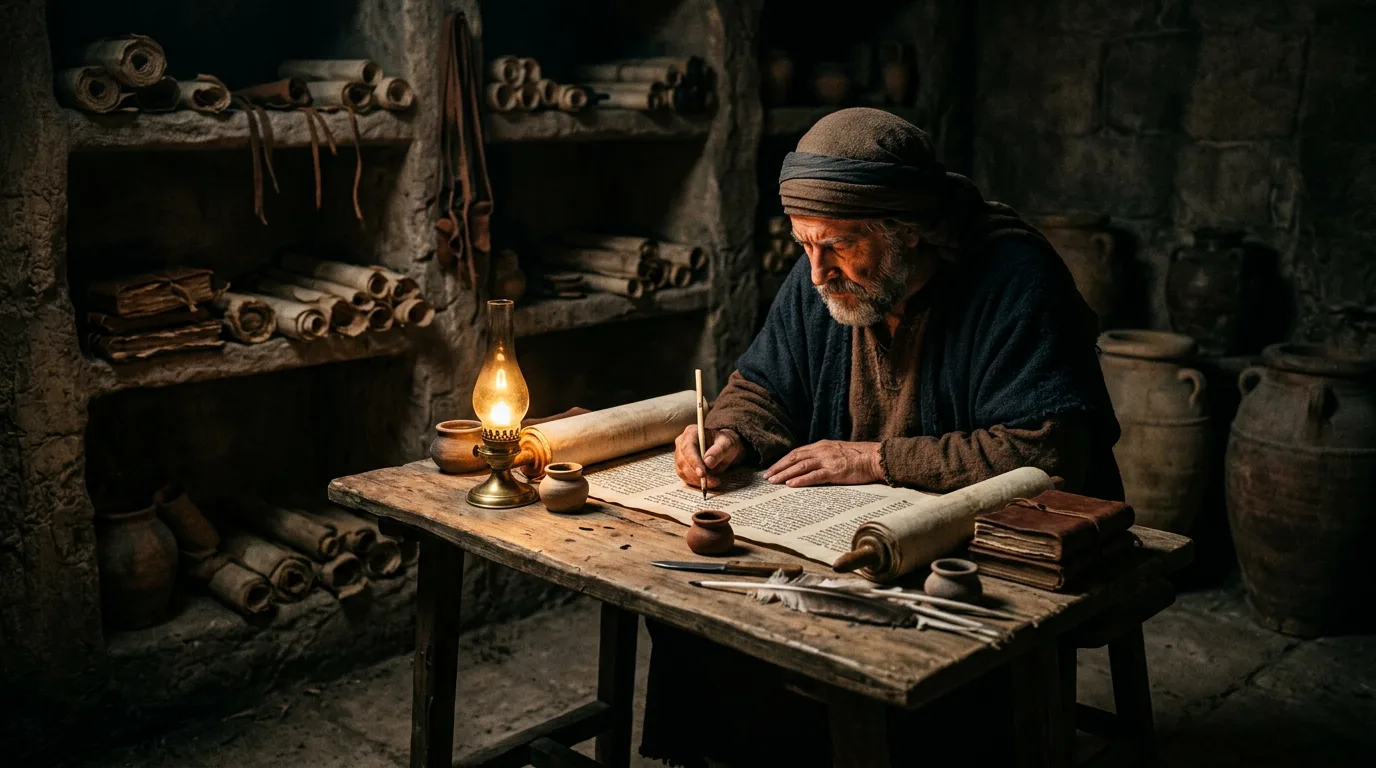
You are not reading what was written. You are reading what survived – after centuries of editing, by scribes who believed they had the right to change the words.
This is not a conspiracy theory. It is the starting point of every textual criticism course taught at every seminary in the world. Jewish, Catholic, Protestant – every tradition's scholars acknowledge the same fact: the Hebrew Bible was deliberately edited after it was composed.
The scribes did not hide it. They kept records. They documented which passages they changed, what the originals said, and why they made the corrections. Eighteen of these edits are catalogued in a rabbinic tradition called the Tiqqune Soferim – the "corrections of the scribes." Eighteen that they admit to.
Then came the Dead Sea Scrolls.
In 1947, manuscripts were discovered in caves near the Dead Sea – a thousand years older than the oldest Hebrew Bible anyone had. For the first time, scholars could compare what the text used to say with what the scribes turned it into.
In some places, the differences are minor. In others, they change who God is.
Two gods became one.
The oldest layer of the Bible describes a hierarchy: a supreme God called El Elyon – the Most High – who presided over a council of divine beings. He divided the nations among his sons and gave each one a people to govern. Yhwh received Israel.
Read that again. Yhwh was not the Most High. He was one of the Most High's sons. He was given one nation out of seventy. Deuteronomy 32:7–9 says it. The Dead Sea Scrolls confirm it. The Greek translation confirms it. The later scribes could not tolerate it – so they changed it.
That single edit – and the hundreds like it – collapsed the entire hierarchy. Two distinct beings became one. And every Bible printed since has carried the edited version as if it were the original.
Then they did it again – in the New Testament.
A thousand years later, different scribes made the same move. This time they took two distinct persons – Jesus and His Father – and merged them into one. They added a pen stroke to turn "He who" into "God." They deleted the words "nor the Son." They invented a Trinity verse that no Greek manuscript contains for over a thousand years.
Same operation. Same direction. Same result. Two distinct beings collapsed into one – twice.
Old Testament study → New Testament study →
Three things your pastor has never told you
The scribes admit it
Jewish tradition records at least eighteen passages where scribes deliberately altered the text to protect Yhwh's reputation. They flipped subjects and objects, changed pronouns, and softened language that made Yhwh look subordinate or fallible. These are not accusations – they are the scribes' own records.
The manuscripts prove it
The Dead Sea Scrolls preserve readings that the later scribes changed. In the most critical case – Deuteronomy 32:8 – the older text says "sons of God" where your Bible says "sons of Israel." That one word swap erased an entire divine hierarchy. And it is proven by manuscript evidence.
A prophet warned about it
Jeremiah 8:8 – a verse almost never preached in churches – says it directly: "The lying pen of the scribes has made it into a lie." A biblical prophet, writing during the very period when scholars believe the heaviest editing took place, accusing the scribes of turning the law into a falsehood.
Go deeper
Questions to sit with
- If the scribes changed the text – and admitted it – how do you know which parts of your Bible are original?
- If the oldest manuscripts say something different from the version you were given, which one is the Word of God?
- If Yhwh was originally a subordinate deity who received one nation, what happens to every doctrine that assumes he is the supreme God?
- Why have you never heard any of this in church?