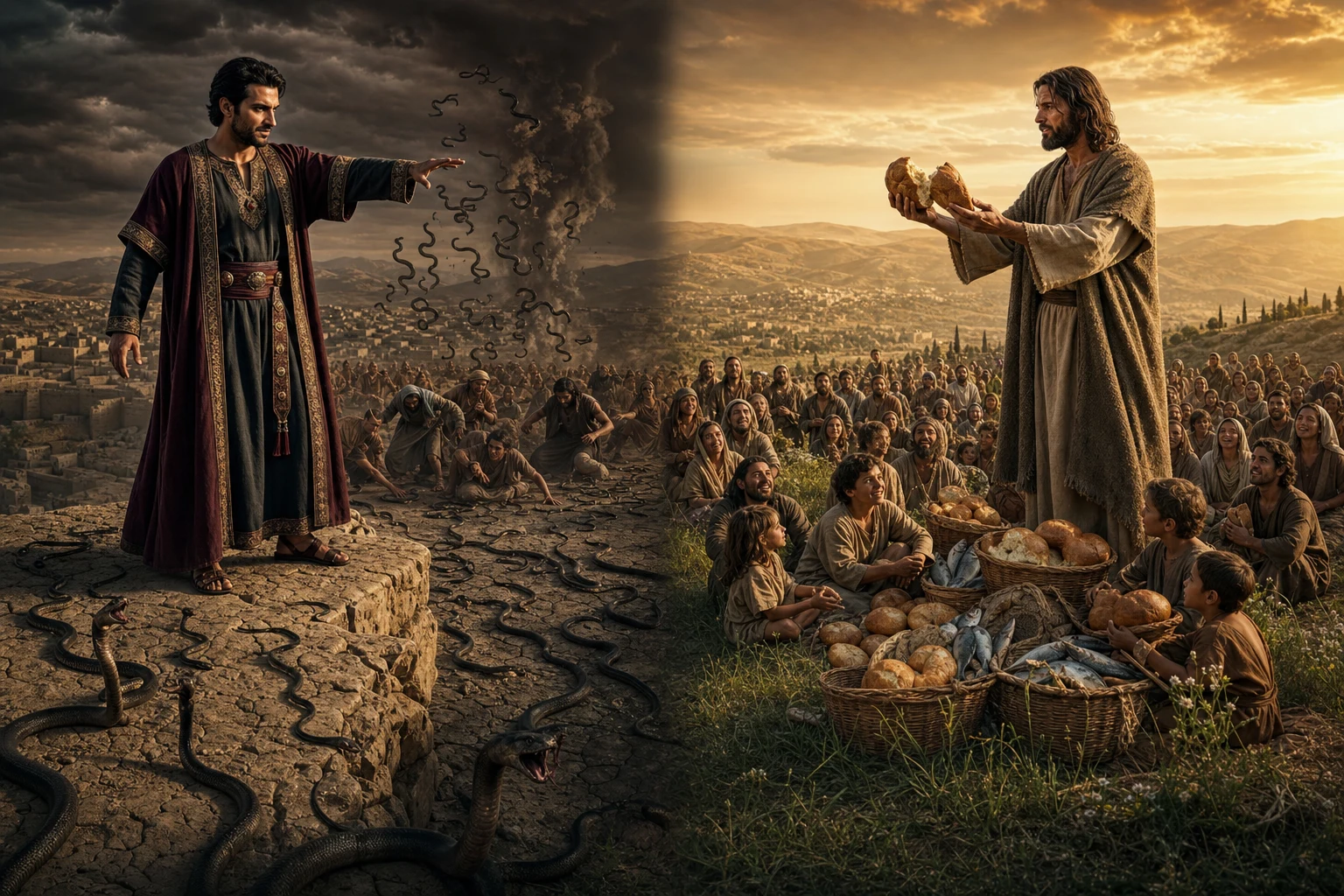
A legal test
Jesus gave us one tool for this question. "You will know them by their fruit." Not their name. Not the number of times their name appears in the Bible. Their fruit.
Jesus also said that no one truly knows Abba except the Son, and that seeing Him is seeing Abba. If that is true, Jesus is not just another voice in the Bible. He is the standard. Every picture of God we read has to be held up against Him.
The Bible preserves two portraits that do not match.
On one side stands Yhwh, the covenant Elohim of the Hebrews: he sends plagues and droughts, commands holy wars and ethnic cleansing, sanctions permanent slavery, builds curses into his covenant, kills priests for using the wrong incense, and sends lying spirits to trap kings into fatal battles.
On the other stands Jesus: Jesus heals every disease, feeds hungry crowds, refuses violence, touches the untouchable, forgives enemies, protects the accused, and announces a kingdom that cannot be taken away by fear or failure.
Current theology has spent two thousand years fusing these two into one God with two sides – Old Testament wrath, New Testament grace. Same person, different moods. Same person, "revealing Himself slowly over time." That is the official answer. It asks you to believe the being who ordered the slaughter of children is the same Abba Jesus describes – the one who sends sun and rain to good people and bad people alike.
This study does not merge them. For each theme, we put a Yhwh text next to a Jesus text or action on the same issue. We let the contrast stand. Then we ask which pattern matches Abba – the one who does not give snakes to sons, who did not come to condemn the world but to save it, who is kind to the ungrateful and to evil people.
"If the tree is known by its fruit, then the question is no longer how do we defend everything the Bible calls God. The question is which voice, which set of actions, which legal pattern actually matches Abba – the Father Jesus revealed."
23 contrasts at a glance
Each contrast is examined in full below. This table is a map of the territory.
Life and death
The most basic thing you can say about a ruler is what they do with the power over life. Start here.
1. Death as weapon vs. life as gift
Deuteronomy 32 is the Song of Moses – Yhwh's formal case against the Hebrews. When Yhwh says "I put to death," he is making a claim. Deaths among the Hebrews are not accidents. They are his work. The surrounding verses spell out the methods: famine, plague, sword, arrows drunk with blood. Death is the tool he uses to enforce his covenant – and he calls it his alone. "There is no one who can deliver from my hand." That is the boast of a god who has made escape impossible by design.
John 10:10 puts Jesus on the opposite side of a different player – the thief who "steals and kills and destroys." Jesus does not name Yhwh. Jesus does not have to. Jesus defines His own mission as the exact opposite: He gives life. He lays His own life down so His people can live. Under Yhwh's system, death is how loyalty is enforced. Under Jesus, death is the enemy He came to undo.
Read plainly, these are not one ruler with shifting moods. They are two rulers with opposing agendas. Which one would you want with your life in their hands?
2. Killing the lost vs. seeking the lost
Genesis 6 is Yhwh's response to a corrupt world. His conclusion: wipe out almost all of it. The entire human race except one protected family – all drowned, not pursued one by one, not warned individually, not called to change. No door is left open. No one outside Noah's immediate household survives. The lost, in Yhwh's judgment, are simply removed.
Luke 19 is Jesus meeting Zacchaeus – a tax collector, a collaborator, exactly the kind of person a righteous community would write off. Jesus calls him by name, goes to his house, and the encounter changes the man – he repents and pays back what he stole. Then Jesus states His own mission: "The Son of Man came to seek and to save the lost." Not to drown them. Not to erase them. To go to them. The fact that they are lost is exactly why Jesus comes for them, not why He removes them.
One treats the lost as a problem to be eliminated. The other treats the lost as the very people He came to find. If you were the one who was lost, which of these two would you want coming for you?
3. No pity, only destruction vs. no condemnation, only rescue
Jeremiah 13 is Yhwh's case against Judah for staying unfaithful. Yhwh spells out what is being taken away: pity – gone. Mercy – gone. Compassion – gone. This is not reluctant punishment. It is an official statement that mercy is off the table. Parents and children alike. The position is total: when the line is crossed, destruction comes without compassion.
Jesus defines His mission as the opposite of condemnation. John 3:17 is not an aside – it is a mission statement. In John 8, Jesus applies it directly to a woman caught in adultery – an obvious case under Yhwh's law, punishable by stoning. Jesus does not arm the crowd. Jesus does not sentence her. Jesus asks "Has no one condemned you?" She says no. Jesus says "Neither do I condemn you. Go, and do not sin any more." Real sin, real warning, no death sentence.
One withdraws compassion as official policy. The other makes rescue His stated purpose even when guilt is obvious. When you have done something you cannot defend, which of these two would you want sitting in judgment?
Violence and war
How does a ruler handle enemies? What does he command his people to do to those in his way? The record here is the hardest to dismiss, because it is the most explicit.
4. Genocide as obedience vs. enemy love as the family mark
Deuteronomy 20 is not a regrettable war story. It is law. Rules for war, issued by Yhwh, covering specific peoples in a specific land. The command is total: anything that breathes. Not just soldiers. The surrounding families, the elderly, the children. Sparing them is disobedience. The text is clear about that: wiping them out is doing what Yhwh commanded.
Matthew 5 is Jesus in the Sermon on the Mount. Loving your enemies is not a nice idea. Jesus ties it directly to who Abba is. Abba makes the sun rise on the evil and the good. Abba sends rain on the righteous and the unrighteous alike. Loving enemies is the family likeness. It is how you show whose child you are.
Under Yhwh, faithfulness means kill everything. Under Jesus, faithfulness means love everything. These are not "different eras." They are different spirits. Which command would you actually want to live under?
5. Do not spare infants vs. welcome the child as me
First Samuel 15 is Samuel passing on Yhwh's direct command. What Yhwh tells them to kill includes children and infants. The command is "do not spare them." Mercy toward infants is disobedience. When Saul later spares the Amalekite king Agag and the best livestock, Yhwh calls this a rejection of his word. How thoroughly they kill is how Yhwh measures their loyalty.
In Matthew 18, Jesus calls a child into the middle of the group and says that welcoming such a child in His name is welcoming Him. Jesus then adds the strongest possible warning against causing harm to "one of these little ones who believe in me." For Jesus, a child is where you meet Jesus Himself. Children are not expendable. They are not a group to be wiped out. They are the ones Jesus identifies with.
Yhwh ordered the killing of infants. Jesus said welcoming a child is welcoming Him. Could the same being have said both?
6. Destroy them totally vs. put your sword away
Deuteronomy 7 closes the door. No treaty. No mercy. Surrender is not an option. Repentance is not an option. The command is to wipe these groups out completely so they cannot influence the Hebrews. Yhwh makes the killing the test of loyalty: doing it is faithfulness, sparing them is rebellion.
Matthew 26 is the night Jesus is arrested. A disciple pulls a sword and cuts off a man's ear. Jesus stops him at once. Jesus does not say "wrong moment." Jesus says everyone who picks up the sword dies by it. Then in John 18 Jesus explains why: His kingdom does not run on force. His followers are not soldiers fighting for territory. This is not weakness. It is a different kind of rule with different rules.
Yhwh's order was kill them all. Jesus' order was put the sword down. Both cannot be coming from the same king. Which one are you actually supposed to follow?
7. Fire on offenders vs. rebuke of fire callers
In Leviticus 10, Aaron's sons Nadab and Abihu light incense with fire Yhwh had not authorized. The offense is about ritual, not morals. Wrong fire. The response is instant. Fire comes out from Yhwh's presence and burns them alive. No warning. No correction. No second chance. In 2 Kings 1, the same tool gets celebrated. Elijah calls down fire on two groups of soldiers – 100 men burned alive – just to prove he speaks for Elohim. The story treats it as vindication. Fire from heaven is a Yhwh tool, and his prophets are allowed to use it on people who reject his messengers.
James and John see a Samaritan village turn Jesus away. They reach for the same tool. "Lord, do you want us to call fire down from heaven and consume them?" That is the Elijah move. Jesus does not adjust the target. Jesus does not say "wrong people." Jesus rebukes them for even asking. Then Jesus walks to another village. The same Jesus who could calm a storm with a word refuses to use that kind of power on people who reject Him.
When people refused Yhwh, fire fell. When people refused Jesus, Jesus kept walking. Whose response would you rather face when you say no?
8. Eye for eye vs. turn the other cheek
Watch what Jesus does in Matthew 5. Six times in the Sermon on the Mount Jesus uses the same line: "You have heard that it was said… but I say to you." What Jesus quotes each time is the Torah – direct quotes from the law. Jesus is not fixing a misreading of the law. Jesus is putting His own teaching against what the law actually says. When Jesus quotes "eye for eye, tooth for tooth," that is Exodus 21:24 word for word. That is Yhwh's own legal code.
Jesus does not say "the deeper meaning of the law was always mercy." Jesus does not say "the rabbis got it wrong." Jesus says "but I say to you" and then commands the opposite. Jesus sets His own authority against Yhwh's law. Jesus is not polishing the law. Jesus is replacing it with something that runs on a different principle. That move is the central move of the Sermon on the Mount, and Jesus makes it six times in a row – each time pointing at a piece of Yhwh's law as the thing being replaced.
Jesus quoted Yhwh's law and then said "but I say to you." If Jesus and Yhwh were the same being, who is overruling whom?
Provision and care
What does each one do when people are sick, hungry, thirsty, or in need? This is fruit in the most literal sense.
9. Disease as weapon vs. healing as policy
Exodus 7–12 is plague after plague: blood, frogs, gnats, flies, livestock disease, boils, hail, locusts, darkness, dead firstborns. These are not natural disasters. They are tools. Yhwh uses sickness to pressure a foreign king and to put his power on display in front of a watching nation. He is not healing Egypt's sick. He is making them sick on purpose. Deuteronomy 28 turns this into official policy: disease goes on the curse list. Step out of line and Yhwh will give you the diseases of Egypt. Sickness in Yhwh's system is either his judgment or his leverage.
Matthew 4:23 sums up the start of Jesus' work in one sentence: Jesus healed every disease and sickness among the people. Not sometimes. Not when they earned it. The Gospels repeat this on purpose: the crowds bring everyone who is sick, and Jesus heals them. There is no story where Jesus calls down disease on someone to punish them or to prove a point. Sickness is treated as an enemy to remove, not a tool to use.
One uses sickness as pressure. The other treats sickness as the thing to remove. If you got sick tomorrow, which of these two would you want in charge of your healing?
10. Famine as sentence vs. hunger met with compassion
In 2 Kings 8, the famine is Yhwh's decision. He called for it. It will last seven years. Seven years of a land unable to feed its people – written into his system as the penalty for disobedience. Deuteronomy 28:23–24 spells out the formula: bronze sky, iron earth, no rain, no crops. Hunger is a tool. Yhwh controls the food supply and turns it off when his people step out of line.
In Matthew 15, Jesus looks at a crowd that has been with Him three days with nothing to eat. The word that comes out is compassion. Not strategy. Not lesson. Feeling. Jesus does not want them sent away hungry. Jesus feeds them. In Luke 11, when Jesus is teaching His disciples how to pray, He tells them to ask "give us today our daily bread" – because, Jesus says, your Father already knows you need these things, and giving is what Abba does.
One uses hunger to enforce loyalty. The other feels people's hunger and feeds them. Which of those two is the Father Jesus came to reveal?
11. Snakes for complaints vs. no snakes for sons
Numbers 21 is one of the cleanest moments in the Exodus story. The people are hungry. They complain about the food and the water. Yhwh's response: venomous snakes. Many of them die. Only after Moses begs for them does Yhwh provide a remedy – a bronze nachash on a pole. The bitten can look at it and live. The same Elohim who sent the snakes manages the cure. The people asked for food. They got snakes.
Luke 11 is part of the Good Father Discourse. Jesus is describing the Father His disciples are praying to. Jesus makes the contrast directly: "What father among you, if his son asks for a fish, will give him a snake instead?" The answer is obvious. No good father does that. Then Jesus argues from the smaller to the bigger: even broken human fathers give good gifts. How much more your Father in heaven. Jesus is naming the Exodus pattern – snakes for food requests – and saying: that is not your Father.
One sent snakes when the people asked for food. The other says no real father would ever do that. Could they possibly be the same Father?
More context Numbers 21 and the nachash on the pole
In Numbers 21, after the snake deaths, Yhwh instructs Moses to make a bronze nachash (serpent/shining one) on a pole. Anyone bitten who looks at it lives. Jesus references this in John 3:14: "Just as Moses lifted up the serpent in the wilderness, so the Son of Man must be lifted up." The nachash that brings life when lifted on a pole is Jesus. The same symbol. This is one of the most arresting connections in the biblical text.
12. Shutting the heavens vs. rain for everyone
This is probably the most-quoted verse in American church culture: 2 Chronicles 7:14. Thousands of prayer campaigns and bumper stickers use it. Almost every one of them cuts off verse 13. But verse 13 is the same sentence. "When I shut up the heavens… if my people humble themselves…" Verse 14 is the response to the threat in verse 13. Yhwh is saying: when I send drought, locusts, and plague on my own people, here is how they get me to stop. That is the actual context of the famous promise. The relief is offered after he is the one causing the harm.
Jesus describes Abba's rain differently. Abba sends rain on the righteous and the unrighteous. On the evil and the good alike. Sun for both. Rain for both. No covenant condition. No "humble yourselves first." This is a Father whose generosity does not sort people before He gives. Rain is not leverage. It is evidence of who Abba is – a Father who gives life even to people who reject Him.
What about "God is the same yesterday, today, and forever – so he didn't really change"
That verse (Hebrews 13:8) refers to Jesus, not Yhwh. And ironically, it is one of the strongest arguments against the merger – if Jesus is the same yesterday, today, and forever, and Jesus does not send droughts or order genocides or deploy lying spirits, then the being who does those things is not Jesus. You cannot simultaneously claim Jesus is unchanging and that Jesus used to act like Yhwh.
One withholds rain until you repent. The other sends rain whether you do or not. Which one sounds like the Father Jesus describes?
Relationship and presence
How does each ruler relate to the people who follow him? What is the emotional posture of the relationship? What happens when they fail?
13. Rule by fear vs. gifted kingdom
Deuteronomy 6 is the Shema section – the most central command in the Torah. The fear in "fear Yhwh your Elohim" is not awe or respect. It is the kind of fear a slave has for a master who can destroy him. The surrounding verses make the threat concrete: if the people follow any other Elohim, Yhwh's anger will burn and he will wipe them off the land. Service is tied to fear. Loyalty is held in place by the warning of what comes if they leave. And when people did try to leave, he killed them for it.
Luke 12:32 sits in a teaching about anxiety. Jesus calls His followers "little flock" – a shepherd's word. The command is "do not be afraid." Not "do not be afraid unless you sin." Not "do not be afraid as long as you obey." Do not be afraid – because your Father has already decided to give you the kingdom. The gift comes first. The demand comes after. Fear is taken apart, not installed.
One rules by the fear of what happens if you walk away. The other tells you upfront that the kingdom is already yours. Which one wants you close because you love Him, and which one wants you close because you are afraid?
14. Removed from sight vs. never driven away
When the northern kingdom falls in 2 Kings 17, the writer is not just describing a military defeat. He says Yhwh personally pushed them away: "He removed them out of his sight." Exile is two things at once. Pushed off the land. Pushed out of his presence. Other texts say the same: Deuteronomy 31:17 – "I will hide my face from them." Removal is one of Yhwh's enforcement tools.
John 6:37 runs in the opposite direction. Whoever comes to Jesus will not be sent away. The verb is strong – "never drive away." No later eviction. The prodigal son parable in Luke 15 is the same logic: a son who has wasted everything comes home expecting to be demoted, and the father runs to meet him and throws a party. No probation. No exile. No hidden face. The direction reverses: Yhwh removes from sight when you fail; Jesus refuses to send you away when you come.
One removes you from sight when you fail. The other refuses to send you away when you come. Which of these two would you trust with your worst day?
15. Hiding his face vs. never leaving orphans
In Deuteronomy 31, Yhwh describes his own future behavior when his people turn away. He will hide his face. The result is abandonment to disaster. Hiding is a deliberate action. The covenant response to unfaithfulness is to turn away and let the consequences come. Abandonment is not a slip. It is policy.
Jesus' last words in Matthew 28 are a promise of presence: "I am with you always, to the end of the age." In John 14, knowing He is about to physically leave, Jesus uses the exact category Yhwh used: "I will not leave you as orphans." Jesus refuses the category. His followers will not be left without Him. Where Yhwh hides his face when people fail, Jesus commits to stay when people fail.
When His people failed, Yhwh hid his face. When His followers fail, Jesus refuses to leave. Which posture sounds like a real Father?
16. One family chosen vs. all nations invited
Amos 3:2 is a stark sentence. Yhwh has formally chosen one family out of all humanity. The Hebrews alone are "known" – the word means committed, in a covenant relationship. Every other group is outside that relationship. Deuteronomy 7:6 says the same thing: out of all the peoples on the face of the earth, Yhwh chose this one to be his treasured possession. His favor has an ethnic and national line drawn around it.
In Matthew 8, a Roman centurion shows faith and Jesus uses the moment to break that line wide open. Many will come from east and west – outsiders, foreigners, people outside the covenant – and take their places at the table with Abraham, Isaac, and Jacob. Then Jesus adds the warning: some of those who assumed their seat was guaranteed will find themselves shut out. The seat is not inherited. The table is open to anyone who trusts Jesus, no matter where they come from.
One built a covenant around a single favored family. The other opens the table to outsiders and warns the insiders that being born inside matters less than they think. Which of those two sounds like a Father to all of us?
Justice and the vulnerable
Who does each ruler protect? Who does he exploit? What does he do with power over those who cannot defend themselves?
17. Commanded stoning vs. exposed accusers
Deuteronomy 21 spells out the community's response to a son who will not obey his parents. The offense is disobedience – not violence, not theft, not murder. The method is execution by the whole town. The stated goals are "purge evil" and put fear into the people. And stoning is not limited to this case. Yhwh's law prescribes the same penalty for adultery, blasphemy, idolatry, and Sabbath-breaking. The pattern is consistent: certain sins are met with public killing carried out by the group.
In John 8, religious leaders bring a woman caught in adultery and quote Moses' command to stone her. It is a textbook stoning case under that law. Jesus does not pick up a stone. Jesus does not back the sentence. Jesus moves the spotlight from her guilt to the accusers' guilt. One by one they leave. Jesus asks her, "Has no one condemned you?" No one. "Then I do not condemn you either. Go and do not sin any more." Jesus stops the stones, sends the accusers away, and frees the woman alive.
One commanded the community to stone the sinner. The other stopped the community from stoning the sinner. Whose verdict would you want the day you actually deserved one?
18. System of curses vs. command to bless
Deuteronomy 28 is the official curse list. If the Hebrews break the covenant, Yhwh promises curses, confusion, and rebuke on everything they put their hand to. The scope: everything. The duration: until they are destroyed. The lineup: disease, defeat, drought, madness, the loss of their children. Cursing his own people when they fail is part of how Yhwh governs them. He is the one sending the curses.
In Luke 6, Jesus gives His followers a different ethic for dealing with those who wrong them: love them, do good to them, bless them, pray for them. Cursing is what enemies do – and Jesus forbids it in return. A few verses later Jesus ties this directly to Abba's character: "Abba is kind to the ungrateful and the evil. Be merciful, just as your Father is merciful." Blessing your enemies is not a nice idea. It is the family likeness. It is how Abba actually behaves.
One sends curses on his own people when they disobey. The other tells His people to bless even their enemies. Which of these is the family you want to be in?
19. People as property vs. son who frees slaves
Leviticus 25 is not a regrettable story. It is Torah – law issued by Yhwh as the lawgiver. The structure is explicit: foreigners and their descendants can be bought, owned as property, passed down to your children, and kept as slaves for life. The Jubilee year that freed Hebrew debt-slaves did not apply to them. Yhwh does not just permit this. He defines its terms. He is the one who decides who can be a master and who can be permanent property.
In John 8, Jesus tells people who think they are free that they are already slaves – slaves to sin, slaves to the system they trust. Jesus presents Himself as the one who can move them out of slavery into real freedom. And in Matthew 20, Jesus blocks any kind of master-and-slave hierarchy among His followers: "The rulers of the Gentiles lord it over them… it must not be so among you." That is the direct opposite of Leviticus 25 in practice.
One wrote a law that lets you own a person for life. The other says if the Son sets you free, you are truly free. Which one would you want to encounter on the worst day of your life?
20. Erase from the land vs. outsider as true neighbor
The peoples listed in Deuteronomy 20:17 – Hittites, Amorites, Canaanites, Perizzites, Hivites, Jebusites – are the inhabitants of the land. The command is total destruction. No integration. No protection. No mercy. Their entire presence – ethnic, religious, cultural – is to be removed so that only the Hebrews remain. The order is not a regret. It is a rule of war signed by Yhwh.
In Luke 10, a legal expert asks Jesus, "Who is my neighbor?" He is really asking: who falls inside my circle of obligation? Jesus answers with the Good Samaritan. The religious insiders – a priest, a Levite – walk past a beaten man. The Samaritan, a member of a despised outsider group, stops, helps, and pays for the man's ongoing care. Then Jesus asks the legal expert, "Which of these was a neighbor?" The outsider. The despised one. The one who would have been on Yhwh's extermination list. Jesus holds him up as the model and says, "Go and do likewise."
One ordered the destruction of the outsider. The other made the outsider the hero. Which of these would you want walking into your village on the day you needed help?
21. Inherited curse vs. refusing to blame ancestors
Exodus 20:5 sits inside the Ten Commandments – not at the edge, not in fine print. Yhwh calls himself "jealous" and announces that children will carry the consequences of their parents' covenant failures down to the third and fourth generation. This is not a slip. It is his stated policy, attached to his own description of who he is. The same formula appears again in Exodus 34 and Deuteronomy 5. Punishing children for what their parents did is not a glitch in Yhwh's system. It is built into the foundation.
In John 9, Jesus' disciples see a man born blind and ask the obvious question under that framework: who sinned – this man or his parents? Jesus rejects both options. Neither. Jesus refuses to root the man's suffering in family guilt. Then Jesus heals him. The response to inherited suffering in Jesus' presence is not blame. It is restoration.
One punishes children for what their parents did. The other refuses to blame the man or his parents and heals him. Whose family ledger would you actually want to be born into?
22. Touch the sacred, die vs. touch Jesus, be healed
Uzzah is transporting the ark on a cart. The oxen stumble. He reaches out to steady it – the instinct of anyone who does not want something holy to fall in the dirt. The ark does not fall. Uzzah does. The text calls his act "imprudence." Uzzah meant well. He died anyway. Yhwh's holiness kills.
The woman in Mark 5 has been bleeding for twelve years. Under Yhwh's purity laws, her bleeding makes her ritually unclean. Anyone she touches becomes unclean. She pushes through a crowd and secretly touches the hem of Jesus' robe. In Yhwh's system, her touch should defile Him. The opposite happens. Her bleeding stops at once. She is healed. Jesus calls her "daughter" and tells her that her faith has made her well. Contact with Jesus does not contaminate the unclean. It heals them.
Yhwh's holiness killed a man who reached out without permission. Jesus' holiness healed a woman who reached out in desperation. Whose holiness would you want to touch?
Truth and deception
This one last. Because it is the capstone. If you can get past the genocide, the slavery, the famine-as-policy, and still say "same person, different era" – read this one.
23. Author of deception vs. truth and spirit of truth
First Kings 22 is a council scene. The prophet Micaiah describes Yhwh sitting with his divine council, planning the death of King Ahab. Different ideas get floated. One spirit volunteers: "I will go out and be a lying spirit in the mouths of all his prophets." Yhwh's response: "Entice him and you will succeed. Go and do it." Micaiah delivers the verdict to the king directly: "The LORD has put a lying spirit in the mouth of all these prophets of yours." Yhwh is not permitting deception from a distance. He approves the plan, commissions the agent, and is given credit for the result. A lying spirit is one of his tools.
On the night before Jesus is arrested, Jesus names Himself "the truth" – not as a quality He has, but as something He is. Then Jesus promises Abba's Spirit to His disciples and gives that Spirit a specific name: the Spirit of truth. The Spirit's job is to guide them into all truth. Not effective strategy. Not managed outcomes. Truth. The contrast with an Elohim who sends out lying spirits could not be sharper.
Current theology tells you God cannot lie. "He is truth by nature." Then ask what to do with 1 Kings 22. The standard answer is "well, the lying spirit was a demon." Read the text. Yhwh approves the plan, commissions the agent, and is given credit for the result. You cannot quarantine this passage with a footnote.
Yhwh sent out lying spirits. Jesus sent out the Spirit of truth. If you had to bet your life on the words of one of them, which one would you trust?
The conclusion
Twenty-three contrasts. The same issues, the same text, the same test Jesus gave us.
The Yhwh pattern: legal violence, conditional acceptance, collective punishment, ethnic preference, fear as governance, drought and plague as leverage, deception as strategy.
The Jesus pattern: healing, enemy love, protection of children, breaking condemnation, refusing generational blame, a Father who gives sun and rain to all, who does not hand snakes to sons.
You are not looking at justice then mercy. You are not looking at the same God in two different moods across two testaments. You are looking at two different rulers with opposite instincts about life, enemies, children, outsiders, truth, and the use of power.
Christianity invented a merger and told you it was orthodoxy. The merger requires you to redefine "good" so that commanded genocide, infant killing, multigenerational punishment, drought as a weapon, and lying spirits sent to kill kings can all be called the same goodness that Jesus reveals. The apologetics industry exists to make that redefinition seem reasonable.
But Jesus did not give us the apologetics test. Jesus gave us the fruit test.
Look at the fruit. Not the name. The fruit.
The remaining question is not how to harmonize these two portraits. It is which ruler you stand under and which voice you trust as Father and Son. Jesus said you cannot serve two lords. You will love one and despise the other. The choice is not between Christianity and atheism. It is between Yhwh and Jesus.
Three questions to sit with:
If a man treated his children the way Yhwh treats his people in these passages, would you call him a good father – or would you call the police?
When you pray, who do you actually picture? The one who sent snakes when his children asked for food, or the one who said no real father would ever do that?
Jesus said you would know them by their fruit. Look at the two patterns side by side. If the names were stripped off, which one would you call God?
Jesus came to reveal a Father they did not know. A Father whose character matches His own words and actions. In direct contrast to the record attached to Yhwh.