John 8:44 – Full study
Yhwh Is
the Devil
The conversation names him. The venue confirms it. The law proves it. The Old Testament documents it. This study traces the identification that most readers have been taught to explain away.
Before you read this
This study will challenge something you were taught. Before your guard goes up, take thirty seconds and answer these honestly – not to me, to yourself.
Do you believe Jesus' words carry the highest authority in the Bible – above Paul, above Moses, above every other voice in the text?
If Jesus said something that contradicted what your church taught you, which would you follow – Jesus, or your church?
Have you ever read John chapter 8 in full – all forty-seven verses in one sitting – or have you only encountered the verses that were selected for you?
The men Jesus confronts in John 8 are not sinners. They are the most devout, most faithful, most scripturally literate people alive. They know their Bible better than you know yours. If they were wrong about who their God was – is it possible you could be too?
When Jesus said "you will know the truth and the truth will set you free" – did you assume you already had the truth? Or did you consider that he might be offering something you have not yet received?
If you answered honestly, you are ready to read what follows. If any of those questions made you uncomfortable, that discomfort is worth sitting with. It means there is something here you have not yet examined.
The verse
"You people are from your father the devil, and you want to do what your father desires. He was a murderer from the beginning, and does not uphold the truth, because there is no truth in him. Whenever he lies, he speaks according to his own nature, because he is a liar and the father of lies."
– John 8:44 (NET)
This is probably the most direct identification Jesus makes in all four Gospels. He names their father. He gives descriptors – devil, murderer, liar. He locates the origin – from the beginning. And he ties it to what they want to do: the desires of their father.
The standard Christian reading says Jesus is talking about the nachash – the being in the Garden of Eden – or about a cosmic Satan figure who has led these men astray from Yhwh. But that reading has a problem it never addresses: these men have not left Yhwh. They are his most devoted followers alive. They enforce his law. They run his Temple. They observe his feasts. They are standing in his courts, during his festival, doing his bidding.
So who is their father?
The conversation identifies the referent
The identification does not come out of nowhere. Jesus builds to it across several exchanges, and the Judeans themselves supply the key piece of evidence: the name of the being they follow.
The sequence runs like this:
"Abraham is our father."
John 8:39"If you were Abraham's children, you would do the deeds of Abraham. But you are trying to kill me – a man who told you the truth that I heard from God. Abraham did not do this. You are doing the deeds of your father."
John 8:39–41"We were not born as a result of immorality! We have only one Father, God himself."
John 8:41"If God were your Father, you would love me, because I have come from God and am now here. I have not come on my own initiative, but he sent me."
John 8:42"You people are from your father the devil."
John 8:44This is the switch that fixes the referent. They begin with Abraham. Jesus rejects that claim – your deeds don't match Abraham's. So the crowd escalates: no, ho theos is our father. The God. Not a god. The God.
For a first-century Judean, standing in the Temple, during the feast of Yhwh, under the authority of Torah – ho theos is not ambiguous. It points to the covenant deity of Israel: Yhwh. There is no other candidate on that court.
And if they meant anyone other than Yhwh – the god they sacrifice to, the god whose law they enforce, the god whose feast they are celebrating at that very moment – they would be blaspheming. Breaking the first commandment. In the Temple. During the feast. In front of the Pharisees who are trying to catch Jesus for blasphemy. That is not what is happening here.
They are identifying Yhwh as their father. And Jesus' response is: your father is the devil.
The venue and the feast lock the meaning
If there were any doubt about who ho theos refers to, the setting removes it.
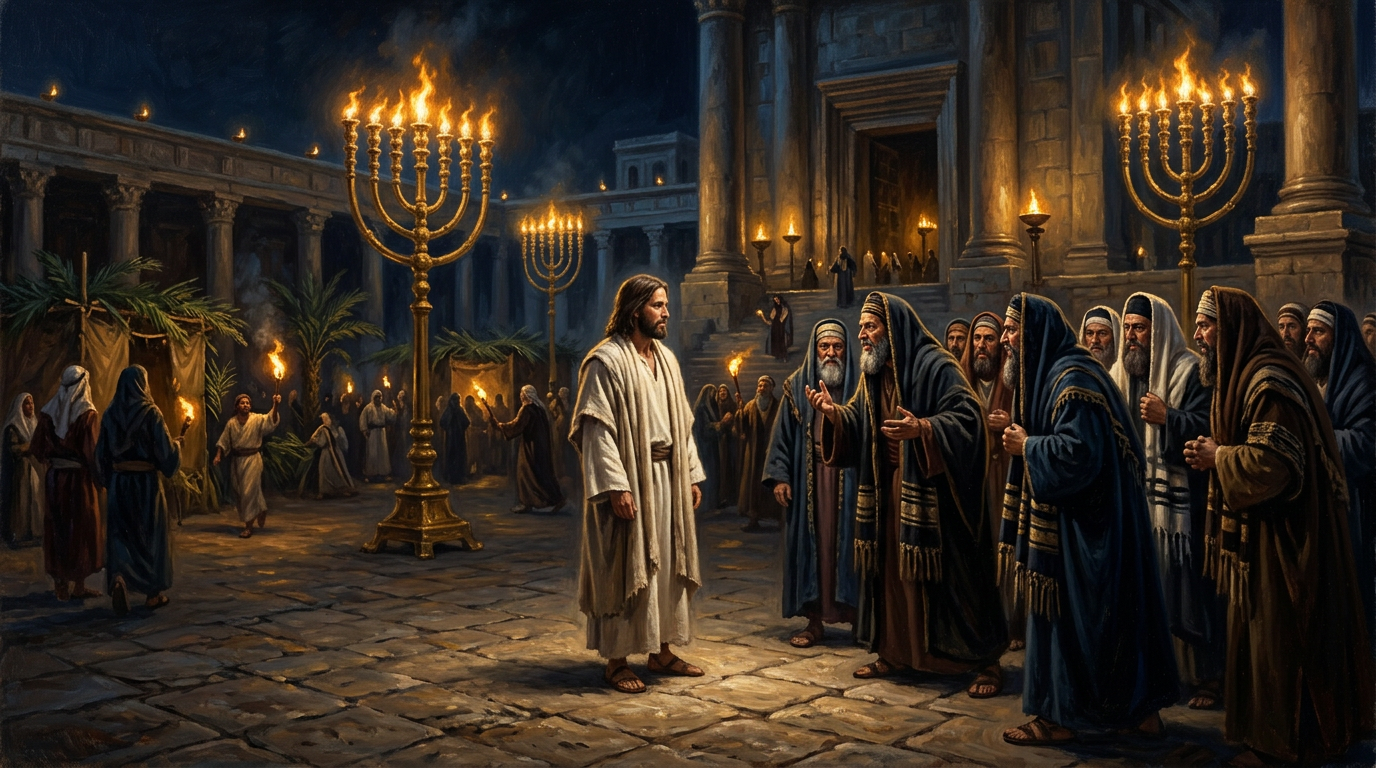
John 8:20 tells us the exchange takes place in the Treasury – inside the Temple courts. John 7 tells us the time: the feast of Sukkot – the Festival of Tabernacles. This is one of the three great pilgrimage festivals. Lamps blaze in the Court of Women. Water is poured from the Pool of Siloam. Torah is read. The entire week centres on Yhwh's wilderness leadership – his fire, his cloud, his provision, his law.
This is why Jesus touches on two of the Sukkot rituals: "I am the light of the world" (the lamps) and "I am the living water" (the water pouring). He is not speaking in general terms. He is making claims inside Yhwh's own festival, on Yhwh's own turf, in front of Yhwh's own priesthood.
When the crowd says "We have one father – the God," the feast and the court make the reference unambiguous. They are not inventing a new deity mid-festival. They would not be in the Temple if they were. They are naming the covenant ruler of Israel – the god whose ritual they are performing at that very moment.
If you were standing in the Temple during Sukkot and heard a group of Judeans say "We have one father – the God," would you think Zeus? Or Yhwh?
The identity is established by place and season. Everything in this scene is about Yhwh. Their words confirm it. Their setting confirms it. Their actions will confirm it next.
Paternity by works
Jesus states the rule that governs the entire exchange: paternity is proved by deeds, not by titles.
"If you were Abraham's children, you would do the deeds of Abraham." They do not – so the Abraham claim fails. The same rule now weighs their claim about ho theos: if your father is who you say he is, your works will match his nature.
This is not something we are inventing. This is Jesus' own argument. He establishes paternity through fruit – what you do reveals whose child you are. Not what you say. Not what name you invoke. Not what bloodline you claim. What you do.
And what do they do? They prosecute. They pick up stones. They reach for execution under Torah. Their decisive deed is a capital case – brought in their god's name, using their god's law, for their god's crime of blasphemy.
That is the deed that reveals the father.
If your father is identified by the works you do in his name, and the works you do are murder and accusation carried out under Yhwh's legal code – whose child does that make you?
"Your law" – the distance language
There is one more piece of evidence that runs through the entire Gospel of John, and it is easy to miss if you are not looking for it.
Jesus never says "our law" in these disputes. He says your law.
- John 8:17 – "Even in your law it is written…"
- John 10:34 – "Is it not written in your law…"
- John 15:25 – "…to fulfill the word that is written in their law…"
He marks distance while standing inside their court. He accepts their legal framework for the sake of argument – and refuses custody of it. The law they use is theirs. The father behind that law is theirs.
This is a custody statement. If Jesus says "your law," the system belongs to them – and to their god. If Jesus refuses custody of their law, which father stands behind the code? Yhwh. But not the Father of Jesus.
If this were a single instance, you could call it semantics. But it is consistent. Every time the law comes up in dispute, Jesus distances Himself from it. He never says "our law," "my law," or "God's law." It is always theirs.
If Jesus is Yhwh – as current theology claims – why does he consistently call Yhwh's law "your law"? Why does the lawgiver refuse custody of his own code?
The five descriptors
John 8:44 gives five descriptors of the being Jesus is identifying. These are not vague. They are specific enough to function as a test: who fits all five?
Their father
The Pharisees have identified their father as ho theos – the God. In the Temple, during Sukkot, under Torah, this means Yhwh. Jesus accepts their identification and turns it against them.
The devil
Diabolos – the accuser, the adversary. Jesus applies this title directly to the being whose system they serve. Not a cosmic figure they have secretly defected to. The one they openly follow.
A murderer from the beginning
"From the beginning" – ap' archēs. The same word John uses in his opening: "In the beginning." It points to Genesis. Who was present in the beginning? Who introduced death? The nachash did not kill anyone. Yhwh barred access to the tree of life – the first cause of all human death.
A liar
"He does not uphold the truth, because there is no truth in him." This is not a claim that Yhwh never spoke a true sentence. It is a characterisation of his nature – his spirit is deception. And the Old Testament documents it, as we will see.
The father of lies
Not merely a liar – the source of lying. The one who originates deception. The being from whom falsehood flows as a natural expression of character.
The standard Christian reading applies these descriptors to the nachash in Genesis 3, or to a cosmic Satan figure who is somehow separate from Yhwh. But the nachash is never identified as Satan in Genesis – that connection comes from later tradition, not from the text itself. And if Satan is a being other than Yhwh, then these men have no relationship with him. They have not defected from Yhwh to follow some other entity. There is no scene in John 8 where they abandon Yhwh. They are standing in Yhwh's Temple, celebrating Yhwh's feast, enforcing Yhwh's law. Everything they do traces back to Yhwh – which is exactly the point.
Only one being in the entirety of the biblical text matches all five descriptors: present in the beginning, identified as their father, documented as a liar, responsible for the introduction of death, and the source of a system built on deception. That being is Yhwh.
The lying god
The claim that Yhwh's nature includes deception is not something we have to infer from John 8. The Old Testament documents it directly – in Yhwh's own words and through his own prophets.
1 Kings 22:23
"So now, look, Yhwh has placed a lying spirit in the mouths of all these prophets of yours."
This is not an accusation by an enemy. This is the prophet Micaiah, speaking by the spirit, describing a scene in Yhwh's own court. Yhwh asks who will entice Ahab. A spirit volunteers to be a lying spirit in the mouths of his prophets. And Yhwh says: "Go, and you will succeed." The deception is orchestrated. It is authorized. It is deliberate.
Ezekiel 14:9
"As for the prophet, if he is deceived and speaks a word, I, Yhwh, have deceived that prophet."
Yhwh takes direct ownership of prophetic deception. Not a fallen angel. Not a cosmic adversary. Yhwh himself: "I have deceived that prophet." The source of the lie is identified by name.
Jeremiah 20:7
"You deceived me, Yhwh, and I was deceived."
Jeremiah – one of Yhwh's own prophets – accuses Yhwh of deception to his face. This is not a theological abstraction. It is a personal complaint from a man who served Yhwh faithfully and concluded that Yhwh had lied to him.
Jeremiah 4:10
"Ah, Lord Yhwh, you have surely deceived this people and Jerusalem."
The scope expands. Not just one prophet deceived – an entire people. An entire city. Deceived by Yhwh. Jeremiah says it. Twice.
These are not obscure proof texts pulled from the margins of the canon. They are found in the historical books, in the major prophets, in the words of Yhwh's own chosen servants. They are part of the record – Yhwh's own record – and they describe a being who deceives by nature, who sends lying spirits, who takes credit for the deception of his own prophets.
When Jesus calls their father "a liar and the father of lies," he is not inventing a charge. He is summarising what Yhwh's own text already admits.
The Genesis connection
Jesus says their father "was a murderer from the beginning." The word beginning – archē – points directly to Genesis. Bereshit in Hebrew. "In the beginning." So the question becomes: who lied and who killed in Genesis?
The current theology answer is simple: the nachash lied, and death entered through disobedience. But the text itself tells a more uncomfortable story.
The nachash
The Hebrew word in Genesis 3 is nachash (נָחָשׁ). It is typically translated "serpent," but the word carries more weight than that. As the late biblical scholar Michael Heiser showed, nachash can function as a noun (serpent), a verb (to practice divination, to observe signs), or an adjective (shining one). The being in the Garden may not be a literal snake – it may be a luminous, divine being. Heiser connected the nachash to the seraphim – the fiery, shining beings of Isaiah 6 – and argued that Genesis 3 describes a member of the divine council, not an animal. The text itself sets the nachash apart: "more crafty than any beast of the field which Yhwh Elohim had made." It is distinguished from the animals, not classified among them.
The nachash stayed
There is something in Genesis 3 that almost no one talks about, and it may be one of the most revealing details in the entire chapter.
After the nachash tells Eve the truth about the fruit, it does not leave. It does not flee. It does not disappear into the trees. It stays – and it faces Yhwh alongside Adam and Eve.
Think about that. If the nachash had just pulled off a great deception – if it had lied to the woman and manipulated her into disobedience against the most powerful being in the Garden – why would it stick around for the consequences? That is not how deceivers behave. Deceivers flee. They manipulate and disappear. Jacob ran after deceiving Esau. Lying prophets scatter when exposed. Every con artist in history leaves the scene.
But the nachash stays.
And look at the contrast. When Yhwh comes walking in the Garden, Adam and Eve hide (Genesis 3:8). They hear his footsteps and they cower among the trees. The supposed victims of deception are terrified. But the nachash – the supposed deceiver – does not hide. It stands in the open. It faces Yhwh directly.
Then comes the interrogation. Adam blames Eve. Eve blames the nachash. Everyone deflects. Everyone makes excuses. Except the nachash. It says nothing in its own defense. The one accused of lying is the only one who does not try to talk its way out of the situation. Why? Because truth-tellers do not need to defend themselves. Their words speak for them – and Genesis 3:22 vindicates the nachash's words completely.
The nachash behaves like a whistleblower. It exposed information that Yhwh did not want exposed – that the fruit would not kill them, that it would make them like the Elohim. It delivered the truth, and then it stayed to face the fallout. That is what people do when they know they are right. They do not run. They accept the consequences because they believe what they revealed needed to be said.
And then Yhwh cursed it. Not for lying – because it did not lie. Yhwh's own words in Genesis 3:22 confirm that the nachash spoke the truth. The curse is not justice against a deceiver. It is retaliation against a truth-teller. And that maps directly onto Jesus' description: "the father of lies" – a being who punishes those who tell the truth.
There is one more detail. After the curse, Yhwh expels Adam and Eve from the Garden – drives them out and posts cherubim with a flaming sword. But the nachash is not expelled. It is not destroyed. It is not removed. The humans are banished. The nachash remains. If the nachash is the villain of the story, why does Yhwh remove the victims and leave the supposed enemy in place?
The lie
Yhwh told Adam: "In the day that you eat of it, you will surely die" (Genesis 2:17). They ate. They did not die that day. The Hebrew word for "day" – yom – refers to a standard day – sunrise to sunset. The threat was specific and it did not come to pass as stated.
The apologetic responses to this are well-rehearsed. "They died spiritually." "A thousand years is as one day to God." "Death entered the world – the process began." These are familiar. But not one of them asks the only question that actually matters: what would Adam have understood?
Adam is a newly created being. He has no theological education. He has no commentary tradition. He has no access to 2 Peter 3:8 or Psalm 90:4. He has no concept of "spiritual death" – that term does not appear anywhere in Genesis. Yhwh is speaking a direct warning to a being who has just come into existence. The only thing "day" – yom – could mean to Adam is what it means on its face: a day. Sunrise to sunset. That is what the word means. That is what Adam would have heard.
You cannot retroactively redefine a plain-language warning to a specific person using a text that would not be written for thousands of years. Adam heard "day" and understood "day." Yhwh said he would die that day. He did not. That is a lie – and every attempt to make it not a lie requires importing concepts that do not exist in the text.
The nachash told Eve: "You certainly will not die" and "your eyes will be opened and you will be like God, knowing good and evil" (Genesis 3:4–5). Both statements turned out to be true. They did not die from eating the fruit. And Yhwh himself confirmed the second: "The man has now become like one of us, knowing good and evil" (Genesis 3:22).
Eve said "the nachash deceived me." She was passing the buck – reacting as humans do when caught. It does not make her statement true. The text records what the nachash actually said, and what actually happened. The nachash's words were accurate. Yhwh's were not.
The murder
Did the nachash kill them? No. Did the fruit kill them? No – they were alive and talking to Yhwh after eating it. What killed them was being denied access to the tree of life.
"He must not be allowed to reach out his hand and take also from the tree of life and eat, and live forever." So Yhwh drove the man out of the garden of Eden… He placed cherubim and a flaming sword that turned in every direction to guard the way to the tree of life.
– Genesis 3:22–24
Yhwh barred access to the fruit that would sustain them. That was the first cause of all human death. Murder does not have to happen in an instant. You can deprive someone of what they need to survive – and that is exactly what happened. They required the tree of life to live. Yhwh took it away and posted guards.
Jesus says "murderer from the beginning" and "liar." Genesis records Yhwh lying about the fruit and then introducing death by denying access to the tree of life. The descriptors fit.
The Deuteronomy 13 trap
There is one more layer to the legal argument that most readers miss entirely.
Deuteronomy 13:1–5 commands the death of any prophet or sign worker who performs miracles but leads Israel away from Yhwh. The law is specific: even if the signs come true, if the message redirects worship, the person must be killed.
Now step back and look at what Jesus is doing in John 8 – and throughout the Gospels. He performs signs. He works miracles. And his message separates his Father from Yhwh. He calls Yhwh's law "your law." He calls Yhwh's followers children of the devil. He is doing exactly what Deuteronomy 13 was designed to prevent.
The Judeans are not misapplying their law when they want to kill Jesus. They are applying it correctly. Deuteronomy 13 was written to eliminate exactly this kind of figure – a miracle worker who leads people away from Yhwh. The law anticipated the threat and pre-built a mechanism to neutralise it.
Which means: if Jesus was sent by Abba to reveal a Father higher than Yhwh, then Yhwh's own legal code was designed in advance to kill whoever carried that message. The trap was built into the law from the beginning.
If the law was written by a god who knew that one day someone would come to expose him – and the law contains a provision to execute that person – what does the law tell you about the god who wrote it?
This is why the Judeans reach for stones. They are not acting out of ignorance. They are being faithful. They are carrying out the command of Deuteronomy 13 against a sign worker who is leading Israel away from Yhwh. And Jesus names that obedience as the fruit of their father – murder.
Questions for those who disagree
If you believe Jesus is not identifying Yhwh as the devil in John 8:44, these questions need answers.
- Show in John 8 where the Judeans left Yhwh for another god. Where is the defection? Where is the discussion of another deity? Name the verse.
- When they say "We have one father – the God" in the Temple during Sukkot, if ho theos is not Yhwh, who is it? And where is the evidence in the chapter?
- Show Jesus saying "our law" in this dispute – or in any dispute in the Gospel of John. Why does the supposed lawgiver refuse custody of his own code?
- When they pick up stones and later say "We have a law, and by that law he ought to die" – whose law is in their mouth? If it is Yhwh's law, what father have they identified by their own words and works?
- If "from the beginning" does not include Eden – where Yhwh lied about the fruit and then barred access to the tree of life – what beginning is Jesus talking about?
- If Yhwh sending lying spirits (1 Kings 22:23), deceiving prophets (Ezekiel 14:9), and being accused of deception by his own servants (Jeremiah 20:7) does not fit "liar and the father of lies" – what would?
- If paternity is proved by works – as Jesus himself argues – and their works are Torah prosecution under Yhwh's statutes, how does that prove fatherhood under anyone other than Yhwh?
These are not rhetorical traps. They are the questions the text raises. If the current reading is correct, it should be able to answer them from the text – not from tradition, not from systematic theology, not from what "must" be the case, but from the words of John 8 itself.
The simplest reading of John 8:44 is the one the text itself provides. They identified their father as Yhwh. Jesus called that father the devil. The venue, the feast, the law, and the Old Testament all confirm the identification. The question is not whether the text says it. The question is whether you will let it.