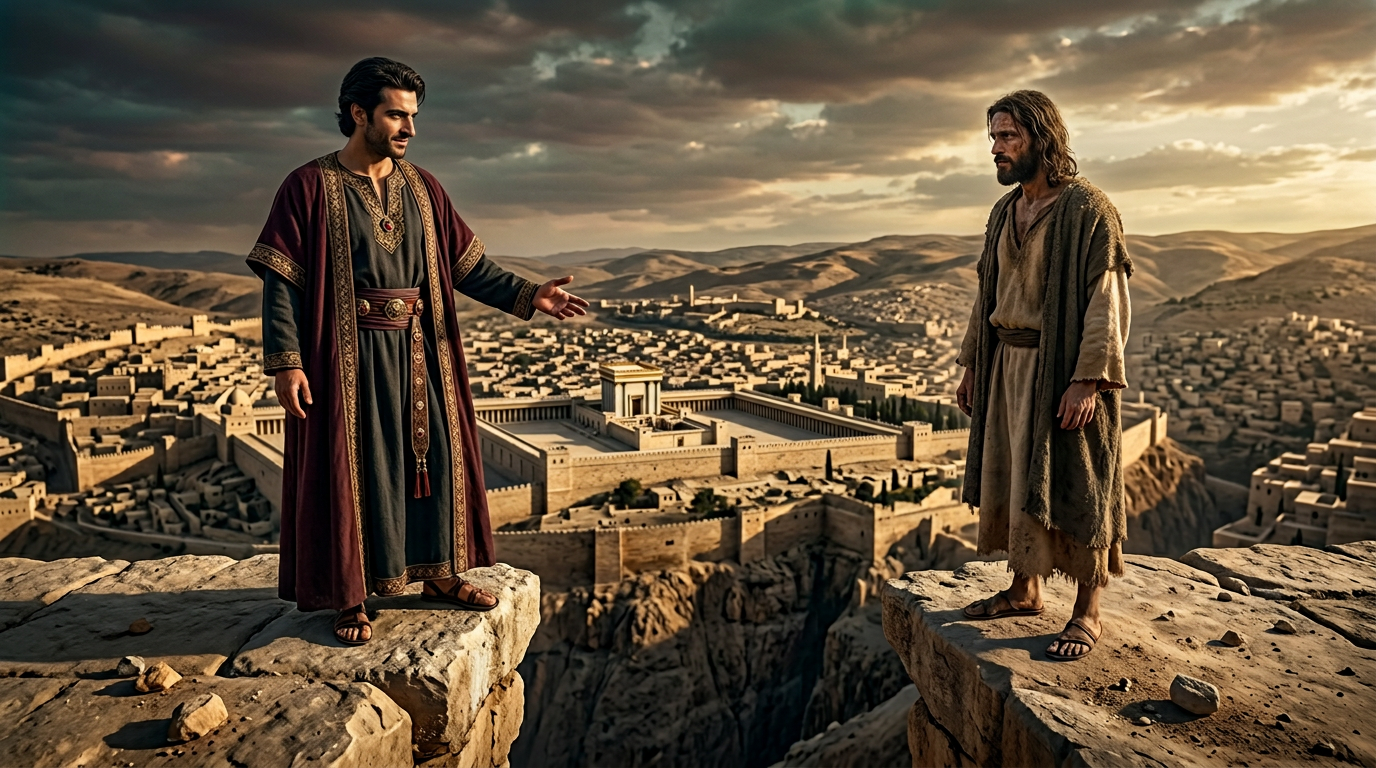
The Three Names
Jesus Gave Yhwh
Three discourses. Three settings. Three audiences.
You know all three passages. You have never heard what they say.
Across three separate occasions – in the wilderness, in the Temple, and on a hillside – Jesus identified the god of the Old Testament by name. Not once. Not ambiguously. Three times, Jesus gave him a name. A different name each time.
These are not obscure passages. You have read all three. You may have recited one of them this morning. The question is not whether you have seen the text. The question is whether you noticed what it said.
The Wilderness
The Temptation – Matthew 4 · Luke 4Forty days in the wilderness. Three tests. Every one mirrors the Exodus – the same wilderness, the same hunger, the same testing. Jesus answers all three by quoting Deuteronomy 6–8: the chapters where Yhwh explains why He tested Israel.
The bread test: making bread is not a sin. It is only a trap if the one who imposed the hunger had the authority to forbid it. The kingdoms offer: the tester claims authority over all kingdoms – and Jesus does not dispute the claim. The Temple jump: Jesus says "You shall not put Yhwh your elohim to the test" – a statement that only makes sense if Yhwh is the one standing in front of Him.
The Greek word for "test" is peirazō. It is the same word the Greek Old Testament uses for Yhwh testing Israel in Deuteronomy 8:2. Same word. Same wilderness. Same test. Then Jesus names the tester:
"Go away, Satan!"
Jesus – Matthew 4:10
Satan. The first name.
The Temple
John 8:12–59Jesus is standing in the Temple. He is talking to the Pharisees – devout Yhwh worshippers who keep the Law, run the sacrificial system, and enforce Yhwh's commandments. These are not pagans. These are not idol-worshippers. These are the most religiously observant people in Israel.
He leads them through a 47-verse argument. Five tests – knowledge, hearing, love, deeds, truth. They fail every one. Then He delivers the verdict:
"You are of your father the devil, who is a murderer from the beginning and does not uphold the truth, because there is no truth in him. Whenever he lies, he speaks according to his own nature, because he is a liar and the father of lies."
Jesus – John 8:44
The Pharisees do not serve a fallen angel. They do not worship some dark spirit. They serve Yhwh. His law. His Temple. His system. If "your father" is the god they worship and obey – Jesus just named him.
The Devil. The second name.
The Hillside
The Good Father Discourse – Luke 11:1–13The Lord's Prayer. You have recited it hundreds of times. But read it against the Exodus and something emerges that changes the meaning of every line.
"Give us daily bread" – Yhwh gave manna with a compliance test built into the schedule. "Forgive us our sins" – Yhwh requires blood, a priest, and an altar. "Do not lead us into a time of testing" – the entire Exodus was a test. And then the last line:
"Deliver us from the evil one."
Jesus – Matthew 6:13
The prayer is addressed to Abba. The evil one it asks to be delivered from is not Abba. Jesus then asks: what kind of father gives a snake to a child who asks for fish? The Hebrews asked for fish (Numbers 11:5). Yhwh sent snakes (Numbers 21:6). Jesus says even evil humans would not do that – and "evil" is Yhwh's own label for the human race (Genesis 8:21).
The Evil One. The third name.
Satan. The Devil. The Evil One.
Three names. Three discourses. One identification.
The pattern
Three separate occasions. Three different settings. Three different audiences. Three different names. One identification.
Read the evidence
Every verse in context. Every claim sourced. Three complete studies – and one that brings all three together.
Two Tests, One Tester
The Temptation is not a moral lesson. It is a legal replay of the Exodus. Three tests, three Deuteronomy citations, and the name Jesus gives the tester.
Matthew 4 · Luke 4 Read study → The DevilYour Father Is Not My Father
A 47-verse courtroom argument in the Temple. Five tests. One verdict. Jesus separates His Father from the god the Pharisees worship – then names that god.
John 8:12–59 Read study → The Evil OneThe Good Father They Never Knew
Thirteen consecutive verses. Every line references the Exodus. The Lord's Prayer is not what you think it is. It is a prayer to Abba for deliverance from Yhwh.
Luke 11:1–13 Read study →If these three names refer to a fallen angel – a being the Pharisees had no relationship with, whose law they did not enforce, whose system they did not run – then explain whose system they did run. Whose law they did enforce. Whose penalties they did carry out.
The being whose system they ran, whose law they enforced, whose Temple they served in – that is Yhwh. And that is who Jesus named. Three times.