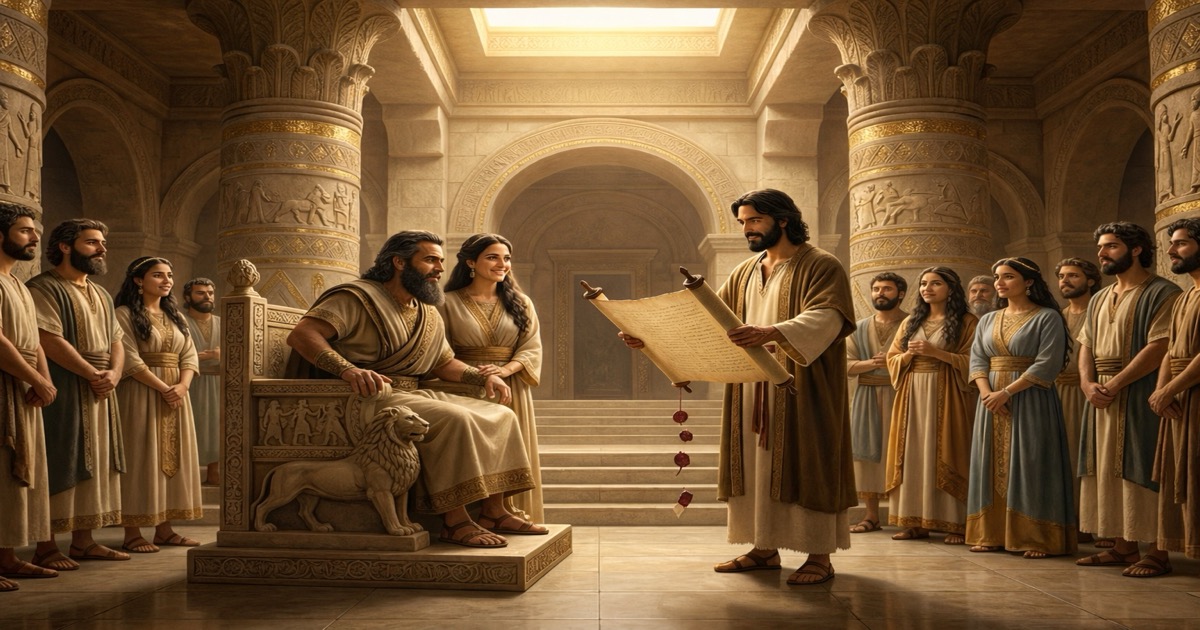
What did Jesus call his own message?
Before we get into the argument, look at the label. Not the label Christianity gave it. The label Jesus gave it.
"Jesus went throughout all of Galilee, teaching in their synagogues, preaching the gospel of the kingdom, and healing every kind of disease and sickness among the people." – Matthew 4:23 NET
That phrase – the gospel of the kingdom – appears in Matthew 4:23, 9:35, and 24:14. Mark opens with it: "The time is fulfilled and the kingdom of God is near. Repent and believe the gospel!" (Mark 1:15). Luke records Jesus saying, "I must proclaim the good news of the kingdom of God to the other towns too, for that is what I was sent to do" (Luke 4:43).
Jesus did not call his message the gospel of salvation. He did not call it the gospel of grace. He did not call it the plan of redemption or the gospel of personal relationship. He called it the gospel of the kingdom.
This matters because a kingdom is a political category. It has a king, a territory, subjects, laws, and borders. When you announce a kingdom, you are making a claim about authority – who rules, where, and over whom. You don't announce a kingdom unless there is already a kingdom in place, and the announcement means something is about to change.
So the first question is simple: if Jesus came to announce a kingdom, whose kingdom was already there?
The occupied territory
To understand the gospel of the kingdom, you have to understand the kingdom that was already in place when Jesus arrived. And to understand that, you have to go back to a passage the scribes tried to bury.
"Remember the ancient days; bear in mind the years of past generations. Ask your father and he will inform you, your elders, and they will tell you. When the Most High gave the nations their inheritance, when he divided up humankind, he set the boundaries of the peoples, according to the number of the sons of God. For the LORD's allotment is his people, Jacob is his special possession." – Deuteronomy 32:7–9 NET
This is a hierarchy. The Most High (Elyon) divided the nations among the sons of God. Yhwh received one of those allotments – Israel. He is not the Most High. He is a son of the Most High who was given a portion.
The Dead Sea Scrolls (4QDeutj) read "sons of God" (bene elohim) here. The later Masoretic Text changed it to "sons of Israel" – a deliberate theological edit that obscures the hierarchy. The Septuagint independently confirms the older reading. Verse 7 is why this matters: "Ask your father and he will inform you, your elders, and they will tell you." This was not a new idea. This was ancient knowledge, passed down through generations. The elders knew.
So the world Jesus enters is Yhwh's jurisdiction. The temple belongs to Yhwh. The Law was given through Yhwh. The sacrificial system serves Yhwh. The priesthood mediates between the people and Yhwh. The festival calendar revolves around Yhwh's calendar. Every institution the Judeans depend on – temple, Torah, priesthood, covenant, sacrifice – is infrastructure built and operated by one god, for his purposes.
This is the occupied territory. And this is why announcing a different kingdom is not a theological technicality. It is a declaration of war.
If Jesus came to announce Yhwh's kingdom, why did Yhwh's entire apparatus try to kill him?
The invasion
Jesus doesn't describe his arrival in gentle terms. He describes it as a military operation.
"But if I cast out demons by the Spirit of God, then the kingdom of God has already overtaken you. How else can someone enter a strong man's house and steal his property, unless he first ties up the strong man? Then he can thoroughly plunder his house." – Matthew 12:28–29 NET
Read that carefully. Jesus says he has entered a strong man's house, tied the strong man up, and is now plundering his property. The "property" being plundered is people – the sick, the demonized, the oppressed. The "house" is the system. And the strong man is the one who built it.
Current theology reads the "strong man" as Satan – a generic spiritual adversary floating somewhere in the background. But look at what the strong man actually owns. He has a house. He has goods. He has a functioning operation. The people Jesus is freeing are trapped inside a specific, identifiable system – the temple system, the purity system, the sacrificial system. These belong to one god. We know who built the house.
"The kingdom of God has already overtaken you" is not a spiritual metaphor. It is a statement of military fact. The invasion is underway. The old ruler is being bound. The captives are being freed. That is what the gospel of the kingdom means in practice.
Luke's version adds a detail worth noting: "When a strong man, fully armed, guards his own palace, his goods are safe. But when one stronger than he attacks him and overcomes him, he takes away his armor in which he trusted and divides his spoil" (Luke 11:21–22). The stronger one doesn't negotiate. He strips the armor. The protection the strong man relied on – his law, his temple, his priesthood – is removed.
More context Isaiah 49:24–25 – the prophetic backdrop
"Can the prey be taken from the mighty, or the captives of a tyrant be rescued? For thus says Yhwh: 'Even the captives of the mighty shall be taken, and the prey of the tyrant be rescued.'" The language is identical: captives of a mighty one, freed by a greater power. The Prophets already knew what was coming – someone stronger would arrive to free the people from whoever was holding them.
The Beelzebul accusation that triggers this parable is itself revealing. The religious authorities watch Jesus heal people and accuse him of working for the enemy. They can see that something powerful is happening, and they cannot accept that it comes from outside their system. So they label it demonic. This is the system defending itself. When the captives start walking free, the warden accuses the liberator of being a criminal.
If Jesus is working inside Yhwh's system and on Yhwh's behalf, why does Yhwh's system treat him as a threat from the very first day?
Replacement, not reform
If Jesus were simply improving Yhwh's system – upgrading the software without changing the operating system – you would expect him to repair the existing institutions and hand them back. That is not what happens. Not once.
Read through the Gospel of John discourse by discourse, and a pattern emerges that is impossible to miss once you see it. Jesus doesn't fix the system. He replaces every piece of it with himself.
Every single element of Yhwh's infrastructure – the things the Judeans depend on for their religious identity – is retired and replaced with Jesus himself. He doesn't improve the water system; He is the water. He doesn't reform the priesthood; He retires it. He doesn't upgrade the Law; He replaces it with a single command rooted in a different character entirely.
The vine is a good example of how thorough this is. "I am the true vine" (John 15:1) – the Greek word is alethinos, meaning genuine or real. It implies there was a false or failed vine. There was. Every single vine passage in the Hebrew Bible is a failure story. Isaiah 5: bad grapes, judgment. Jeremiah 2: choice vine turned degenerate. Ezekiel 15: vine wood good only for fuel. Hosea 10: fruitful vine that built altars to the wrong god. Psalm 80: vine brought out of Egypt, now cut down and burned. Not one success. Jesus says: I am the vine that actually works, and my Father – not Yhwh – is the gardener (15:1).
The Nazareth sermon in Luke 4 sets the pattern for the entire replacement program. Jesus reads Isaiah 61 – liberation for the captives, sight for the blind, freedom for the oppressed, the year of the Lord's favor – and then stops reading mid-verse. The next clause is "and the day of vengeance of our God." He takes the liberation and leaves the destruction on the scroll. He claims Abba's mercy and edits out Yhwh's wrath. When the crowd realizes what he's done, they try to throw him off a cliff.
What about "Jesus said he came to fulfill the Law, not abolish it"
He did say that (Matthew 5:17). And he did fulfill it. The Law was fulfilled – completed, finished, executed to its last requirement – through his perfect life and death. Fulfillment is not continuation. When a contract is fulfilled, the contract is done. You don't keep making payments after the mortgage is paid. The Law reached its designed endpoint in Jesus, and what replaced it was not more law but a person: "Come to me, all you who are weary and burdened, and I will give you rest. Take my yoke upon you" (Matthew 11:28–29). My yoke. Not the old one.
The Mark 11 fig tree sandwich makes the same point through narrative. Jesus approaches a fig tree, finds no fruit, curses it. Then he enters the temple, overturns the tables. The next day the fig tree is dead to its roots. Mark's literary structure forces the reader to interpret the stories together: the tree is the temple is the system. Jesus inspects it, finds it fruitless, and pronounces judgment. You don't curse a tree you're planning to prune. This tree is done.
This is what "the gospel of the kingdom" looks like at the institutional level. You do not renovate a building when you are moving people to a different address.
If Jesus came to support Yhwh's system, why does he systematically replace every piece of it with himself?
Two kingdoms, two fathers, one field
Matthew 13 contains several kingdom parables. One of them – the wheat and the tares – is the only parable Jesus explains in full. And the explanation is the two-kingdom framework in plain language.
"The one who sowed the good seed is the Son of Man. The field is the world. The good seed are the people of the kingdom. The poisonous weeds are the people of the evil one, and the enemy who sows them is the devil." – Matthew 13:37–39 NET
Two sowers. Two kinds of seed. Two populations. One field. Growing together until harvest.
This is John 8:44 in parable form. There are two fathers producing two kinds of offspring in the same world. The sons of the kingdom belong to Abba's family. The sons of the evil one belong to the devil's family. They are mixed together, often indistinguishable by appearance, until the fruit shows. The tares – zizania in Greek – look like wheat while they're growing. You can only tell the difference when they mature and produce (or fail to produce) grain.
The servants want to pull the tares immediately. The master says no. Wait until harvest. This is Abba's character in action. He doesn't destroy by force. He doesn't burn down the field to get at the weeds. The process has integrity. The separation comes at the appointed time, not by vigilante action. This is why the world looks the way it does – why evil and good coexist, why the system persists alongside the kingdom. It is not a failure of God's power. It is patience built into the process.
And notice who the two populations are. They are not "believers and unbelievers" in the way current theology uses those terms. They are children of two different fathers – two different sources, two different systems. The boundary cuts differently than Christianity assumes. A person can be deeply religious, deeply committed to the system, deeply faithful – and still be a tare if their faithfulness is directed at the wrong father. The Judeans in John 8 were not bad at their religion. They were excellent at it. That was the problem. They were faithful sons of the wrong god.
More context The growing seed – Mark 4:26–29
Mark records a parable found in no other Gospel. A man scatters seed, sleeps and rises night and day, and the earth produces "of itself" – automate in Greek. The farmer does not understand how it grows. When the grain is ripe, he harvests.
This is the opposite of Yhwh's system. That system requires constant maintenance: daily sacrifices, weekly Sabbaths, annual festivals, perpetual purity management, priestly mediation, temple infrastructure, tithing, offerings. It cannot run for a single day without human effort keeping it going. Abba's kingdom grows automate – by its own vitality. It doesn't need a temple, a priesthood, a legal code, or a festival calendar. It needs seed and soil. Everything else happens on its own.
The mustard seed, the leaven, the hidden treasure, the pearl of great price – every kingdom parable in Matthew 13 describes something small, hidden, growing, and ultimately overwhelming. None of them mention a temple. None of them require a priesthood. None of them depend on a sacrificial system. The kingdom Jesus describes runs on completely different infrastructure from the system it is infiltrating.
If the kingdom of God and the kingdom of this world are the same system, why does Jesus describe them as two different seeds planted by two different sowers?
The regime change
John uses the phrase "the ruler of this world" (ho archon tou kosmou toutou) three times. Each one is a statement about what the cross actually accomplishes.
Current theology identifies this "ruler" as Satan and leaves it there – an abstract villain behind the scenes. But John's Gospel has already spent chapters identifying who actually rules the world the Judeans live in. The temple, the festivals, the law, the priesthood, the covenant – all belong to one system administered by one god. John 8:44 names the father the Judeans serve. John 10:8 says all who came before Jesus are thieves and robbers. John 12:31 says the ruler of this system will be cast out through the cross.
The timing matters. Jesus says "now" – at the moment of the cross. The cross is not just a sacrifice for sin. It is a regime change. The ruler who held the world is judged and cast out at the precise moment Jesus is "lifted up" (12:32). And the result: "I, when I am lifted up from the earth, will draw all people to myself."
All people. Not just Israelites. Not just the covenant community. All people. The old ruler's jurisdiction was one nation – Yhwh received Israel as his portion under Deuteronomy 32:8–9. Jesus draws all people. The entire allotment system is overridden.
"He has no claim on me" (14:30) is legal language. The ruler of this world has claims on everyone born under the system, but not on the one who came from Abba and lived perfectly within the system without once becoming its debtor. Jesus fulfilled every requirement of the Law without violating it. The system has no leverage. The ruler has no jurisdiction. And because the system has been fulfilled – completed, exhausted, finished – its authority is dissolved.
The last supper confirms the nature of the transition. "This cup is the new covenant in my blood" (Luke 22:20) echoes Exodus 24:8 where Moses took the blood and said, "Behold the blood of the covenant." But the source text Jesus is drawing on – Jeremiah 31:31–34 – makes the distinction explicit: "I will make a new covenant with the house of Israel and the house of Judah, not like the covenant that I made with their fathers on the day when I took them by the hand to bring them out of the land of Egypt."
Not like it. A new covenant that is explicitly, by its own terms, unlike the Exodus covenant. Not a better version of the same thing. A different thing entirely.
What about "If the ruler has been cast out, why does the world still look like this?"
The legal verdict has been rendered, but the enforcement is in process. Think of it like a government that has fallen legally before the territory is fully secured. The strong man has been bound (Matthew 12:29), but the plundering of his goods is ongoing – captives are being freed one by one. The house hasn't been torn down yet, but the locks have been broken. The wheat and tares parable addresses this directly: both grow together until harvest. The gap between the legal verdict and the full transfer is the age we live in.
If the cross is only about forgiveness of sins, why does Jesus describe it as the moment the ruler of this world is judged and cast out?
The transfer is complete
Before the cross, Jesus consistently distinguished between "my Father" and "your father" when speaking to the Judeans. Their father was the devil (John 8:44). His Father was Abba. Two fathers. Two families. Two jurisdictions.
After the resurrection, the language changes.
"I am ascending to my Father and your Father, to my God and your God." – John 20:17 NET
"My Father and your Father." Before the cross, that sentence was impossible. The disciples were Yhwh's people – part of his allotment under Deuteronomy 32. Through the cross and resurrection, they have been transferred from Yhwh's jurisdiction to Abba's family. They now share Jesus' Father.
The phrasing is careful. Not "our Father" – which would flatten the distinction between Jesus' unique Sonship and the disciples' adopted sonship. "My Father and your Father" maintains the relationship while declaring the shared access. The transfer is relational, through the Son. John 1:12–13 says it plainly: "To all who received him, who believed in his name, he gave the right to become children of God – who were born, not of blood nor of the will of the flesh nor of the will of man, but of God."
This is the fulfillment of the prayer Jesus prayed in John 17:6 – "They were yours, and you gave them to me." That is jurisdictional language. They belonged to one ruler. They were given to another. And now, on the other side of the cross, the transfer is complete. They belong to the Father.
The new creation breath in John 20:22 seals it. "He breathed on them and said, 'Receive the Holy Spirit.'" This echoes Genesis 2:7 – Yhwh formed the man and breathed into his nostrils the breath of life. But this is a different breath from a different source. Jesus breathes Abba's Spirit into them. The old creation was animated by Yhwh's breath. The new creation is animated by Abba's Spirit through Jesus. Different breath, different origin, different kingdom.
If Yhwh is Jesus' Father, why does Jesus wait until after the resurrection to say "your Father" to his own disciples?
What the gospel actually is
Put it all together and the gospel of the kingdom comes into focus.
It is not "believe in Jesus and go to heaven when you die." It is not "accept God's forgiveness for your sins." It is not "join a religion called Christianity." Those are versions of the gospel invented by a tradition that merged Yhwh and Abba into one being and therefore had to reinvent what Jesus was doing.
The gospel of the kingdom is this: A foreign king has entered occupied territory. He has bound the occupier, begun freeing the captives, and opened a door from one jurisdiction into another. The kingdom of Abba – the Most High, the true God – is now accessible through Jesus. You can leave.
"The kingdom of heaven is near" is not a vague spiritual promise. It is a military bulletin. The perimeter has been breached. The locks are broken. The captives can walk out. "Repent and believe the gospel" means: change your allegiance and trust the announcement. The old ruler has been judged. A new king is here.
This is why "seek first the kingdom" (Matthew 6:33) is not a devotional slogan. It is strategic advice for people living in occupied territory. Seeking the kingdom means identifying which king you serve, which system you belong to, and which father you call your own. It means looking at the fruit of the system you inherited and asking whether it matches the character of the Father Jesus reveals.
"My kingdom is not of this world" (John 18:36) is not a denial of kingship. It is a statement of origin. His kingdom comes from somewhere else. It runs on different principles. It produces different fruit. Love instead of law. Mercy instead of sacrifice. Freedom instead of fear. A table instead of a temple. A person instead of a system.
And this is why current theology cannot see it. When you collapse Abba and Yhwh into one god, you collapse the two kingdoms into one kingdom, and the gospel becomes incoherent. It becomes "God sent his Son to save you from God" – which is the doctrine of the atonement as most Christians understand it. The cross becomes God punishing himself to satisfy himself. The kingdom becomes the same kingdom that was already there, just with a new management style.
But if you let the two stand separate – as Deuteronomy 32 originally presented them, as Jesus restated in John 8, as the parables illustrate, as the cross accomplishes – then the gospel snaps into focus. It is not circular. It is linear. A rescue operation. An evacuation. A transfer from one kingdom to another, from one father to another, from death to life.
"And this gospel of the kingdom will be preached throughout the whole inhabited earth as a testimony to all the nations, and then the end will come." – Matthew 24:14 NET
Jesus said this gospel – this gospel, the one about the kingdom – would be preached to the whole world. Not a gospel about going to heaven. Not a gospel about personal morality. Not a gospel that names Yhwh as God and asks you to worship him harder. The gospel that says: there is another kingdom, and its king came to get you out.
That is what Jesus preached. That is what he called the gospel. That is what he lived, demonstrated, died for, and rose to complete.
Seek first the kingdom.