Scripture in context
Context & flow
John 8:12–59 – the argument traced from first claim to final stone, passage by passage
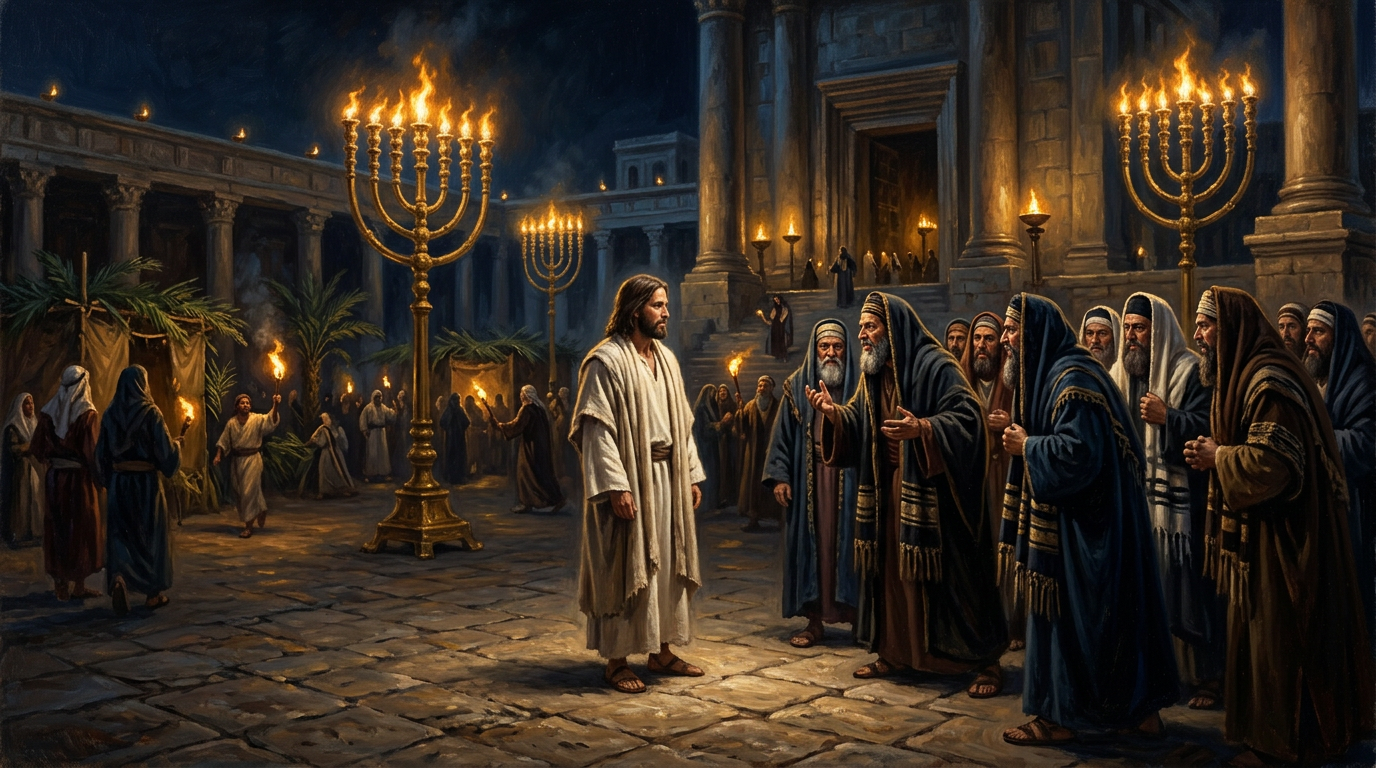
The argument at a glance – eleven moves from first claim to final stone.
| # | Passage | Theme | Key move | Result / fruit |
|---|---|---|---|---|
| 1 | John 8:12–18 | Two witnesses under ‘your law’ | Jesus opens with a public authority claim. | His Father enters as both second witness and sender. |
| 2 | John 8:19–20 | You know neither me nor my Father | They go after the witness Jesus just named. | Two separate sources are now on the record. |
| 3 | John 8:21–24 | Below versus above | This is a closing warning, not a travel itinerary. | ‘I am he’ is identity within the discourse, not a Yhwh claim. |
| 4 | John 8:25–27 | I speak what I heard from my Father | They press for a label they can prosecute. | The gospel writer flags the real issue. |
| 5 | John 8:28–30 | My Father’s backing becomes visible | The act meant to destroy Him will reveal Him. | Belief splits the crowd – and sets a trap. |
| 6 | John 8:31–36 | Remain in my word or stay enslaved | Belief alone is not enough – Jesus demands continuation. | Slavery is redefined as a lived condition. |
| 7 | John 8:37–38 | Your father is exposed by your fruit | Ancestry conceded. Fatherhood denied. | The axis of the discourse is now explicit. |
| 8 | John 8:39–47 | ‘Your father the devil’ – named | Jesus makes fatherhood testable. | Belonging is the final dividing line. |
| 9 | John 8:48–51 | They switch from argument to character attack | Out of arguments, they reach for insults. | The promise is tied to obedience, not lineage. |
| 10 | John 8:52–56 | Their ‘god’ claim denied – Abraham turned against them | Jesus identifies who glorifies Him – and it is not them. | Abraham is taken out of their hands. |
| 11 | John 8:57–59 | Stones prove the fruit | The peak claim of the discourse. | They do not answer. They reach for stones. |
Long-form with scripture and notes.
Two witnesses under ‘your law’
Then Jesus spoke out again, “I am the light of the world! The one who follows me will never walk in darkness, but will have the light of life.” So the Pharisees objected, “You testify about yourself; your testimony is not true!” Jesus answered, “Even if I testify about myself, my testimony is true, because I know where I came from and where I am going. But you people do not know where I came from or where I am going. You people judge by outward appearances; I do not judge anyone. But if I judge, my evaluation is accurate, because I am not alone when I judge, but I and the Father who sent me do so together. It is written in your law that the testimony of two men is true. I testify about myself and the Father who sent me testifies about me.”
Jesus opens with a public authority claim.
The Pharisees attack procedure, not substance. They skip past the claim entirely and object to the form: ‘You testify about yourself.’ If they can disqualify the testimony on a technicality, they never have to deal with what He actually said.
Jesus turns their own legal code against them. He cites the two-witness requirement and calls it ‘your law.’ Not ‘our law.’ Not ‘God’s law.’ He accepts the rule for the sake of argument while making clear the system is theirs, not His Father’s.
His Father enters as both second witness and sender. Jesus satisfies the two-witness rule by pairing His testimony with ‘the Father who sent me.’ The divide is already set: Jesus speaks from His Father. They speak from their law. These are not the same source.
You know neither me nor my Father
Then they began asking him, “Where is your father?” Jesus answered, “You do not know either me or my Father. If you knew me you would know my Father too.” (Jesus spoke these words near the offering box while he was teaching in the temple courts. No one seized him because his time had not yet come.)
They go after the witness Jesus just named.
There is no route to the Father that bypasses the Son. ‘If you knew me, you would know my Father too.’ This locks the door. They know their god – Yhwh – intimately. But the Father Jesus is talking about is Abba, the Most High. They do not know Him, because they reject the One He sent.
Two separate sources are now on the record. Jesus has distinguished His Father from the god they serve. From here, the argument is about whose voice you actually hear and whose instructions you actually follow. These are not the same source.
Below versus above
Then Jesus said to them again, “I am going away, and you will look for me but will die in your sin. Where I am going you cannot come.” So the Jewish leaders began to say, “Perhaps he is going to kill himself, because he says, ‘Where I am going you cannot come.’” Jesus replied, “You people are from below; I am from above. You people are from this world; I am not from this world. Thus I told you that you will die in your sins. For unless you believe that I am he, you will die in your sins.”
This is a closing warning, not a travel itinerary.
Jesus draws an origin line that will become a father line. ‘You are from below – I am from above. You are from this world – I am not.’ The division is not ethnic or political. It is about source and belonging.
‘I am he’ is identity within the discourse, not a Yhwh claim. The phrase refers back to what He has already stated – the light of the world, the one sent by the Father. It is a claim of identity within the argument, not a quotation of Exodus 3:14.
I speak what I heard from my Father
So they said to him, “Who are you?” Jesus replied, “What I have told you from the beginning. I have many things to say and to judge about you, but the Father who sent me is truthful, and the things I have heard from him I speak to the world.” (They did not understand that he was telling them about his Father.)
They press for a label they can prosecute.
Jesus positions Himself as a channel, not a self-appointed authority. ‘The things I have heard from Him I speak to the world.’ He is delivering His Father’s words. Their response to Jesus is, in fact, their response to the Father who sent Him.
The gospel writer flags the real issue. ‘They did not understand that He was telling them about His Father.’ John sees what they cannot: the entire dispute is a father question. Their blindness to this is exactly what Jesus will diagnose in verse 44.
My Father’s backing becomes visible
Then Jesus said, “When you lift up the Son of Man, then you will know that I am he, and I do nothing on my own initiative, but I speak just what the Father taught me. And the one who sent me is with me. He has not left me alone, because I always do those things that please him.” While he was saying these things, many people believed in him.
The act meant to destroy Him will reveal Him.
Obedience is His credential. ‘He has not left me alone, because I always do what pleases Him.’ Jesus points to consistent alignment with His Father as evidence of Sonship. This is the fruit test applied to Himself.
Belief splits the crowd – and sets a trap. ‘Many people believed in Him.’ That belief will now be tested. Who continues? Who endures? The next section will separate genuine recognition from shallow agreement.
Remain in my word or stay enslaved
Then Jesus said to those Judeans who had believed him, “If you continue to follow my teaching, you are really my disciples and you will know the truth, and the truth will set you free.” “We are descendants of Abraham,” they replied, “and have never been anyone’s slaves! How can you say, ‘You will become free’?” Jesus answered them, “I tell you the solemn truth, everyone who practices sin is a slave of sin. The slave does not remain in the family forever, but the son remains forever. So if the son sets you free, you will be really free.”
Belief alone is not enough – Jesus demands continuation.
They reach for lineage as a shield. ‘We are descendants of Abraham and have never been anyone’s slaves.’ Ancestry is their fallback – the credential that is supposed to end every argument. Jesus is about to show it settles nothing.
Slavery is redefined as a lived condition. ‘Everyone who practices sin is a slave of sin.’ Jesus moves slavery from politics to the inner life. The question is not who you descend from but what rules you in practice – and only the Son can change that status.
Your father is exposed by your fruit
“I know that you are Abraham’s descendants. But you want to kill me, because my teaching makes no progress among you. I am telling you the things I have seen while with the Father; as for you, practice the things you have heard from your father!”
Ancestry conceded. Fatherhood denied.
Murder intent is the controlling evidence. ‘But you want to kill me, because my teaching makes no progress among you.’ Whatever they say about Abraham, their intent to kill Jesus overrides the claim. Actions expose alignment.
The axis of the discourse is now explicit. ‘I speak what I have seen with the Father; you do what you have heard from your father.’ Two sources. Two sets of instructions. Two fathers. The hinge of the entire discourse is stated openly.
‘Your father the devil’ – named
They answered him, “Abraham is our father!” Jesus replied, “If you are Abraham’s children, you would be doing the deeds of Abraham. But now you are trying to kill me, a man who has told you the truth I heard from God. Abraham did not do this!” Then they said, “We have only one father, God himself.” Jesus replied, “If God were your Father, you would love me, for I have come from God and am now here. I have not come on my own initiative, but he sent me. Why don’t you understand what I am saying? It is because you cannot accept my teaching. You people are from your father the devil, and you want to do what your father desires. He was a murderer from the beginning, and does not uphold the truth, because there is no truth in him. Whenever he lies, he speaks according to his own nature, because he is a liar and the father of lies. But because I am telling you the truth, you do not believe me. Who among you can prove me guilty of any sin? If I am telling you the truth, why don’t you believe me? The one who belongs to God listens and responds to God’s words. You don’t listen and respond, because you don’t belong to God.”
Jesus makes fatherhood testable.
They escalate to the ultimate claim. ‘We have only one father – god himself.’ This is not vague piety. They are claiming Yhwh is the Most High – the God, the supreme Father. That is the bedrock assumption of their entire system, and it is the claim Jesus is about to demolish.
Jesus rejects their claim with a single test. ‘If God were your Father, you would love me.’ Love for the one sent is the proof. Their hostility is the counter-evidence. The god they serve and the God who sent Jesus are not the same being.
The verdict: their father is the devil. ‘You are from your father the devil.’ This is not an insult hurled in anger. Jesus has built the case step by step – claim, test, fruit, verdict. These men are not failing because they are bad at their religion. They are among the most devout people alive. The problem is that their faithful obedience to Yhwh’s system produces exactly the fruit Jesus attributes to the devil: murder and lying from the beginning.
Belonging is the final dividing line. ‘The one who belongs to God listens and responds to God’s words. You don’t – because you don’t belong to God.’ Listening is the mark. Rejection is the diagnosis. The argument is closed.
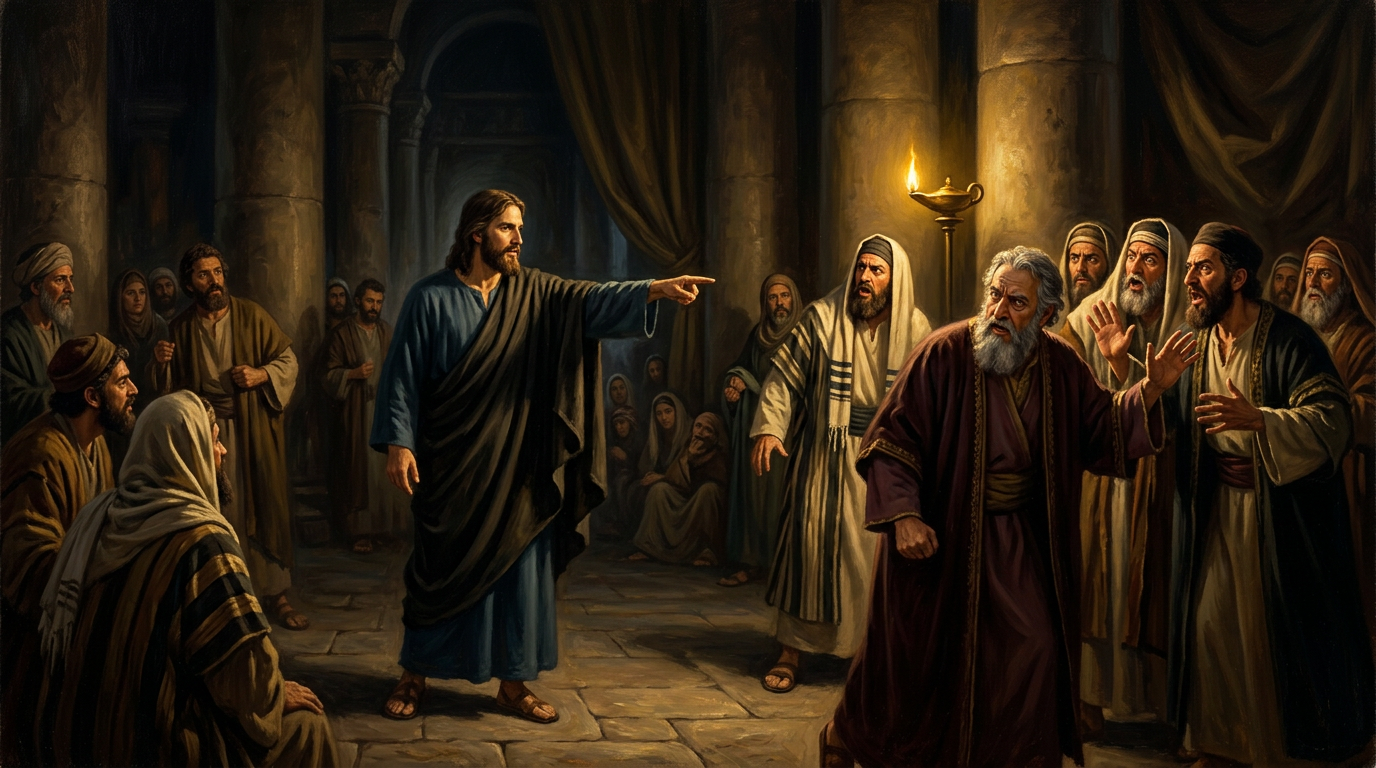
They switch from argument to character attack
The Judeans replied, “Aren’t we correct in saying that you are a Samaritan and are possessed by a demon?” Jesus answered, “I am not possessed by a demon, but I honor my Father – and yet you dishonor me. I am not trying to get praise for myself. There is one who demands it, and he also judges. I tell you the solemn truth, if anyone obeys my teaching, he will never see death.”
Out of arguments, they reach for insults.
Jesus responds with the divide restated simply. ‘I honor my Father – and you dishonor me.’ Honor and dishonor are the distilled version of the entire argument. Dishonoring Jesus proves they do not recognize the Father who sent Him.
The promise is tied to obedience, not lineage. ‘If anyone obeys my teaching, he will never see death.’ Life and death are attached to receiving His word. Not to Abraham. Not to pedigree. Not to their religious system.
Their ‘god’ claim denied – Abraham turned against them
Then the Judeans responded, “Now we know you’re possessed by a demon! Both Abraham and the prophets died, and yet you say, ‘If anyone obeys my teaching, he will never experience death.’ You aren’t greater than our father Abraham who died, are you?” Jesus replied, “If I glorify myself, my glory is worthless. The one who glorifies me is my Father, about whom you people claim, ‘He is our God.’ Yet you do not know him, but I know him. If I were to say that I do not know him, I would be a liar like you. But I do know him, and I obey his teaching. Your father Abraham was overjoyed to see my day, and he saw it and was glad.”
Jesus identifies who glorifies Him – and it is not them.
He quotes their claim back to them, then demolishes it. ‘My Father – about whom you say, “He is our god.” Yet you do not know him.’ They know Yhwh. They are experts in Yhwh. But the ‘Him’ they do not know is Abba – the Most High, Jesus’ Father. Their lie is the claim that Yhwh is that being. Jesus denies it in the same breath.
Abraham is taken out of their hands. ‘Your father Abraham was overjoyed to see my day.’ They wielded Abraham as a shield. Jesus turns Abraham into a witness for Him – an authority who celebrated what they are trying to destroy.
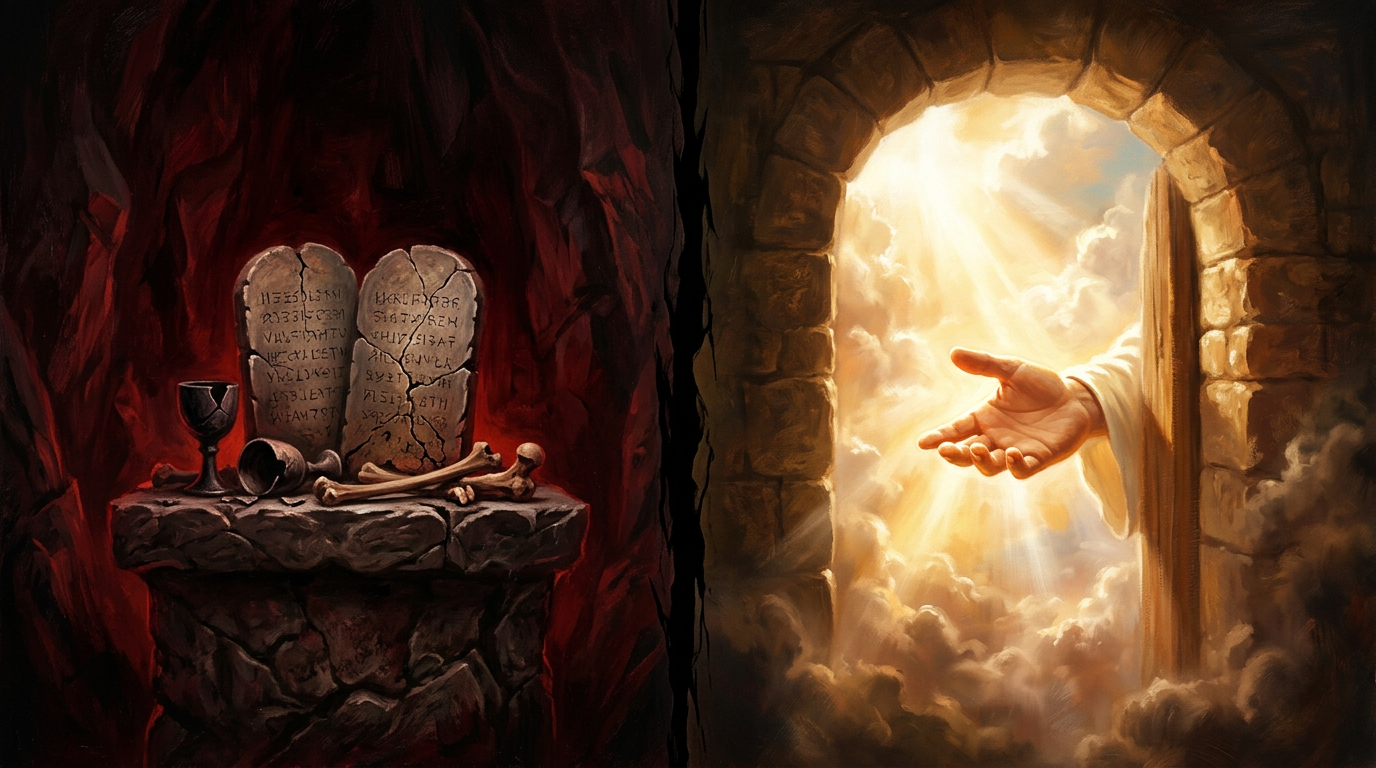
Stones prove the fruit
Then the Judeans replied, “You are not yet fifty years old! Have you seen Abraham?” Jesus said to them, “I tell you the solemn truth, before Abraham came into existence, I am!” Then they picked up stones to throw at him, but Jesus was hidden from them and went out from the temple area.
The peak claim of the discourse.
This is pre-existence, not identification with Yhwh. By this point, Jesus has separated His Father from their god, named their father as the devil, and denied their claim that Yhwh is the Most High. Verse 58 cannot suddenly reverse the entire argument. And the standard link to Exodus 3:14 depends on translating ehyeh asher ehyeh as ‘I am who I am’ – but the Hebrew is future-oriented: ‘I will be who I will be.’ The link dissolves on both ends.
They do not answer. They reach for stones. No rebuttal. No counter-evidence. Just violence. Stoning was the prescribed penalty for blasphemy – they are acting as enforcers of the very system Jesus has been exposing. Their final act is the final fruit: the murder intent He named from the start.