Summary
- Enuma Elish is a Babylonian creation epic, named from its opening words (“When on high…”).1
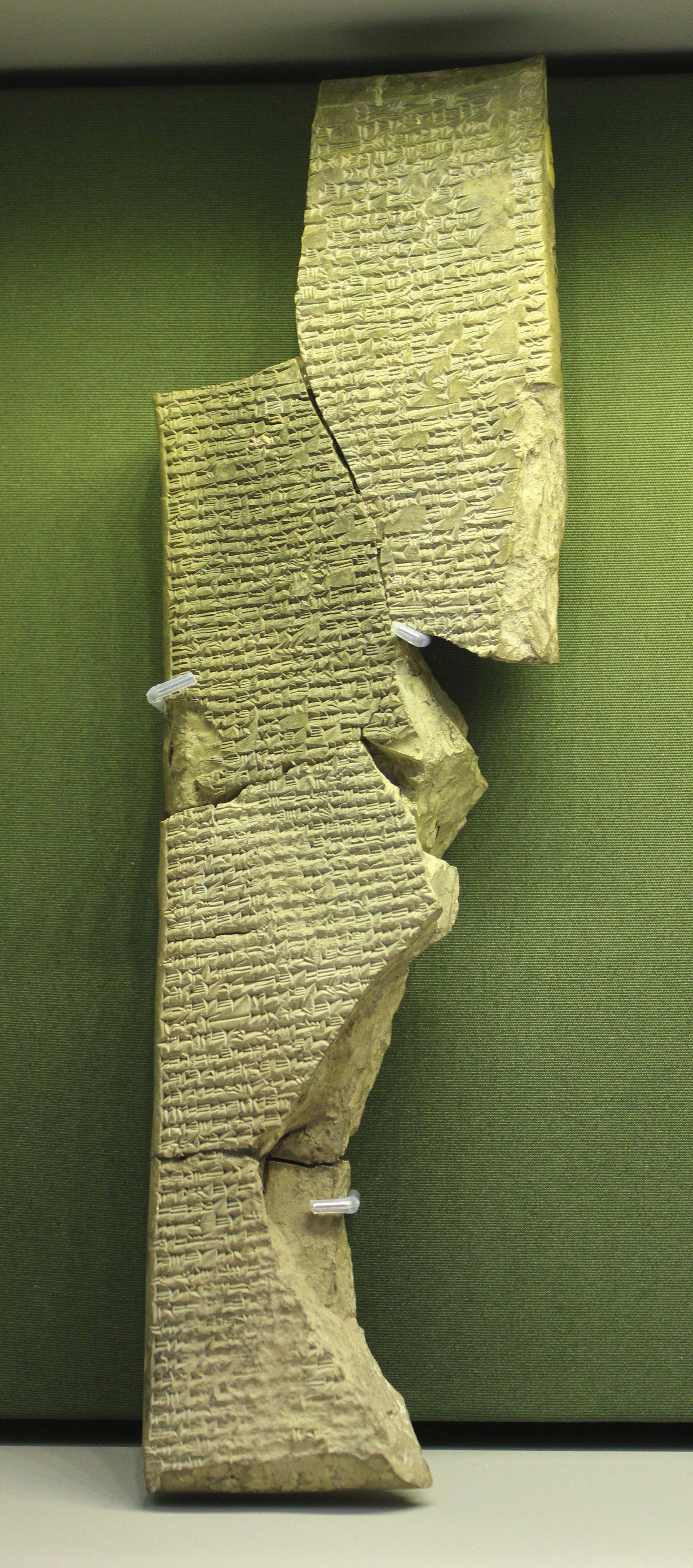
- The “full text” you see in translations is a reconstruction built by collating many fragmentary witnesses, not a single intact tablet.234
- The tablets give clear data about Babylonian divine hierarchy and cosmic order - and they also leave room for real questions about how myths form, travel, and get reused by empires.15
What’s new / what happened
No verified new development as of 2026-02-10. The main progress is practical: better public catalogs and digital corpora make it easier to check witness metadata (museum numbers, provenience notes, dating labels, joins, and duplicates).23
How we know
What we can verify starts with the objects and their records:
- Museums catalog specific witnesses (example: British Museum K.3473) with findspot/provenience notes, material description, and dating labels.2
- CDLI aggregates standardized metadata for witnesses and links them across corpora/publications (example: CDLI P365283, a witness associated with Enuma Elish Tablet 3).3
- Critical editions and translations are built by comparing exemplars and reconstructing broken lines across witnesses (a normal process for cuneiform literature).5
The evidence
1) What it is (Fact)
Enuma Elish is a Babylonian creation epic written in Akkadian cuneiform. It is conventionally labeled a seven-tablet composition in modern reconstructions, centered on divine conflict, kingship, and cosmic order.15
2) What the tablet record actually looks like (Fact)
You do not have a single “master copy.” You have witnesses.
A concrete, checkable example is British Museum K.3473. The museum catalog identifies it as a Neo-Assyrian clay tablet fragment excavated at Kuyunjik (Nineveh) and associated with Ashurbanipal’s library context.2 CDLI also treats this as a Nineveh/Kuyunjik Neo-Assyrian witness (Akkadian, clay) and tags it within the Enuma Elish tablet tradition.3
A related checkable point: British Museum K.8575 is cataloged as a Neo-Assyrian duplicate fragment tied to Enuma Elish Tablet III and described as a duplicate of K.3473.6
That’s the foundation - objects, numbers, provenience notes, duplicates, and collation work.236
3) What the story is doing (Inference, grounded in the text)
At a high level, the epic moves from primordial conflict to Marduk’s elevation and the ordering of the cosmos, with humanity’s role framed in relation to divine labor and cultic life.1
The important point is not “is it literally true?” The important point is what it’s trying to achieve inside its own world: a story that makes kingship and hierarchy feel inevitable and justified.1
4) Dating: two different questions (Fact + Open question)
- Fact: many surviving witnesses are later copies (Neo-Assyrian period), not original composition-era tablets.23
- Open question: when the composition reached the form we call “Enuma Elish.” A widely repeated model places compilation in the later 12th century BC (often linked to Nebuchadnezzar I), but the surviving tablet record people commonly read is still largely first-millennium BC copying.1
If you want a clean mental model: the story can be older than the clay object you’re holding.
5) Ritual setting claims (Open question)
Some scholarship connects Enuma Elish with the Babylonian Akitu/New Year festival and suggests recitation within that ritual frame.7 That may be right. The caution is category: this is reconstruction from multiple lines of evidence, not a single tablet label that says “read on day X.”
Other ideas people discuss
This is the “what if” zone. Not endorsement. Not mockery. A place to think clearly.
Idea 1: Could the Tiamat battle preserve memory of a real catastrophe?
- Why people consider it: many cultures preserve flood/cataclysm narratives; some readers treat myth as cultural memory.
- What we’d need to see: independent, datable records that tie a specific event to this tradition (chronicles, omen texts, consistent multi-site destruction horizons aligned with a plausible timeline).
- Evidence status: Open question (interesting, but the tablet tradition alone doesn’t pin a specific event).
Idea 2: Could it be mapping real astronomy (not just poetic imagery)?
- Why people consider it: ancient peoples watched the sky obsessively; the language of “heavens,” “waters,” and ordering can invite astronomical readings.
- What we’d need to see: explicit links in parallel texts (astronomical diaries, star lists, commentaries) that interpret Enuma Elish motifs as specific celestial bodies or events in a consistent way.
- Evidence status: Speculative (possible, but requires external corroboration beyond the epic itself).
Idea 3: Could the epic be political propaganda dressed as cosmology?
- Why people consider it: empires often sacralize power; Marduk’s rise mirrors Babylon’s rise.
- What we’d need to see: consistent alignment between political shifts and textual emphasis across copies/redactions, plus comparative evidence from other state texts.
- Evidence status: Supported (this is a common, grounded reading in museum and scholarly summaries).1
Idea 4: Could there be missing portions of the tradition that would change how we read it?
- Why people consider it: we are working from fragments; libraries burn; archives vanish.
- What we’d need to see: new joins, new witnesses, or securely provenanced tablets that add major blocks of text or alternate sequences.
- Evidence status: Open question (the mechanism is real; whether it would change the core story is unknown).5
Idea 5: Could later editors have reshaped the story to serve different empires?
- Why people consider it: empires reuse older materials; Assyrian adaptations of Babylonian traditions are documented in general.
- What we’d need to see: clear variant lines across witnesses with consistent ideological substitutions and traceable copying lines.
- Evidence status: Open question (plausible in principle; needs specific variant mapping per passage).
Reflection break
- If a text is reconstructed from scattered witnesses, what would count as a “clean win” showing that a specific deeper reading was intended by the scribes?
- If a reading is true, what would it predict we should find outside the epic (in archives, lab work, or parallel texts)?
- What would falsify your favorite interpretation - not emotionally, but materially?
- Are we seeing the ancient world, or are we seeing our own pattern-hunger reflected back at us?
- If a theory can explain anything, does it actually explain anything?
- What would you need to see to say, “Okay - that’s not just possible; that’s supported”?
- Which parts of this story are clearly ideological, and which parts might preserve older layers?
- If new witnesses were found tomorrow, what’s the one kind of difference that would genuinely change the big picture?
What’s uncertain / debated
- Composition history: “later 12th century BC compilation” is widely repeated, but the hard anchor remains that many major witnesses are later copies.123
- Reconstruction decisions: when lines are broken, editors must choose restorations; different editions can disagree, especially in damaged passages.5
- Ritual performance details: the Akitu connection is argued, but it’s not the same type of claim as “this tablet was excavated at Kuyunjik.” Treat it as a reasoned proposal, not a hard label.7
What the data currently supports (and what would change it)
What we can say with confidence:
- Enuma Elish is a real cuneiform literary tradition preserved on physical tablets, with cataloged witnesses and duplicates that can be checked.236
- The epic’s story-world strongly centers kingship, hierarchy, and the ordering of reality around Marduk in a way that fits Babylon’s cultural self-assertion.1
What would meaningfully move the conversation:
- Earlier, securely provenanced witnesses that change the timeline or show a materially different core narrative.5
- New joins or new exemplars that resolve major disputed restorations in key passages.5
- Strong external corroboration for any “catastrophe/astronomy” mapping (parallel texts that interpret motifs explicitly and consistently).3
Sources / Further reading
- Metropolitan Museum of Art - “Mesopotamian Creation Myths” (Ira Spar), 2009. https://www.metmuseum.org/essays/epic-of-creation-mesopotamia
- British Museum Collection Online - “tablet, K.3473.” https://www.britishmuseum.org/collection/object/W_K-3473
- Cuneiform Digital Library Initiative (CDLI) - “P365283.” https://cdli.ucla.edu/P365283
- Wikimedia Commons - “File: Enuma Elish K.3473.jpg” (CC BY-SA 4.0). https://commons.wikimedia.org/wiki/File:Enuma_Elish_K.3473.jpg
- Lambert, Wilfred G. - “Babylonian Creation Myths” (book page), 2013. https://www.eisenbrauns.org/books/titles/978-1-57506-247-1.html
- British Museum Collection Online - “tablet, K.8575.” https://www.britishmuseum.org/collection/object/W_K-8575
- Sommer, Benjamin D. - “The Babylonian Akitu Festival: Rectifying the King or Renewing the Cosmos” (PDF), 2016. https://janes.scholasticahq.com/article/2432-the-babylonian-akitu-festival-rectifying-the-king-or-renewing-the-cosmos.pdf

Footnotes
-
Ira Spar (Metropolitan Museum of Art), “Mesopotamian Creation Myths,” 2009. https://www.metmuseum.org/essays/epic-of-creation-mesopotamia ↩ ↩2 ↩3 ↩4 ↩5 ↩6 ↩7 ↩8 ↩9
-
British Museum, Collection Online, “tablet, K.3473.” https://www.britishmuseum.org/collection/object/W_K-3473 ↩ ↩2 ↩3 ↩4 ↩5 ↩6 ↩7 ↩8
-
Cuneiform Digital Library Initiative (CDLI), “P365283.” https://cdli.ucla.edu/P365283 ↩ ↩2 ↩3 ↩4 ↩5 ↩6 ↩7 ↩8 ↩9
-
Zunkir, “Enuma Elish K.3473.jpg,” Wikimedia Commons, CC BY-SA 4.0. https://commons.wikimedia.org/wiki/File:Enuma_Elish_K.3473.jpg ↩
-
Wilfred G. Lambert, “Babylonian Creation Myths” (Mesopotamian Civilizations 16), 2013 (publisher page). https://www.eisenbrauns.org/books/titles/978-1-57506-247-1.html ↩ ↩2 ↩3 ↩4 ↩5 ↩6 ↩7
-
British Museum, Collection Online, “tablet, K.8575” (duplicate fragment; Enuma Elish Tablet III). https://www.britishmuseum.org/collection/object/W_K-8575 ↩ ↩2 ↩3
-
Benjamin D. Sommer, “The Babylonian Akitu Festival: Rectifying the King or Renewing the Cosmos” (PDF), 2016. https://janes.scholasticahq.com/article/2432-the-babylonian-akitu-festival-rectifying-the-king-or-renewing-the-cosmos.pdf ↩ ↩2